

TABLE OF CONTENTS
- TL;DR
- Why Succession Is a Strategic Imperative, Not a Family Conversation
- The 10-Step Succession Playbook for Family Businesses
- Where Asora Supports Succession Execution
- Taking the Helm: Playbooks for Taking Over (Including Small Family Businesses)
- Conclusion: Turn Succession Into a Managed Advantage
- FAQ
TL;DR
Most family businesses aim for the enterprise to thrive across future generations, yet many still operate without a succession plan. A practical, written plan that develops the next generation, protects ownership, and preserves institutional knowledge reduces risk and stabilises employee morale. A platform like Asora helps by centralizing structures, documents, performance reporting, and workflows (tasks), so leadership and business continuity aren’t left to chance.
Why Succession Is a Strategic Imperative, Not a Family Conversation
A solid succession plan separates a smooth handover from a scramble after a founder’s sudden departure. Many family businesses still rely on informal intentions rather than a written plan, leaving leadership and business continuity to chance.
Succession in the family business does not start with a name on a door; it starts with strategy. Families that treat succession as a critical process typically outperform those that wait for a founder’s sudden departure. The risk of no succession planning shows up in three ways:
Operational fragility. When a key leader unexpectedly exits, approvals stall, decision-making slows, and customers take notice.
Cultural whiplash. Unclear leadership roles create anxiety among other employees, leading to lower morale and unwanted turnover.
Value leakage. Without an aligned estate plan, buy-sell mechanics, and tax-aware ownership pathways, the long-term success of a family firm gets traded for short-term fixes at a high cost.
Successful family-owned businesses mitigate these threats by documenting key information, rehearsing handovers, and aligning family members, board members, and management on business objectives. Technology can help. Asora gives family business owners and lean single family offices one secure, cloud-based place to see banking, private equity, real estate, and trusts alongside documents and workflows.
This article examines why succession planning is a strategic imperative, rather than a family conversation, and then outlines a practical, ten-step playbook that you can tailor to your company, industry, and family.
The 10-Step Succession Playbook for Family Businesses
A durable plan does more than pick a successor. It fosters continuity of leadership, ownership, and culture, while maintaining the company’s investability, bankability, and attractiveness to talent. Use the framework below to build an effective succession plan that balances leadership continuity, business goals, and organizational culture. Adapt each step to your industry, ownership structure, and your family’s preferences, because families and companies differ, and your plan should, too.
1) Put Succession on a Timeline and Make It Written
Vague intentions rarely survive the quarter. Select a target date range for the transition, map key gates (shadowing, acting authority, and whole delegation), and publish it to the leadership team. A written plan clarifies who is responsible for what, when, and why. It also reduces the need to make assumptions about the next generation’s interest or readiness.
2) Align Owners, Family Members, and Board Members
Governance alignment turns family preferences into practice. Use a Family Charter or constitution to define the role of family influence, standards for entering or exiting management, conflict handling, and dividend policy. Board members help keep the balance between ownership and management.
3) Separate Ownership From Leadership and Define Roles Precisely
Not every family member needs to be an operator. Spell out leadership roles, authorities, and reserved matters with a clean RACI. Document reporting lines so key employees and other employees know where authority sits during the leadership transition.
4) Choose Successors Using Criteria, Not Seniority
Selection criteria anchored in skills, values, and performance produce better outcomes than birth order. Develop leadership development plans that incorporate rotations, external roles, and targeted training to address specific skill gaps. Exposure to lenders, auditors, and major customers builds confidence on both sides.
5) Engineer Ownership and Control
The succession process must address voting rights, distributions, and liquidity. Coordinate the estate plan with trust deeds, shareholder agreements, and financing arrangements to ensure a seamless execution. Make explicit how in-laws and non-operating family members participate economically without confusing control.
6) Capture Institutional Knowledge So the Playbook Outlives the Founder
Founders often carry the “real manual”: supplier quirks, pricing levers, seasonality, and deal hygiene. Codify it. Create short playbooks for sales, operations, treasury, and compliance. Identify key employee networks and escalation paths.
7) Build a Transition Plan That the Organization Can Execute
The transition plan should combine authority gates, measurable success criteria, and change communications. A calm handover features dual signatures for a period, clear cash and credit mandates, and an agreed glide path for the outgoing owner.
8) Prepare Employees, Customers, and Suppliers
Change triggers questions. Address “what stays, what changes, and when” for employees. Share an updated organisational chart and escalation matrix. Offer retention packages for key employees where necessary. Customers and suppliers deserve proactive contact from the incoming leader and the sponsor director.
9) Test and De-Risk the Plan Before the Date
Rehearse the unexpected. If the CFO is out for 30 days, who signs? If the COO leaves, who controls vendor approvals? Run table-tops and short-acting assignments to expose weak links. Document the contingency coverage for treasury, payroll, and customer escalations.
10) Execute, Measure, and Adapt After Handover
After Day 1, focus on a 100-day agenda: books are closed on time, top-customer meetings are completed, staff turnover is within bounds, and liquidity targets are met. Schedule governance reviews with board members and the Family Council to assess progress and refine the plan.
Where Asora Supports Succession Execution
Asora keeps the plan, structure, and evidence in one governed place. Treat the succession plan as a living document—version it, and link it to the parent company and relevant trusts in Documents. Attach the key artefacts that make a transition work, including family charters, shareholder agreements, board minutes, organisational charts, RACIs, and bank mandates, each tied to the relevant entity for instant context.
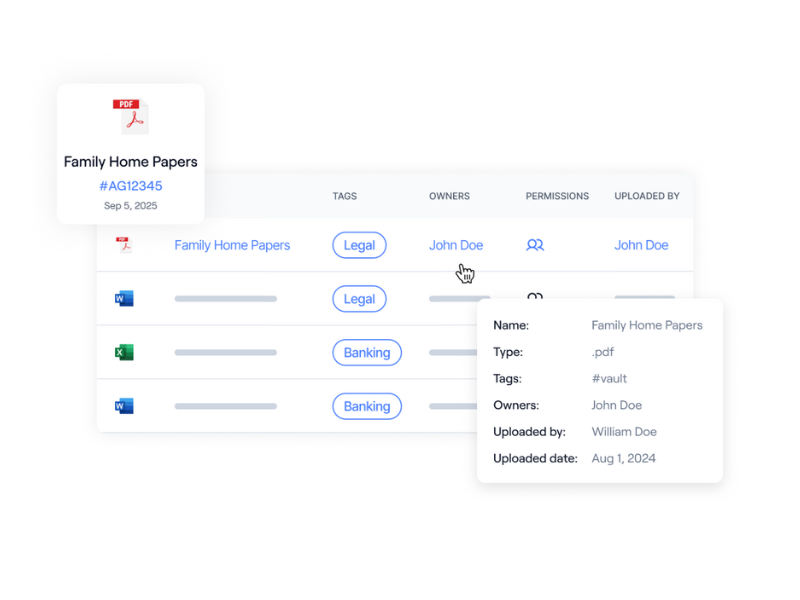
Create “Successor’s Dossiers” so that SOPs and institutional knowledge are easily accessible and actionable. Use Workflows to schedule governance reviews, successor check-ins, and renewal reminders without relying on inbox nudges or memory.
Performance Monitoring and Accounting views support steady monthly reporting across banking, private assets, and operating entities throughout the transition. With mobile access and MFA, principals stay securely connected wherever they are.
Taking the Helm: Playbooks for Taking Over (Including Small Family Businesses)
Taking over a family business often follows two patterns, and each needs a different emphasis.
Founder-to-Second Generation (or Sibling Group)
Clarity beats tradition here. A written mandate defines whether the new owner is charged with growth, consolidation, or preparation for a later exit. Agree on how long dual signatures last, how capital allocation works, and what the first twelve months of leadership succession should deliver. A respected independent chair can stabilize decision-making and protect the successor’s authority. Fresh insights from outside advisors and independent directors mitigate blind spots.
A Small Family Business
Smaller teams amplify key-person risk. Separate compensation from distributions early, clean up vendor and inventory practices, and tighten cash controls. Concentrated relationships matter, so the successor should meet the top 20 customers and top 10 suppliers within 60 days. Most small businesses rely on tacit knowledge; collecting that institutional knowledge into short, searchable SOPs pays dividends.
In both scenarios, Asora helps keep the succession plan, ownership structure, trust mechanics, and core documents in one governed place. Workflows provide structure to recurring governance moments (board packs, charter reviews, bank mandate updates). ISO 27001 controls and GDPR alignment support the privacy posture family businesses expect.
The platform’s Data Aggregation and Performance Monitoring provides founders and successors with a shared view of how the company is performing during the transition, offering a practical competitive advantage when the market demands stable execution.
Conclusion: Turn Succession Into a Managed Advantage
Succession should be a source of strength. With a formal succession plan, leadership criteria, ownership assigning, and a communication rhythm, family business owners create resilience rather than relying on heroics. The succession process becomes predictable; leadership continuity and business continuity become measurable; culture survives beyond titles.
Asora is the “just-right” platform for UHNW families and lean Single Family Offices managing family businesses and succession. It brings together Data Aggregation, Performance Monitoring, Accounting, Private Assets, Documents, and Workflows (tasks, alerts, approvals), plus Mobile access with MFA, under ISO 27001 and GDPR. That unified view shortens the distance between intention and execution, before, during, and after a leadership transition.
Request a demo of Asora and discover how a single, secure platform can align structures, succession plans, and reporting with your business goals.
FAQs
What is a family business succession?
Succession in family business is the process of preparing for leadership succession and ownership transfer while preserving culture, value, and relationships. It coordinates leadership assignments, ownership rights, voting control, and the documentation that proves it.
Why is a formal succession plan crucial?
A formal succession plan prevents ambiguity. It clarifies roles, aligns family influence with governance, and reduces disruption to customers and employees. It also reduces the risk of no succession planning, including valuation gaps, tax friction, and delayed decisions.
How long should the timeline be?
Many successful family businesses begin planning three to five years in advance. Complex companies with multiple entities often require longer processing times, especially when trusts, cross-border assets, or financing are involved.
Who helps with the leadership transition?
Family business succession advisors and consultants guide the design, facilitation, and legal/tax structuring of governance. Advisors work best when engaged early, alongside management, not after a trigger event.
What if there’s no successor in the family?
Alternatives include non-family executives, MBOs, ESOPs, or staged sales. Ownership can remain within the family even when day-to-day leadership is external, provided governance is transparent.
About the Author

Adam Cleland
Adam is the CEO of Asora. Before founding Asora, he co-founded Argeau, a multi-family office. His experience blends deep expertise in investment management, tax structuring, and wealth planning for HNW investors with senior leadership in strategy, digital transformation, and people development.







 English
 Afrikaans
 Albanian
 Amharic
 Arabic
 Armenian
 Azerbaijani
 Basque
 Belarusian
 Bengali
 Bosnian
 Bulgarian
 Catalan
 Cebuano
 Chichewa
 Chinese (Simplified)
 Chinese (Traditional)
 Corsican
 Croatian
 Czech
Czech Danish
 Dutch
Dutch Esperanto
 Estonian
 Filipino
 Finnish
 French
 Frisian
 Galician
 Georgian
 German
 Greek
Greek Gujarati
 Haitian Creole
 Hausa
Hausa Hawaiian
 Hebrew
 Hindi
Hindi Hmong
Hmong Hungarian
 Icelandic
 Igbo
Igbo Indonesian
 Irish
Irish Italian
 Japanese
 Javanese
 Kannada
 Kazakh
 Khmer
Khmer Korean
 Kurdish (Kurmanji)
 Kyrgyz
 Lao
Lao Latin
Latin Latvian
 Lithuanian
 Luxembourgish
 Macedonian
 Malagasy
 Malay
Malay Malayalam
 Maltese
 Maori
Maori Marathi
 Mongolian
 Myanmar (Burmese)
 Nepali
 Norwegian
 Pashto
 Persian
 Polish
 Portuguese
 Punjabi
 Romanian
 Russian
 Samoan
 Scottish Gaelic
 Serbian
 Sesotho
 Shona
Shona Sindhi
 Sinhala
 Slovak
 Slovenian
 Somali
 Spanish
 Sundanese
 Swahili
 Swedish
 Tajik
Tajik Tamil
Tamil Telugu
 Thai
Thai Turkish
 Ukrainian
 Urdu
Urdu Uzbek
Uzbek Vietnamese
 Welsh
Welsh Xhosa
Xhosa Yiddish
 Yoruba
 Zulu
Zulu