

TL;DR
Sustainable investing in 2026 enables affluent families and family offices to align their investments with their values while managing risk and accessing new opportunities. ESG integration helps identify companies with stronger risk management practices, while impact investments address specific social or environmental challenges.
From Debate to Discipline: Sustainable Investing for Family Offices
Sustainable investing has shifted from ‘whether’ to ‘how’. For family offices that steward multigenerational capital, integrating environmental, social, and governance (ESG) factors is now a disciplined path to resilience across market cycles and effective wealth management. Next-gen stakeholders are asking more complex questions, institutions are reallocating capital, and the evidence base continues to mature. This guide details how to operationalize ESG in policy, sourcing, due diligence, measurement, and reporting without compromising return objectives.
What is Sustainable for Family Office Investment Management in 2026?
Family office sustainable investing means integrating ESG criteria into investment decisions (alongside traditional financial analysis). It’s not a separate bucket or a charity exercise. It’s a lens applied across your entire family office investment decisions.
This can take several forms:
- ESG integration: Considering environmental, social, and governance factors when evaluating any investment, whether it’s public equities, private equity deals, or commercial real estate.
- Negative screening: Excluding companies or sectors that conflict with your values. Think tobacco, weapons manufacturers, or fossil fuels.
- Positive screening: Actively seeking companies with strong sustainability practices or those providing solutions to environmental and social challenges.
- Impact investing: Making investments with the explicit intention of generating measurable social or environmental impact alongside financial returns.
- Thematic investing: Focusing on specific sustainability themes like renewable energy, clean water, sustainable agriculture, or affordable housing.
Many family offices (and ultra-high-net-worth individuals) use a combination of these approaches. You can broadly integrate ESG while dedicating a portion of your portfolio to targeted impact investments that align with your family’s mission.
Why Family Offices Are Embracing Sustainable Investments
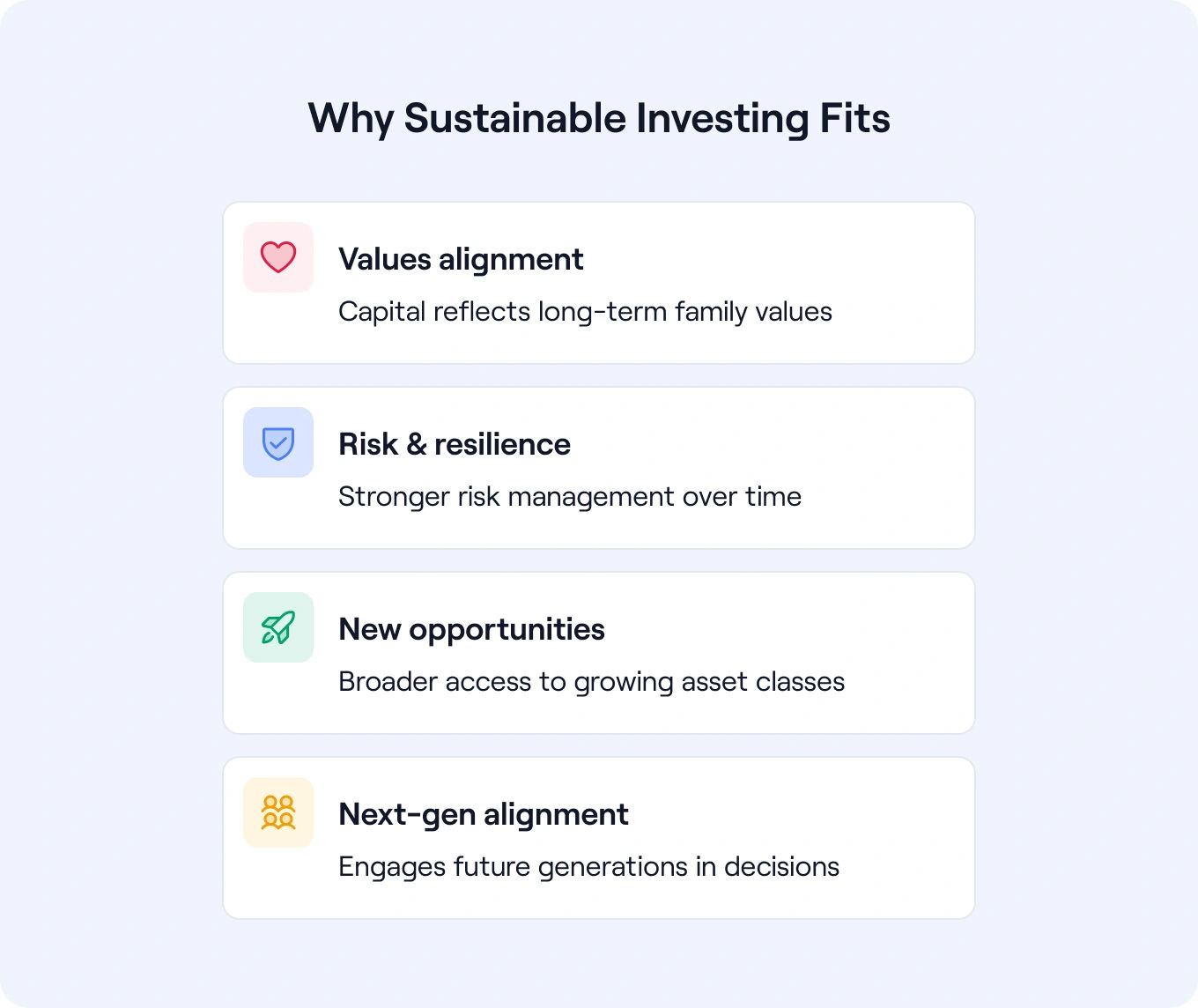
The shift toward sustainable investing in family offices isn’t driven by a single factor. It’s a convergence of risk management, values alignment, and opportunity recognition.
Aligning Values With Investments
For many families managing significant wealth, financial resources represent more than just the value of their portfolio. It represents the ability to influence outcomes, ensure personal security, and support causes that matter to you. Sustainable investing enables single family offices to put their capital behind their principles.
If your family is concerned about climate change, ocean conservation, or educational equity, sustainable investments provide a way to contribute to solutions while building wealth. This alignment matters especially in family governance, where educating family members across generations and maintaining family unity around investment objectives are key.
Managing Risks and Long-Term Performance
Companies with strong ESG practices tend to have better risk mitigation processes in place. They’re less likely to face regulatory fines, reputational damage, or operational disruptions from environmental or social issues.
And it makes sense.
A company that ignores climate risks may face stranded assets as regulations tighten. A business with poor labor practices could see strikes, lawsuits, or consumer boycotts. These aren’t hypothetical risks—they hit the bottom line.
In many cases, companies with strong sustainability credentials outperform their peers over longer time horizons. For family offices focused on wealth preservation across future generations, that long-term focus matters more than quarterly fluctuations.
Access to Growing Investment Opportunities
The sustainable investment landscape has undergone significant growth in recent years. You’re no longer limited to a handful of “green mutual funds.” Today’s options include:
- Renewable energy infrastructure projects with stable cash flows
- Clean technology ventures addressing water scarcity or waste reduction
- Green bonds that fund sustainable projects
- Impact-focused private equity funds
- Direct investments in social enterprises
These opportunities provide diversification while supporting innovation in areas critical to addressing global challenges. For high-net-worth families already investing in alternative investments and private equity, sustainable options fit naturally into existing allocation strategies.
Meeting Next-Generation Expectations
If you’re managing wealth for multiple generations, you’ve probably noticed that younger family members view investing a bit differently. They are increasingly aware of social and environmental challenges and often seek investment strategies that reflect those values.
Family office sustainable investing helps bridge generational divides. It demonstrates that wealthy families take these concerns seriously while maintaining their fiduciary responsibilities. This approach supports succession planning and helps align investment philosophies across generations. For tax and estate planning, outcomes are driven by entity structure and planning strategies rather than ESG considerations.
Several family offices we’ve spoken with note that involving younger family members in impact investment decisions has become a powerful tool for family education and engagement. It teaches investment principles while allowing the next generation to shape part of the family legacy.
How Can Family Offices Incorporate Sustainable Investing Into Their Portfolios?

Moving from interest to implementation requires a structured approach. Here’s how family offices actually do this:
- Start with values clarification
- Integrate ESG into existing investment analysis
- Consider a phased allocation approach
- Work with specialized managers and advisors
- Measure what matters
1. Start With Values Clarification
Before making any investment changes, clarify what sustainability means for your family. Family discussions should clarify:
- Which environmental and social issues matter most to the family?
- Do you prefer to exclude specific industries or actively seek positive impact?
- How will impact objectives be balanced with financial returns?
- What role does sustainable investing play in the family’s mission and in financial planning?
- How do lifestyle management and personal affairs align with investment management?
- In what ways can property management support investment management goals?
- Do family members have the financial literacy required to make informed investment decisions?
This clarity prevents conflicts later and ensures your investment advisors understand what you’re trying to achieve.
2. Integrate ESG Into Existing Investment Analysis
ESG integration doesn’t mean throwing out your current investment process. It means adding another layer of analysis. When evaluating any investment, ask:
- How does this company manage environmental risks?
- What are its labor practices and supply chain standards?
- Is family governance strong, with independent directors and transparent financial reporting?
- Are there any regulatory or reputational risks associated with ESG factors?
Many family offices work with investment managers who already incorporate ESG analysis, or they add ESG data providers to their research toolkit. For performance monitoring across these investments, family offices need systems that can track both financial and impact metrics.
3. Consider a Phased Allocation Approach
You don’t need to overhaul your entire portfolio overnight. Many family offices start with a dedicated sustainable investment allocation—perhaps 5–10% of the portfolio—to learn what works before expanding.
This might mean:
- Allocating a portion to impact-focused funds in areas like affordable housing or renewable energy
- Replacing traditional fixed-income holdings with green bonds
- Dedicating part of your private equity allocation to ESG-focused funds
- Making direct investments in sustainability-focused companies
As you gain experience and see results, you can increase the allocation or apply ESG criteria more broadly across the portfolio.
4. Work With Specialized Managers and Advisors
The sustainable investment landscape is complex and evolving. Few family offices have the internal expertise to evaluate every ESG opportunity.
Consider working with:
- Investment managers and private wealth management firms with ESG expertise and track records
- Impact investment advisors who can source and vet direct deals
- ESG research providers offering company-level sustainability data
- Consultants who can help develop your sustainable investment strategy
For family offices utilizing a multi-family office structure or an outsourced family office model, ensure that your external partners and in-house team possess ESG capabilities and can effectively integrate sustainability into their investment recommendations.
5. Measure What Matters For Family Wealth
If you’re making family offices sustainable impact investments, you need to track both financial performance and impact outcomes. Define metrics upfront:
- Financial returns: IRR, multiples, performance versus benchmarks
- Impact metrics: Carbon emissions reduced, jobs created, people served
- Portfolio-level ESG scores or ratings
- Progress toward specific family goals (e.g., climate targets)
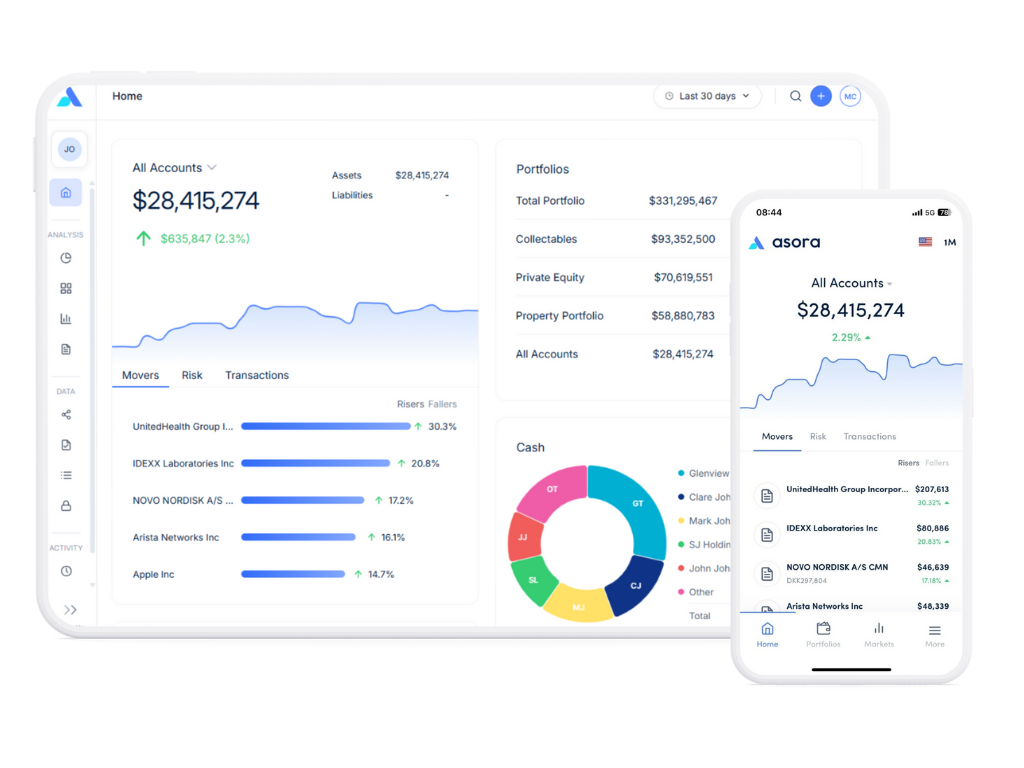
Technology platforms like Asora help family offices track performance across diverse asset classes, including private assets, long-term assets, and digital assets, where impact investments often sit. Having consolidated reporting makes it easier to see both financial and impact results in one place.
Common Approaches To Family Office Wealth Management
Different families take different paths. Here are the most common sustainable investment strategies family offices use:
- Thematic portfolios: Focusing on specific themes like clean energy, water resources, or sustainable agriculture. This works well for multiple families passionate about particular issues.
- Core ESG integration: Applying ESG criteria across the entire portfolio, from public equities to real estate to private equity deals. This comprehensive approach guarantees all investments meet minimum sustainability standards.
- Impact carve-out: Maintaining a traditional portfolio while dedicating a portion (often 5–20%) to high-impact investments that explicitly target social or environmental outcomes. This balances risk management with the expression of values.
- Negative screening with ESG overlay: Excluding problematic sectors while applying ESG analysis to remaining investments. Common for families with clear values and boundaries, but flexibility within those bounds.
The right approach depends on your family’s values, risk tolerance, financial objectives, and your current stage in the wealth accumulation versus preservation cycle.
The Role of Technology in Sustainable Investing and Asset Allocation
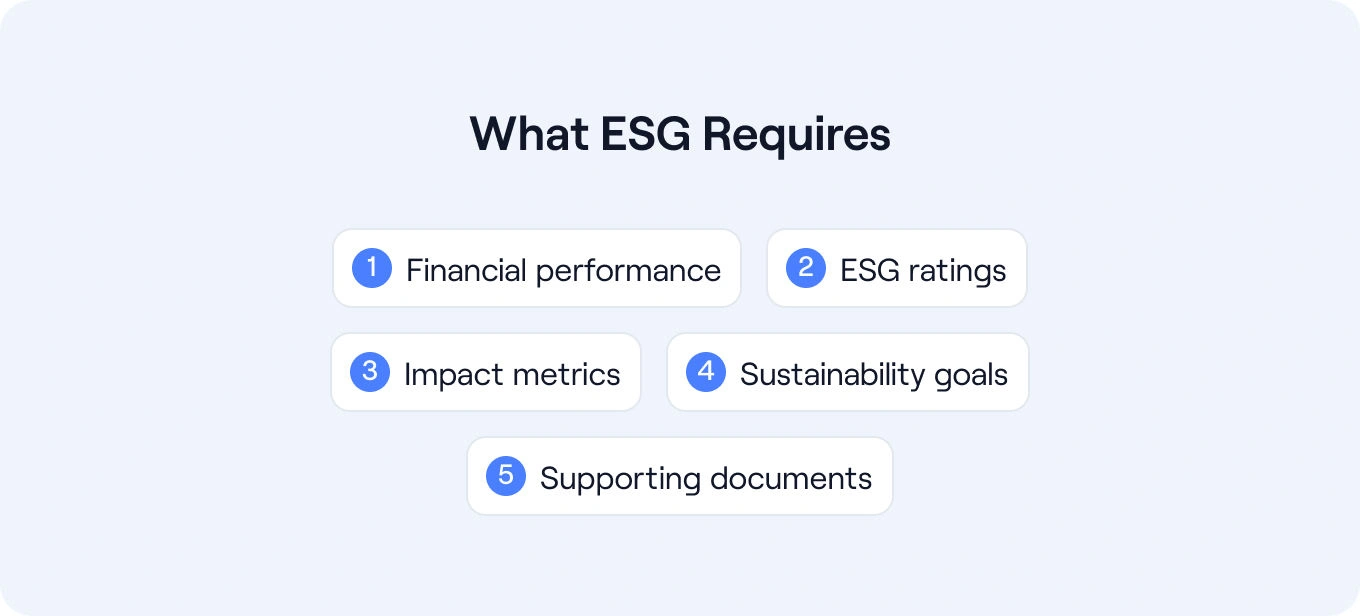
Managing a sustainable investment portfolio requires tracking more data points than traditional investing. You need to monitor:
- Financial performance across a family’s asset classes
- ESG scores and ratings
- Impact metrics specific to each investment
- Progress toward family-defined sustainability goals
- Documents like impact reports and ESG disclosures
Modern family offices increasingly use wealth management software to consolidate asset management information. Having your public equities, private equity, real estate, and impact investments visible on a single platform makes it easier to assess your overall sustainability profile while monitoring financial returns.
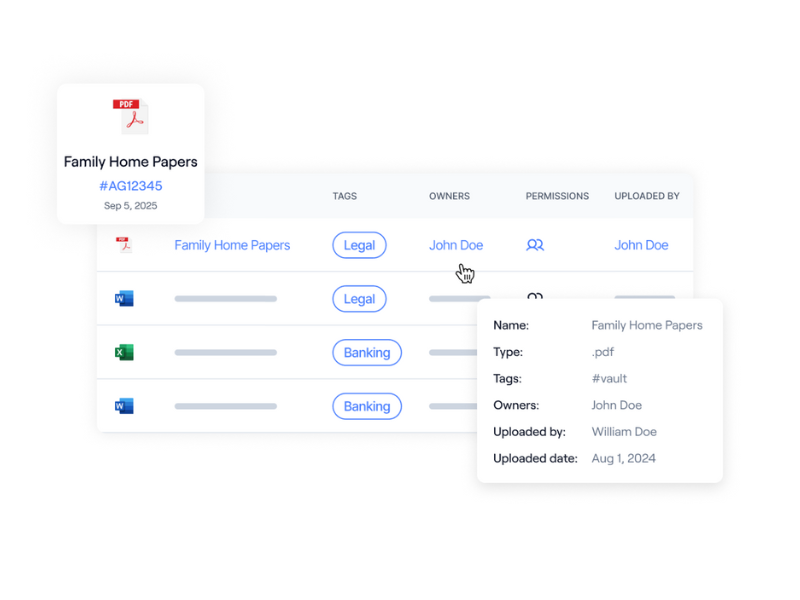
For family offices managing significant private investments across multiple clients, document management matters more than ever. Impact reports, ESG assessments, and portfolio company updates need to be organized and accessible when making investment decisions or reporting to family members.
The Future of Sustainable Investing For Family Offices
Sustainable investing is no longer a niche strategy. It’s becoming the baseline expectation, especially as generational wealth transfers accelerate and younger family members take on leadership roles in family offices.
We’re seeing several trends:
- More sophisticated impact measurement: Better tools and standards for tracking social and environmental outcomes.
- Increased focus on climate: Net-zero commitments and climate risk analysis becoming standard practice.
- Blurring lines: ESG integration moving from optional to default in investment analysis.
- Technology enablement: Better platforms for tracking sustainable investments alongside traditional holdings.
- Regulatory pressure: Growing disclosure requirements around ESG factors and climate risks.
The question is not whether to consider sustainability in investments and philanthropy; it is how to integrate it into financial planning so it serves both financial and family objectives.
Make Sustainable Investing Part of Your Family Legacy
Family office sustainable investing is about building a legacy that extends beyond financial returns. It’s about using capital to shape the world your children and grandchildren will inherit while preserving and growing that capital for their benefit.
Families that do this well find opportunities where strong ESG practices signal better-managed companies, where impact investments offer both meaning and financial performance, and where sustainability considerations help manage risk in an uncertain world.
If you’re running a family office, you don’t need to become a sustainability expert overnight. Start with honest conversations about what matters to your family, work with advisors who understand this space, and take a measured approach to integrating ESG and impact considerations into your investment process.
The result will be a portfolio that reflects your values, manages risk thoughtfully, and positions your family wealth for long-term success across generations.
Asora equips family offices with the tools to operationalize sustainable investing without adding operational clutter. Schedule a 15-minute demo and see Asora in action.
FAQ
How can family offices incorporate sustainable investing into their portfolios?
Family offices incorporate sustainable investing through several approaches, starting with values clarification to define what sustainability means for the family. This is followed by integrating ESG analysis into existing investment processes, allocating a portion of the portfolio to dedicated impact investments, and collaborating with specialized ESG investment managers.
What are the main benefits of sustainable investing for family offices?
Sustainable investing offers family offices several key benefits, including potential access to tax incentives in certain sustainable sectors, alignment between investments and family values, improved risk management through the identification of ESG-related risks, access to growing investment opportunities in areas such as renewable energy and impact funds, stronger engagement with younger family members who prioritize sustainability, and the potential for competitive long-term financial returns.
What is the difference between ESG integration and impact investing for family offices?
ESG integration involves considering environmental, social, and governance factors when analyzing all investments. Impact investing takes it a step further by making investments with the explicit intention of generating both measurable positive social and environmental outcomes alongside financial returns.
What challenges do family offices face with sustainable investments?
Common challenges include definitional confusion about what qualifies as sustainable (greenwashing concerns), variation in ESG ratings across providers, limited availability of high-quality, scalable impact investment opportunities, and the complexity of measuring both financial and impact outcomes.

 ISO 27001 Certified
 GDPR Compliant