

Somebody has asked you to sort out the accounting. Maybe the auditor made a comment. Maybe a family member asked what something was worth and the honest answer was that it would take a week to find out. Maybe you have simply run out of patience with the spreadsheet that holds the whole thing together.
So you start looking at family office accounting software, and within an hour you have a list of a dozen platforms, all of which claim to be built for family offices, and no way to tell them apart. Everybody writing about this sells one of them. That is the problem with the advice in this category.
We do not sell an accounting system. Asora sits alongside one. That means I can tell you something the other guides cannot, which is that a good number of the families reading this do not need to buy anything at all.
Family office accounting software: the short answer
Family office accounting software is a general ledger built for many linked entities instead of one company. It handles trusts, holding companies and partnerships, follows ownership down through each layer, and closes the books in more than one currency.
Which one you need comes down to two things: how many entities you run, and how much of your money sits in private assets. Roughly:
- Fewer than about five entities, mostly listed investments: QuickBooks or Xero is still fine.
- Entity count growing, consolidation eating your month end: Sage Intacct is the usual next step.
- Partnership allocations and capital calls are the real work: FundCount or Asseta.
- You want the books and the investment record in one system: Archway or Asset Vantage.
- Bill pay volume is the bottleneck: AgilLink or Asseta.
Asora is not on that list and should not be. More on where we do fit further down.
Most families move off QuickBooks too early
I want to spend a moment here because it is where the money gets wasted.
The pattern I see goes like this. An office with four or five entities decides it has outgrown its accounting software. It buys something built for thirty. Implementation takes the better part of a year and costs more than the licence. And at the end of it, the thing that was actually bothering everyone has not changed, because the problem was never the bookkeeping. It was that nobody could see the whole picture in one place.
Those are two different complaints and they sound identical when somebody first describes them to you.
Here is how to tell them apart. Ask what is slow about your month end. If the answer is that consolidating the entities is painful, that eliminations get done in a spreadsheet, that the auditor keeps asking for things the system cannot produce, then yes, you have outgrown your ledger and a better one will pay for itself.
But if the answer is that you spend three weeks chasing statements from six banks and four fund managers, and the accounting itself only takes two days once the data finally lands, a new ledger will not help you at all. You will pay six figures and wait a year to make no difference whatsoever. That is a data problem and it needs a different kind of tool.
The other signals worth taking seriously: trusts or partnerships that need allocations between partners rather than a single owner. Capital calls and distributions moving through your books rather than sitting on a manager's statement. More than one currency, translated by hand each period. A tax preparer who quietly rebuilds your numbers every year instead of working from what you send.
Three or more of those and a dedicated system will earn its keep. One of them, on its own, almost never justifies the move.
The expensive mistake, in one line
Buying a general ledger to fix a reporting problem. A ledger records what happened inside the entities you own. It cannot tell you what the family is worth this morning across every bank, custodian and private holding. If the complaint you keep hearing is "I never know where we stand", no accounting system will fix it.
Why normal accounting software struggles
A trading company has one set of books, one currency, one owner. Straightforward. A family office has a web of entities that own pieces of each other, holds things nobody quotes a daily price for, and reports to family members who each want to see it differently.
Four things break when you try to run that on ordinary software.
The first is consolidation. Not adding the entities together, which anything can do, but stripping out the transactions between them. If the holding company lent money to the property company, that loan should not appear as both an asset and a liability in the consolidated accounts. Doing that by hand every month is where the time goes.
The second is following ownership down through the layers. A family member owns 40 percent of a holding company, which owns 60 percent of a partnership, which owns the building. What is their actual share of the building? Purpose-built systems answer that. Everything else makes you work it out yourself, every time.
The third is partnership accounting. Capital accounts for each partner, allocations between them, capital calls and distributions. Generic software does not attempt this, and the workaround is always a spreadsheet that one person understands.
The fourth is the audit trail. Approvals, locked periods, a record of who changed what and when. This is the first thing your auditor asks about and the last thing anyone thinks to check during a demo.
The best family office accounting software: eleven platforms worth knowing
These come up most often when families are choosing. I have grouped them by what they are actually for, because the most common mistake at this stage is putting a general business tool next to a purpose-built one and comparing feature lists as though they were the same kind of thing.
One column needs explaining. Published pricing means the company puts a number on its own website. Most do not, and that is normal here. It is still worth knowing, because the ones who publish are usually the ones you can buy without a three month sales process.
| Platform | What it is | Best for | Published pricing |
|---|---|---|---|
| QuickBooks Online | General small business accounting | Simple structures, few entities | Yes |
| Xero | General small business accounting | The same, stronger bank feeds in the UK and Ireland | Yes |
| Sage Intacct | Cloud accounting for multi-entity businesses | Offices whose entity count broke the old system | No |
| Oracle NetSuite | Full enterprise resource planning | Large offices with an operating business attached | No |
| Microsoft Dynamics 365 | Enterprise resource planning | Offices already committed to Microsoft, with technical staff | No |
| Asseta | Family office accounting and operations | Teams whose bottleneck is bill pay and banking | No |
| SumIt | Family office general ledger | Finance teams closing many entities quickly | No |
| AgilLink | Bill pay and business management accounting | Business managers running high payment volume | No |
| FundCount | Accounting with investment and partnership accounting built in | Offices where allocations are the real work | No |
| Archway | Accounting, investment data and reporting in one | Large, complex offices wanting a single system | No |
| Asset Vantage | Accounting and portfolio oversight in one | Offices wanting the ledger to own the investment record | No |
How this list was put together. Each description comes from the vendor's own public material, linked in the table so you can check it yourself. Pricing position was checked in July 2026 by looking for a published number on each vendor's own site. Companies change this, so confirm before you rely on it. Asora publishes its own pricing, and Asora is not a candidate on this list, for reasons set out below.
The general business tools
QuickBooks is the most used accounting software in the world and plenty of family offices run on it perfectly well. It does books and payables properly. It will not follow ownership through layers, will not do partnership allocations, and will not consolidate a large group cleanly. Cheap, quick to start, easy to outgrow. Xero covers similar ground with better bank coverage outside the United States.
Sage Intacct is the step most offices take when the general tools stop coping. It was built for businesses running many entities, so consolidation is native rather than bolted on. What it does not have is anything family office specific. No partnership accounting, no investment tracking. Budget for a real implementation.
Oracle NetSuite and Microsoft Dynamics 365 will do almost anything, provided you configure them, and configuring them is the whole job. These make sense when the family also owns an operating business that runs on the same platform. Bought purely for a family office, you are paying for a great deal of software you will never switch on.
The purpose-built ones
Asseta puts a general ledger together with banking and bill pay, with heavy automation around payments. It fits offices where the daily grind is paying things and reconciling accounts rather than tracking complicated fund positions.
SumIt competes on one thing, which is speed of close across a large number of entities. If your month end is the problem, it is worth a look.
AgilLink comes out of the business management world, where a firm runs the personal finances of a family or an individual. High payment volume and tight controls are its strength.
FundCount is the most accounting-led of the group. Multi-currency general ledger, partnership accounting and portfolio accounting in one system. The right shape if your money is mostly in funds and direct deals and the allocations are complicated.
Archway has served large family offices for two decades. Ledger, investment data and reporting together, nested ownership handled properly, configurable to a fault. That configurability is also the cost. Not a system a two person office should be buying. Note that the business has changed hands: Aquiline completed its acquisition of SEI's Family Office Services business, Archway included, effective 30 June 2025.
Asset Vantage takes an accounting-first position on purpose. Their argument is that the ledger should be the single source of truth and portfolio reporting should come out of it, rather than being assembled separately. That is a serious position and it deserves a proper answer, which is the next section.
The reconciliation argument, and where I disagree
Read this part knowing what Asora sells, because I have an interest in it.
There are two jobs here and they are not the same one. The ledger records what happened inside the entities you own: transactions, balances, accounts an auditor can sign. The reporting layer shows what the family owns across everything, including what sits outside those entities. Custodian accounts, bank accounts, funds, property, the stake in a private business.
Each is poor at the other's job. A ledger only knows what has been booked into it, so when a fund manager emails a quarterly statement, the ledger knows nothing until somebody types it in. A reporting layer brings everything together and presents it, but it will never produce statutory accounts.
| General ledger | Reporting layer | |
|---|---|---|
| Answers | What was booked, and in which entity | What we own, and how it is doing |
| Source of truth for | Statutory accounts, audit, tax | Net worth, allocation, performance |
| Handles | Journals, eliminations, partner capital | Custodian feeds, private assets, ownership views |
| Updated | On close | Continuously |
Asset Vantage make a specific criticism of running these separately, and it is a fair one. Their case is that when investment data is assembled outside the ledger, the two never quite agree, and you inherit a permanent reconciliation job that gets worse over time, especially around ownership changes and capital events.
They are right that this happens. Run a reporting layer that never reconciles back to the books and you end up with two versions of the truth and a monthly argument about which one is correct. It is a real failure and it is worth naming.
Where I part company is on what follows from it. The reconciliation work does not vanish when everything lives in one system. It moves. Somebody still has to get the custodian data in. Somebody still has to price the private holdings. Somebody still has to chase the manager who reports 45 days after quarter end. One system does not make that data arrive any sooner. It just means the reconciling happens before the numbers reach the ledger instead of after.
So the question that actually settles it is not about architecture at all. It is this: can you get everything the family owns booked into one system? If the assets sit inside entities you control and your accountant can book them all, the single system argument is strong and you should take it seriously. If a real share of the family's wealth sits in accounts, funds and holdings that will never be journal entries, you will need something pulling them together no matter what your ledger does.
A ledger tells you what was booked. It does not tell you what the family is worth this morning. Those are two different questions, and buying the wrong tool for the one you actually have is the most expensive mistake in this category.
Where Asora sits
Alongside the accounting system, not instead of it. Data moves between the two by secure feed, file or interface. The accounting stays where it belongs and we cover what the ledger cannot see.
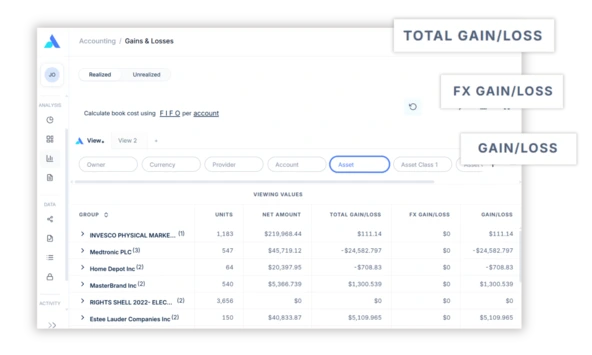
A few parts of the accounting job we do touch directly, and they are worth being specific about. Custodian holdings reconcile automatically, so positions are checked against the custodian rather than by eye. Book cost is tracked per tranche, which is what makes realised and unrealised gains traceable instead of estimated. Withholding tax on dividends is recorded as it arises rather than reconstructed in a panic at year end. Manager fees and charges are captured so somebody can actually analyse them, rather than having them disappear into net figures. Capital calls and distributions on private holdings are tracked as they happen.
On the connection side, we are deliberately narrow about what we claim. Asora aggregates data from custodians and banks by direct feed or structured file, and uses Canoe Intelligence to turn alternative investment paperwork, capital calls, K-1s and investor statements, into structured data. Addepar and Arch are partners too. That is the list.
Everything else we do sits outside the books entirely: the consolidated view, the performance numbers, the reporting that goes to family members.
Five ways families get this wrong
Buying a ledger to fix a reporting problem. The big one, and the reason for the long section above. Work out which question you cannot answer before you go shopping.
Buying for the office you might become one day. Setup cost tracks the size of the system, not the size of your office. A platform built for fifty entities takes months to configure whether you have fifty or five.
Assuming the ledger will show the whole balance sheet. It shows what has been booked. The fund positions, the private holdings, the accounts outside your entities will not appear unless somebody puts them there by hand.
Not asking who is going to run it. No system runs itself. If nobody in the office is an accountant, a more capable ledger makes things worse, not better. An outsourced accountant on a simple system beats an in-house one on a complicated system almost every time.
Not asking the tax preparer first. One conversation with them tells you what format they need and what currently wastes their time. That narrows the shortlist faster than any demo will.
Start with the question, not the shortlist
If your books are genuinely the problem, buy family office accounting software from the list above, and buy for the office you have now rather than the one you imagine.
If the problem is that nobody can see the whole picture, that is what Asora is for. Every asset, every owner, every entity, every account, in one place and kept current rather than assembled at quarter end. That is what we call the wealth map, and it is the thing spreadsheets handle badly and ledgers do not handle at all.
It suits offices running lean. A principal managing their own affairs. A finance director inside a family business who has picked up the family's wealth alongside the day job. A small single family office. A multi-family office serving several families from one platform. There is no minimum you need to reach before it is worth doing. Families get value from a proper record far earlier than the traditional advice suggests, and the sensible order is usually to get the software right and add people later, rather than the other way round.
Frequently asked questions
What accounting software do family offices use?
Most family offices use one of four things. QuickBooks or Xero for simple structures. Sage Intacct or Oracle NetSuite when entity counts grow. A purpose-built family office ledger such as Asseta, SumIt, FundCount, Archway or Asset Vantage when partnership accounting and consolidation get heavy. Or an outsourced accountant running the books for them.
What is family office accounting?
Family office accounting is bookkeeping across many linked entities rather than one company. It covers trusts, holding companies, partnerships and operating businesses, tracks who owns what through each layer, handles more than one currency, and produces accounts that an auditor and a tax preparer can both work from.
What are the top 3 accounting softwares?
There is no top three for a family office. The question is normally asked about general business accounting, and the answer does not transfer, because general tools are not built for multi-entity ownership or partnership allocations. For a family office the shortlist changes with entity count and asset mix, which is what the comparison table above sets out.
What is the minimum net worth to have a family office?
There is no fixed number. Cost is what sets the floor. A dedicated team plus systems runs into the hundreds of thousands a year, which is why the traditional answer has been well above 100 million. Software has moved that floor down a long way. Many families now run a professional setup far earlier by buying the platform first and adding people later.
Can QuickBooks be used for family office accounting?
Yes, and plenty of family offices do. QuickBooks handles day to day books and payables well. It struggles with look-through ownership across many entities, partnership allocations, and reporting across private assets. Offices commonly keep QuickBooks for the books and add a reporting layer on top rather than replacing it.
How do I choose the right family office accounting software?
Start with your entity count, whether trusts and partnerships are involved, whether capital calls run through your books, and how many currencies you hold. Then ask your auditor and your tax preparer what they need. Those two answers narrow the list faster than any feature comparison.
Worth reading next: the full guide to family office software, our comparison of 11 reporting and wealth platforms, how consolidated reporting actually works, or book a demo to see where we fit next to what you already run.
.png)
.jpg)
 ISO 27001 Certified
 GDPR Compliant