
.jpg)
TL;DR
A family office in 2026 is a private firm that manages the financial and personal affairs of high-net-worth families. It handles everything from investments and tax planning to estate planning and philanthropy. Single-family offices serve one family, while multi-family offices work with multiple families.
From Busy to Built-Out: Your Family Office Decision
Selling a business, receiving an inheritance, or accumulating complex assets often necessitates a more comprehensive approach to wealth management. In that context, “family office” becomes more than a buzzword—it’s a potential operating model. This guide explains what a family office is, who it serves, and how it operates across various structures and costs, allowing readers to assess its suitability with clarity.
What is the Definition of a Family Office?
A family office is a private wealth management firm dedicated to serving one family or multiple families. It’s your own in-house team of financial experts (investment managers, tax advisors, estate planners, and sometimes even lifestyle coordinators) all working together to manage and preserve your wealth across generations.
Unlike working with multiple advisors who only see pieces of your financial picture, a family office looks at everything holistically:
- Investment
- Real estate holdings
- Private equity stakes
- Philanthropic goals
- Succession plans
It’s all managed under one roof.
How Does a Family Office Work in 2026?
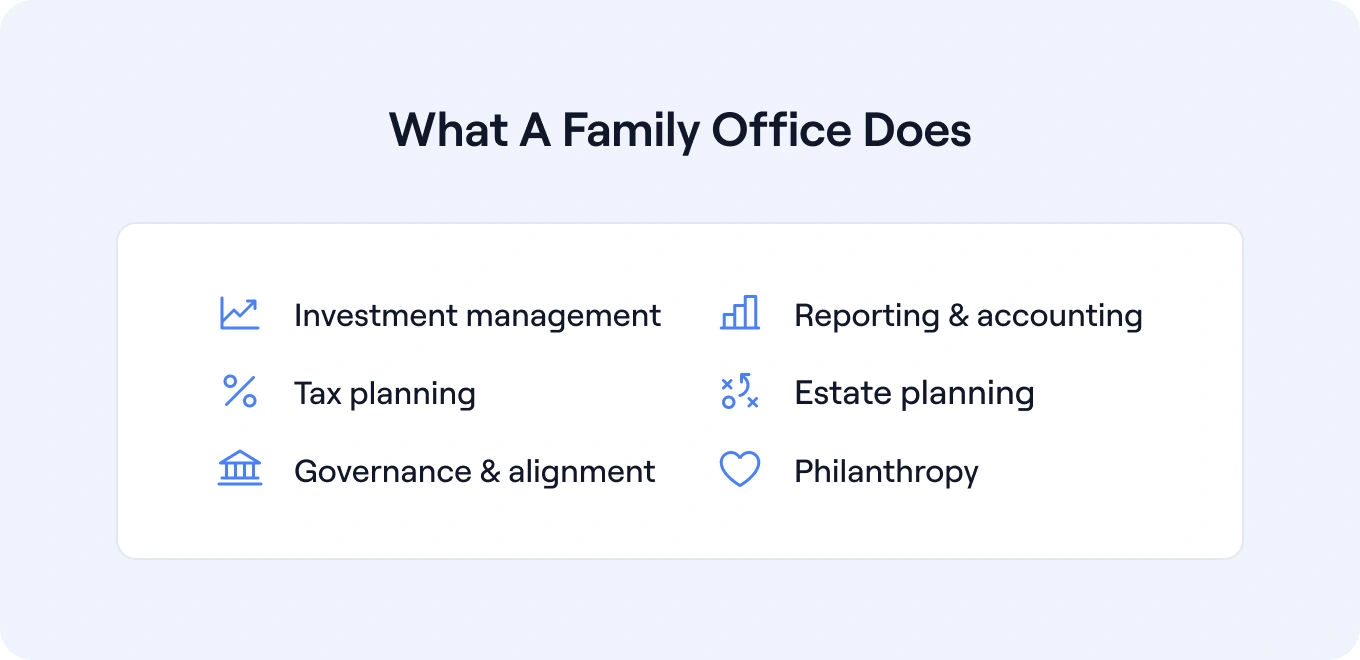
Significant wealth gets complicated fast. You might have assets spread across different banks, custodians, and investment platforms. You're dealing with multiple entities (trusts, LPs, holding companies) and various stakeholders, all wanting different information.
A family office brings order to that complexity. The team typically includes professionals with expertise in investment management, accounting, legal affairs, and estate planning. Some family offices also offer concierge services, including property management and family education programs for younger family members.
Here's what the day-to-day looks like:
- Investment management: Researching opportunities, managing portfolios, and tracking performance across assets.
- Financial reporting and accounting: Maintaining detailed financial records and providing regular reports on your wealth position.
- Tax planning and compliance: Minimizing liabilities while ensuring full compliance across jurisdictions.
- Estate planning and wealth transfer: Structuring strategies to preserve wealth across generations.
- Governance and family unity: Establishing governance frameworks and family meetings to align values and goals.
- Philanthropy: Managing charitable foundations and overseeing grant-making activities.
The Types of Family Offices
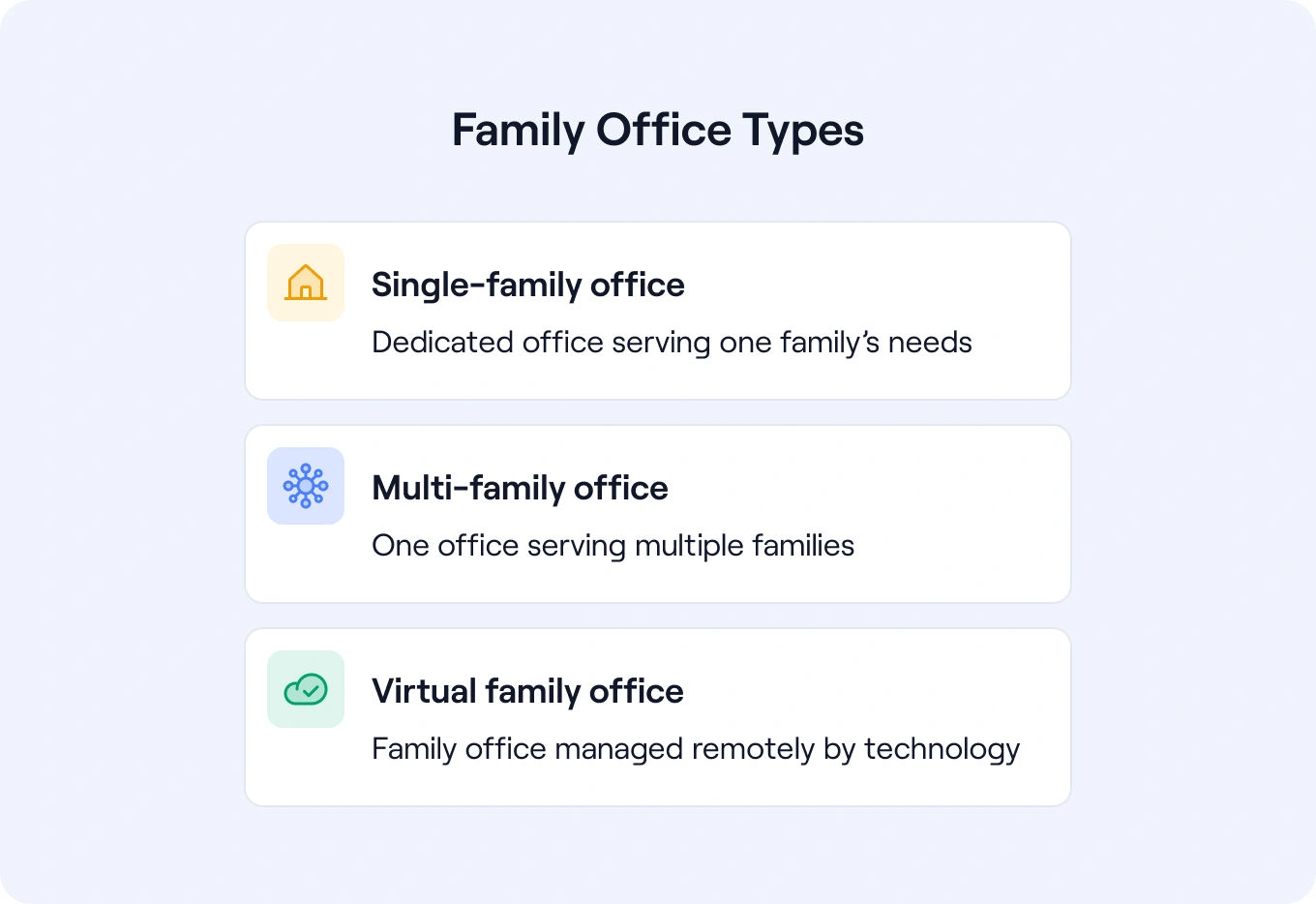
- Single family office (SFO): Serves one family exclusively with a dedicated team. Typically for $100M+ in assets.
- Multi-family office (MFO): Serves multiple families, sharing costs while maintaining personalized service.
- Virtual family office: A hybrid model outsourcing certain functions while retaining oversight.
For a deeper look at how teams and entities are organised in each model, see our guide to family office structure.
What is a Family Office in Wealth Management?
Family offices represent the most comprehensive form of wealth management. They manage investments, estate planning, reporting, and personal affairs under one roof—offering scale, customization, and control far beyond traditional advisors.
Do You Need a Family Office?
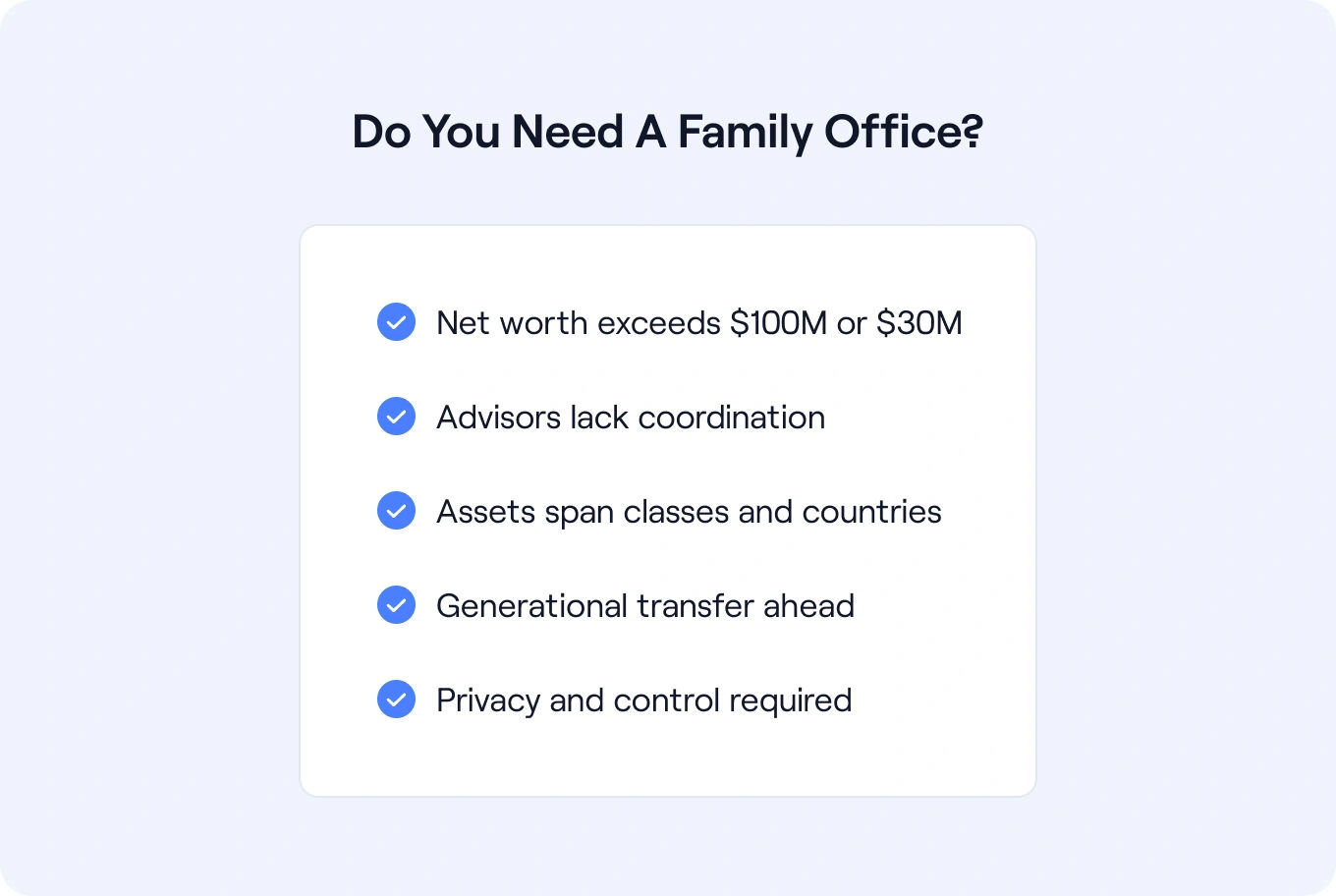
It makes sense to consider one if:
- Your net worth is around $100M+ (for SFO) or $30M+ (for MFO).
- You're coordinating multiple advisors who don’t communicate effectively.
- You hold complex assets across multiple jurisdictions and classes.
- You’re planning generational wealth transfer and legacy preservation.
- You want privacy, control, and fully aligned interests.
How Much Money Do You Need for a Family Office?
There is no single entry ticket. Published thresholds range from roughly $20 million to well over $100 million, and in practice three bands are a useful guide:
- $100M and above: A dedicated single-family office with its own staff becomes realistic. Below this level, the overhead is hard to justify.
- $25–30M and above: Multi-family offices typically accept families in this range, sharing one professional team across several families.
- Below $25M: A virtual family office (a lean setup built on software plus external advisors) usually covers the need without fixed staff costs.
Complexity matters as much as the number. A $40M family with operating businesses, property in three countries, and private fund stakes may need family-office-grade structure sooner than a $150M family holding two custody accounts.
What Does a Family Office Cost to Run?
Staff is by far the largest cost, followed by technology, office space, and external advisors. Three reference points:
- A fully staffed single-family office typically costs $1 million or more a year to run; a common rule of thumb is around 1% of assets under management.
- J.P. Morgan's 2026 Global Family Office Report puts the average annual operating cost at $3 million, rising to $6.6 million for offices managing more than $1 billion.
- Multi-family offices usually charge asset-based fees of roughly 0.5–1.5% of assets under management instead of fixed overhead.
Lean offices bring these numbers down substantially by starting with software rather than staff: consolidating data and reporting first, then hiring only for judgment, not administration.
Family Office Examples
Most family offices guard their privacy, but several are publicly known:
- Walton Enterprises manages the affairs of the Walmart founding family and is widely considered the largest family office in the world.
- Cascade Investment manages Bill Gates's wealth outside Microsoft, from railways to hospitality.
- Bezos Expeditions runs Jeff Bezos's venture investments and personal projects.
- Duquesne Family Office is Stanley Druckenmiller's vehicle, converted from his hedge fund.
- Pontegadea invests the Ortega (Inditex/Zara) family's dividends, mainly into prime real estate.
Every one of these runs a large professional team, but the same jobs (consolidating assets, tracking performance, reporting to the family) exist at every scale. Smaller offices simply solve them with software instead of headcount.
Family Office Services: What Do They Actually Provide?
- Investment management: Oversight of direct, private equity, and venture holdings, plus asset allocation and monitoring.
- Consolidated reporting: One unified view of your family’s wealth.
- Tax services: Strategic planning and compliance management.
- Estate planning: Trusts, foundations, and structures for generational transfer.
- Administrative services: Bill pay, entity management, and coordination with providers.
- Risk management: Insurance and cybersecurity protection.
- Lifestyle services: Property management, travel, and concierge support.
- Family education: Preparing the next generation for wealth stewardship.
The Benefits of Working With a Family Office
- Personalised services: Every strategy and report is tailored to your family’s needs.
- Consolidated view: A single source of truth for your total wealth.
- Expertise and access: Top-tier professionals and exclusive investment opportunities.
- Confidentiality: Stringent privacy and data security measures.
- Long-term focus: Multi-generational perspective, not quarterly results.
- Aligned interests: No conflicts or commissions—your team works only for you.
The Disadvantages of a Family Office
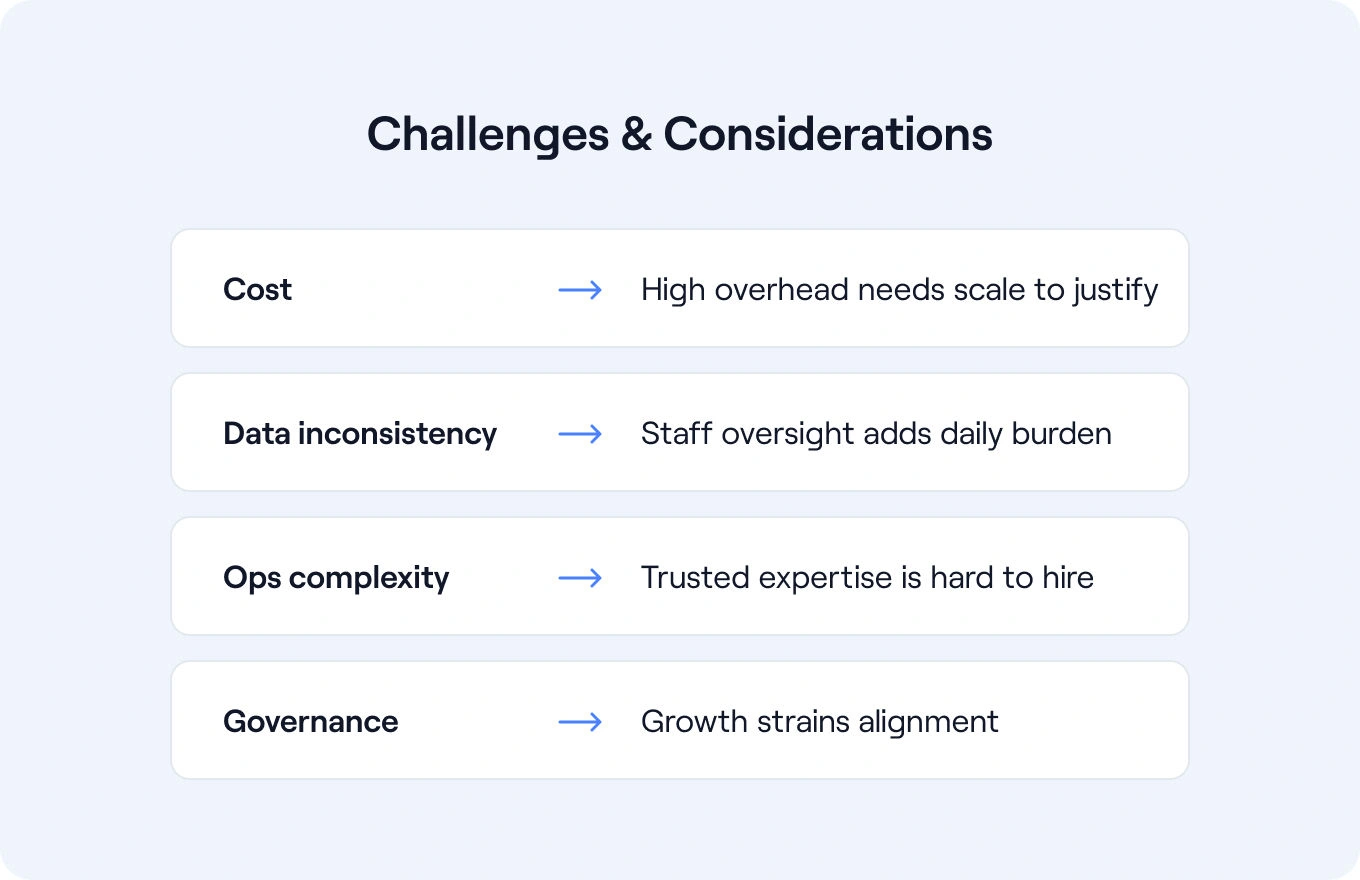
- Cost: Running a single-family office can require $100M+ in assets to justify the overhead.
- Management complexity: Hiring and overseeing staff adds operational demands.
- Talent sourcing: Recruiting trustworthy, skilled professionals is crucial.
- Key-person risk: In smaller offices, critical knowledge often sits with one or two people; if they leave, processes and reporting can leave with them.
- Governance: As offices grow, communication and alignment can become difficult without structure.
Is a Family Office Right For You?
If you’re managing significant wealth and complexity, a family office can bring clarity, control, and continuity. Whether single-family, multi-family, or virtual, the right setup aligns expertise, technology, and governance for long-term success. If you decide to proceed, our step-by-step guide on how to start a family office covers the structure, team, and technology decisions in order.
Modern family offices increasingly turn to technology platforms like Asora for data aggregation, performance monitoring, and reporting—reducing manual effort while maintaining comprehensive oversight.
FAQ
Do I need a family office?
You may need one if you have $100M+ (SFO) or $30M+ (MFO) in assets, manage complex holdings, and spend significant time coordinating advisors.
What is the purpose of a family office in 2026?
Its purpose is to manage, preserve, and grow wealth across generations through investments, tax and estate planning, governance, and philanthropy.
What’s the difference between a single-family office and a multi-family office?
A single-family office serves one family exclusively. A multi-family office supports several families, sharing resources while maintaining personalisation.
What is a family office for wealth management versus a traditional financial advisor?
A traditional advisor manages portfolios for many clients. A family office offers holistic management—covering investments, tax, estate, and governance—for one or few families.
How much money do you need to have a family office?
Published thresholds range from about $20 million to over $100 million. As a rule of thumb, a dedicated single-family office starts to make sense above $100 million, multi-family offices typically accept families from $25–30 million, and below that a software-based virtual setup usually covers the need.
What are the disadvantages of a family office?
The main drawbacks are cost (often $1 million or more a year for a staffed office), the burden of hiring and managing a team, key-person risk when knowledge sits with one or two employees, and governance complexity as the family grows.
What is the richest family office in the world?
Estimates vary because most family offices are private, but Walton Enterprises (the Walmart family) and Cascade Investment (Bill Gates) are widely considered among the largest, each associated with well over $100 billion in family wealth.
How much does the CEO of a family office make?
Industry compensation surveys put family office CEO base salaries roughly between $300,000 and $1 million, with total compensation above that at larger offices once bonuses and long-term incentives are included.

.png)
.png)
 ISO 27001 Certified
 GDPR Compliant