
.png)
TL;DR
The benefits of a family office extend far beyond basic wealth management. Ultra-high-net-worth families often gain coordinated investment strategy, tax planning, privacy protections, and governance structures that can support multi-generational stewardship. This guide explains the main benefits of having a family office and helps you determine if this dedicated structure makes sense for your family.
Why Set Up a Family Office
As wealth grows more complex (multiple entities, cross-border holdings, advisors in different firms), the cracks in a traditional setup start to show. Your banker runs the portfolio, but distribution tax treatment never reaches the CPA. Estate updates live with the attorney and do not hit the ledger. Quarterly numbers get stitched together without a single owner. The result is decisions made without the full picture. What you need is coordinated oversight that links investment, tax, estate, and accounting, whether that means a formal family office or a designated lead who keeps everyone and the data in sync.
That's the core problem a family office solves. Rather than coordinating multiple advisors yourself, you create a dedicated team (your family office) that manages and coordinates everything in one place with your family's goals and values at the center.
Let's look at the benefits of a family office and why ultra-high-net-worth families increasingly choose this structure.
7 Benefits of a Family Office for Wealthy Families
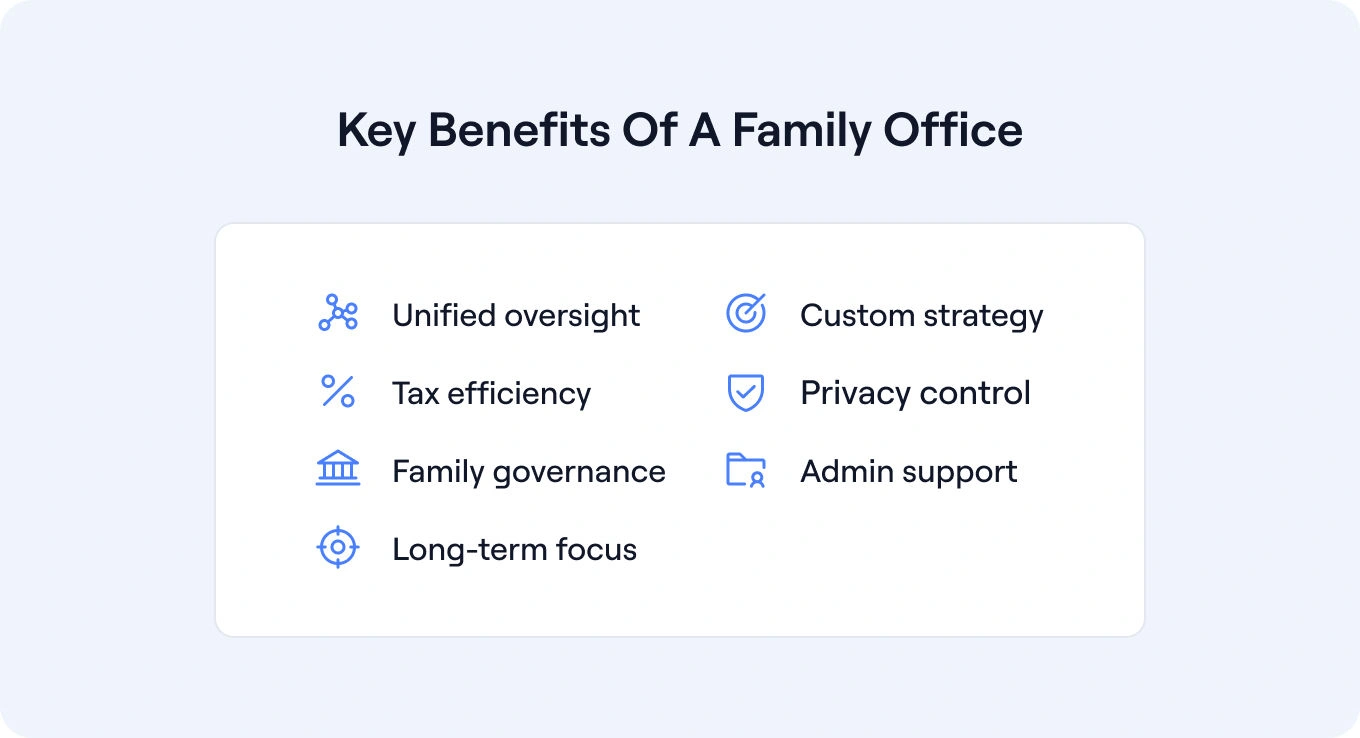
A family office brings your advisors, data, and decisions into one coordinated operating model. Here are seven practical benefits many families see when they centralize oversight and execution in a dedicated team.
1. Coordinated Wealth Management Across the Family’s Assets
The most immediate benefit of having a family office is the coordination it enables. Instead of managing relationships with separate investment advisors, tax planners, estate attorneys, and accountants, you have one team working together on your family's behalf.
What coordinated wealth management looks like:
A family office handles investment management while considering tax implications, estate planning needs, and how decisions affect future generations. When evaluating a real estate investment, your team considers not just returns but also entity structuring, tax efficiency, and how the asset fits into your broader wealth preservation strategy.
Clarify the relevant jurisdiction (s) and confirm that structuring is conducted with qualified legal and tax counsel, balancing tax, liability, governance, and operational constraints.
This integrated approach prevents the common problem where one advisor's recommendations conflict with another's. Your investment strategy aligns with your tax planning. Your estate administration supports your succession planning. Everything works together because one team oversees it all.
Many family offices use comprehensive family office software to consolidate financial data and provide transparency across all the family's assets, ensuring everyone works from the same information.
2. Customized Investment Strategy Beyond Standard Options
Traditional wealth management firms offer model portfolios and standard investment allocations, adjusted slightly for risk tolerance. A dedicated family office builds investment strategies specifically for your situation.
Access to exclusive opportunities:
A well-run family office can broaden your investment universe beyond public markets. Depending on your goals and eligibility, the team may coordinate access to private equity, hedge funds, direct deals, and selective co-investment opportunities. The value is as much about process as it is about product. Your team can conduct disciplined due diligence, structure commitments to align with your objectives, and negotiate terms where appropriate.
What to know
Access is not automatic. Many ultra-high-net-worth investors already access private equity and hedge funds through feeder funds, platforms, private banks, and advisors, subject to rules such as accredited investor or qualified purchaser status. Co-investment allocations depend on manager relationships, ticket size, speed to commit, and individual manager policies. Expanded access does not imply better opportunities or superior performance. Allocations can be limited, oversubscribed, or unavailable, and all investments carry risk.
Compliance note: Clarify the relevant jurisdictions and confirm that any structuring is completed with qualified legal and tax counsel, balancing tax, liability, governance, and operational constraints. Include a reminder that allocations and terms are not assured.
For families with concentrated wealth from a business sale or real estate holdings, a family office helps design and pace diversification over time, managing the move from owner to investor without forced decisions. In reality, liquidity events create time pressure: tax filing and payment dates, concentration risk that cannot be solved in one trade, governance disputes, and earn-out or lockup constraints. Transitions are therefore phased and constraint driven, sequenced to real liquidity windows, tax calendars, and risk limits.
Unlike wealth managers serving multiple clients with similar profiles, your family office builds portfolios around your specific situation. That might be generating income for current spending, maximizing growth for future generations, or balancing both objectives across different family members.
3. Tax Planning That Reduces Liabilities
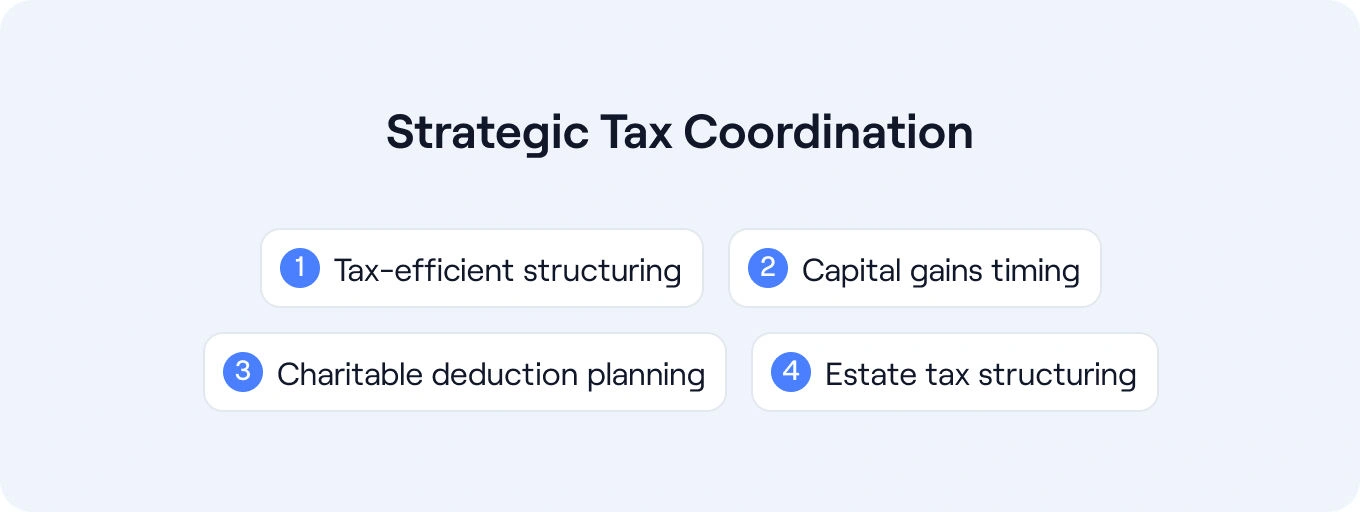
Tax planning becomes exponentially more complex as wealth grows. Multiple entities, cross-border holdings, investment income, and estate considerations create situations in which poor coordination can lead to avoidable tax leakage and compliance risk, especially across entities and jurisdictions.
Your family office:
- Coordinates with tax advisors to structure holdings tax-efficiently
- Time investment sales to optimize capital gains treatment (Timing decisions should be evaluated with tax counsel based on jurisdiction, residency, entity type, and anti-avoidance rules.)
- Manage charitable giving to maximize deductions while supporting causes your family cares about
- Structure trusts and entities to minimize estate taxes while maintaining appropriate control
Most family offices employ or work closely with experienced professionals who understand complex financial structures and can model different scenarios before implementing strategies. This proactive tax advice prevents expensive mistakes and identifies opportunities standard wealth management firms miss.
The benefits of having a family office include the capacity to pursue sophisticated tax planning that requires coordination across multiple entities and jurisdictions. A dedicated team centralises data, timelines, and approvals so strategies are designed and executed consistently. This level of coordination is also possible without a formal family office, for example, through a lead advisor model, a multi-family office, or a private bank working with external counsel. The critical factor is clear ownership, shared information, and disciplined governance.
4. Privacy and Confidentiality Protection for Family Business
Ultra-high-net-worth families face unique privacy concerns. Public disclosure of wealth, holdings, or transactions can create security risks, unwanted solicitations, and complications for family members trying to live normal lives.
A family office is built for discretion, but confidentiality is not unique to this model. Regulated wealth managers also operate under strict client confidentiality obligations. What differs is how privacy is implemented. In a family office, policies, permissions, and data flows can be designed solely around the family’s needs. In any setup, true confidentiality depends on governance, internal controls, vendor selection and contracts, and compliance with applicable laws and regulations.
This discretion can extend to transactions. A family office may help limit public association with your name when evaluating investments or making acquisitions by using intermediaries, NDAs, and appropriate entity structures. Privacy is not absolute, however. Disclosure can still arise from corporate and land registries, financing arrangements, counterparty processes, litigation, or regulatory regimes that require filings. Effective confidentiality depends on governance, controls, vendor and adviser contracting, and the rules that apply in each jurisdiction.
Family offices also provide security for younger family members, managing their financial affairs discreetly while they establish careers and identities independent of family wealth.
5. Multi-Generational Governance and Education
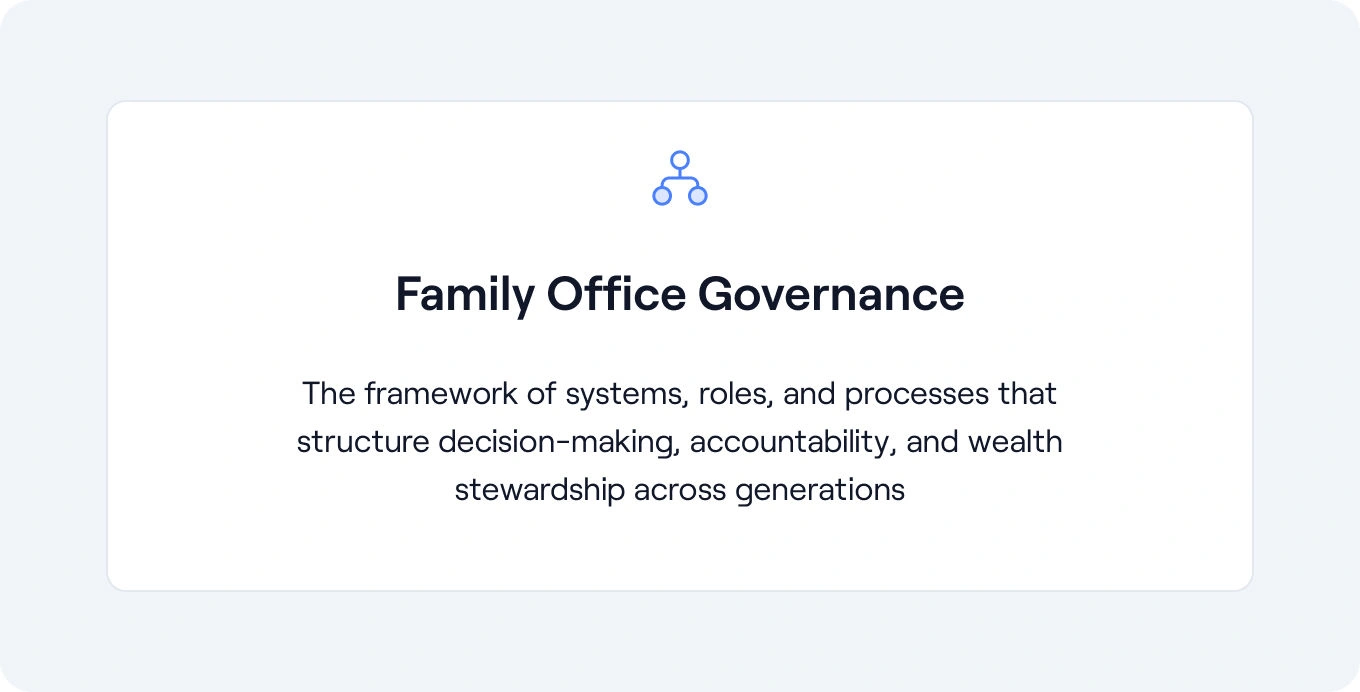
Preserving wealth across multiple generations requires more than smart investing. It also demands family governance structures that promote responsible stewardship and prevent conflicts of interest.
A family office helps establish decision-making frameworks for the family's wealth. This includes defining roles for multiple family members, establishing processes for major decisions, and scheduling family meetings to discuss financial goals and the family's values.
Preparing heirs is a core focus for many families, but the format varies. Some start with informal mentoring, shadowing, and structured family meetings that review budgets, portfolios, and philanthropy. As the office matures and the family grows, this can evolve into formal next-generation programmes, including investment sims, giving committees, and short courses with external partners. The aim is practical readiness across investing, philanthropy, tax, and governance, matched to each person’s stage of life and the complexity of the family’s affairs.
6. Lifestyle and Concierge Services to Assist Families
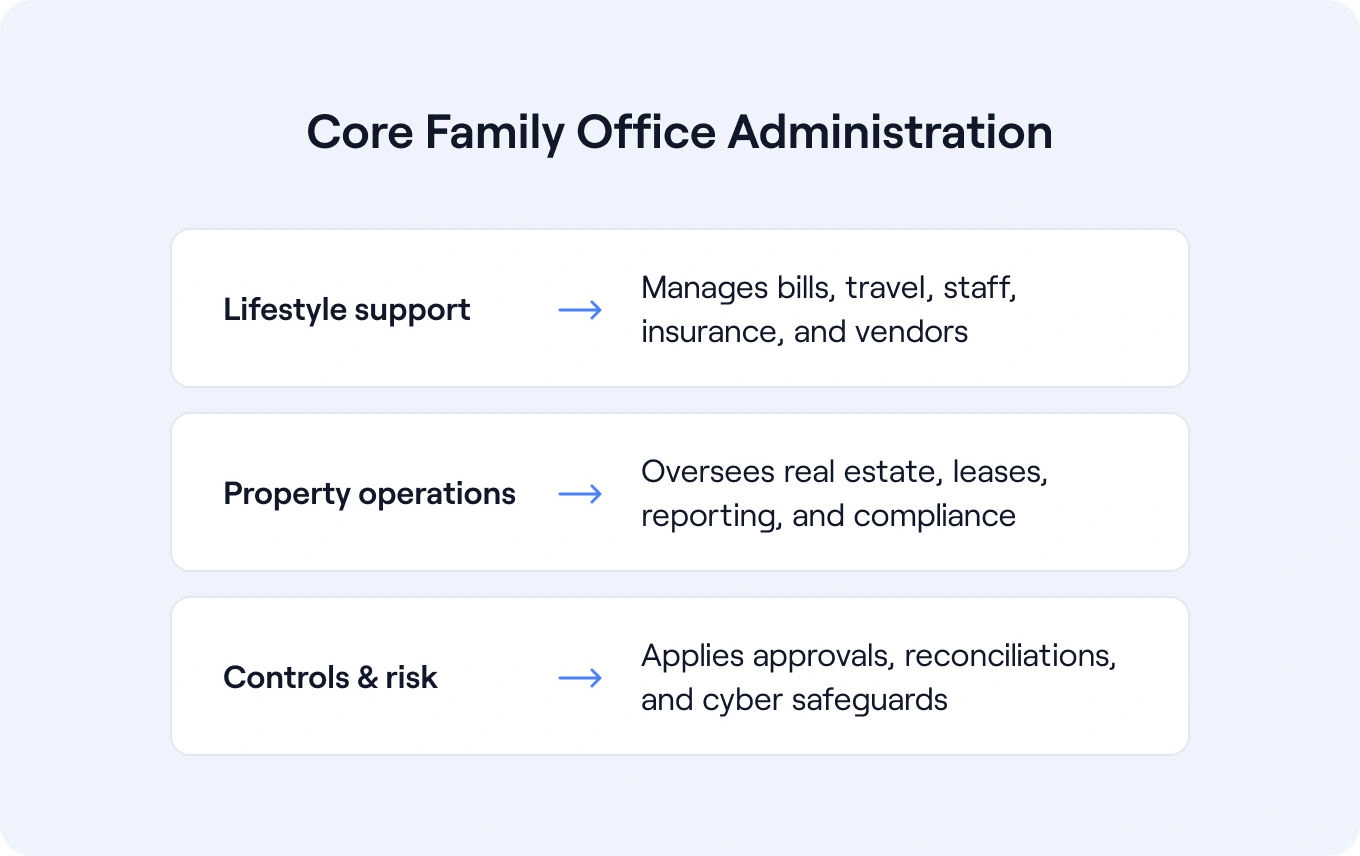
Beyond financial management, many family offices provide administrative services that simplify the family's affairs. These concierge services handle tasks that consume time but don't require family members' direct attention.
Common administrative services:
A family office can cover both family lifestyle needs and investment property operations. Scope and depth depend on the family’s complexity and the office’s maturity.
Lifestyle and personal affairs
- Bill payment and expense management with monthly reconciliation
- Travel planning and logistics
- Household staff hiring, payroll, and HR coordination
- Insurance placement and renewals for homes, valuables, vehicles, and liability
- Document organisation and secure digital storage
- Vendor onboarding and relationship management
- Coordination with external professionals such as CPAs, attorneys, and private bankers
Investment property operations
- Property oversight for real estate holdings, including maintenance schedules and capex tracking
- Lease administration, rent collection monitoring, and vacancy management in coordination with local managers
- Insurance management for each asset and entity
- Entity calendars for filings, permits, and compliance tasks
- Consolidation of reporting across assets and managers
Control framework and risk management
- Clear approvals matrix and spend thresholds
- Segregation of duties for initiation, approval, and payment
- Dual controls on payments, with payee verification and callback procedures
- Monthly bank and card reconciliations with audit trails
- Vendor due diligence, contract tracking, and renewal reminders
- Cyber and fraud prevention, including MFA, role-based access, encryption, and incident response plans
Compliance note: Governance, controls, and vendor contracts should reflect applicable laws and regulations in each jurisdiction.
For families managing multiple properties, operating businesses, or splitting time across jurisdictions, these services provide substantial practical value. Rather than managing these details yourself, your family office handles routine administration while you focus on strategic decisions and personal priorities.
Modern family office platforms streamline these administrative functions with secure document management and workflow tools.
7. Aligned Incentives and Long-Term Perspective
Perhaps the most valuable benefit of having a family office is alignment. Incentives can be more directly aligned when the team is employed by the family, but governance still matters. Conflicts can exist in any model and should be managed through oversight and controls.
A family office structure encourages multi-generational thinking. Decisions are not considered just in terms of current returns but also in terms of their impact on future generations. An investment strategy balances current family members' needs with the preservation of wealth for descendants who haven't yet been born.
This long-term perspective particularly benefits families transitioning from wealth creation to wealth preservation. After selling a business or experiencing a significant liquidity event, many families need help shifting from entrepreneurial risk-taking toa more institutional operating approach (IPS, governance cadence, risk controls, manager oversight, liquidity planning, and disciplined reporting) appropriate for generational wealth.
When Do the Benefits of a Family Office Justify the Costs?
Establishing a family office requires substantial resources. According to industry research, operating budgets vary widely by scope and model. Some benchmarking studies report average operating cost ratios well under 1% of AUM, while complex offices can be higher. A commonly cited benchmark for considering an SFO is ~$100M+ in investable assets, but complexity and service scope are often more predictive than asset level alone.
Factors that indicate readiness:
- Complexity: Multiple entities, cross-border holdings, or diverse asset classes, including private equity and direct investments
- Privacy needs: Desire for confidentiality beyond what traditional wealth management firms provide
- Control: Preference for a dedicated team focused exclusively on your family
- Generational planning: Need to coordinate wealth transfer and educate future generations
- Administrative burden: Time spent coordinating multiple advisors and managing the family's affairs has become unwieldy
If a full single family office is premature, a multi family office or virtual family office can deliver coordinated reporting, investment oversight, and administration at a lower cost by pooling resources across clients, while specialist legal and tax work remains with your advisers.
Alternatively, some families keep core advisers and use technology platforms to gain consolidated visibility and reporting without full family office overhead. When you say consolidated reporting, specify scope: asset types covered (public markets, private funds, direct investments, real estate), valuation approach (market marks, NAVs, appraisals), entity coverage (trusts, companies, SPVs), reconciliation cadence (for example daily for bank and brokerage feeds, monthly or quarterly for private assets), and reporting frequency (monthly, quarterly, or on demand).
Make the Most of Your Family Office
The benefits of having a family office compound over time as your team develops deep knowledge of your family's unique situation, builds relationships with specialized service providers, and implements long-term strategies.
Start with clear objectives about what you want your family office to achieve. Document your family's values and how they should guide decisions. Establish governance structures early, even if they feel formal for a small family group.
Invest in technology that provides transparency. Consolidated reporting platforms help family members gain a clearer financial picture and make informed decisions.
Finally, plan for succession within your family office itself. Who takes leadership as the next generation matures? How do you transfer institutional knowledge? Successful families deliberate through these transitions.
Schedule a demo with Asora to see how family office software provides consolidated wealth visibility, streamlined reporting, and efficient workflows.
FAQ
What are the benefits of a family office versus traditional wealth management?
A dedicated family office is built around one family’s needs, so it can offer:End-to-end coordination across investments, tax, estate, entities, and operations, with one owner for data, timelines, and approvals.Truly customized strategy instead of model portfolios, including mandate design, pacing, and liquidity planning tied to your objectives.Broader private market access where eligible, including private equity, direct deals, and selective co-investments, with disciplined due diligence and fit-for-purpose structures. Access is not guaranteed and does not imply better performance.Tighter operational confidentiality, with policies and permissions configured for your family. Privacy still depends on governance, vendor controls, and applicable regulations.Single client focus, enabling faster decisions and long-term alignment.Administrative support for bill pay, cash management, entity calendars, insurance, and real estate administration, with clear approvals and segregation of duties.Long-term perspective that links investment, estate, and governance decisions across generations.Wealthy families gain control and customization that can be hard to achieve in standardized models. That said, some providers and multi family offices can deliver comparable customization depending on scope and budget.If you keep your existing advisors, Asora gives you the unified picture a family office relies on: consolidated reporting across public, private, and real estate assets; entity-aware tracking for trusts, companies, and SPVs; reconciliation cadences suited to each asset type; and on-demand, monthly, or quarterly reporting. Result: coordinated decisions without the overhead of building a full in-house office.
What's the difference between single family office and multi-family office benefits?
A single family office (SFO) serves one family exclusively, providing complete customization, maximum privacy, and dedicated attention to that particular family's values and objectives. A multi-family office (MFO) serves multiple families, offering similar comprehensive wealth management services at lower per-family costs by sharing resources and overhead.

.png)
.jpg)
 ISO 27001 Certified
 GDPR Compliant