



Table of contents
"What used to take hours or days is now done in minutes"

Donald Campbell
Partner at Capstone Family Office
Schedule Demo
TL;DR
Asset Vantage serves single-family offices, multi-family offices, CPAs, and business management firms with investment accounting and bill pay. Asora is built for family offices (including lean SFOs) that need automated data feeds across custodians, a consolidated view of liquid and illiquid investments, look-through ownership mapping, and digital on-demand reporting.
Choosing Between Asora and Asset Vantage
If you're evaluating family office software, you've probably narrowed your shortlist to platforms that understand how family offices work. Asora and Asset Vantage both serve this market, but they approach the problem differently.
Asset Vantage integrates a full general ledger with portfolio/performance reporting. Built for single- and multi-family offices, CPAs, and business management firms, it combines partnership accounting with operational tooling, including bill pay, so teams can maintain accounting-grade records and consolidated reporting in a single system.
Asora focuses on data aggregation, ownership/entity mapping, performance reporting, and workflows for lean single-family offices that want consolidated reports. The platform eliminates time-consuming manual handling of data from multiple custodians and creates a single source of truth for the family’s wealth data.
Below, we’ll walk through the use cases that typically inform the decision between Asora and Asset Vantage, including specific scenarios family offices face and how each platform addresses them.
Who Each Platform Is Really For
Understanding the target audience helps frame the decision.
Asora is built for family offices and ultra-high-net-worth individuals that need:
- Consolidated financial data aggregation across banks and custodians
- Look-through to ultimate beneficial owners
- Efficient reporting for principals and family members
- Mobile access for on-the-go decisions
- Central, secure document repository with external provider uploads
The focus is on ease of use for lean teams, software that family members, staff, and other stakeholders can navigate without extensive training. Asora automates data capture from financial institutions, providing visibility into liquid and illiquid assets.
Asset Vantage positions itself around integrated performance reporting combined with:
- General ledger functionality
- Partnership accounting for complex entity structures
- Alternatives tracking across all asset classes
- Mobile access through their AV Pro mobile app
They serve single-family offices, multi-family offices, CPAs, and business management firms that cater to UHNW clients. The platform includes operational features such as check writing and bill pay that support family offices with in-house accounting and operational requirements.
Asset Vantage emphasizes being a financial operations platform, unifying general ledger accounting, performance reporting, and secure document management (including external provider uploads) for family offices and advisory/accounting firms.
Are you primarily solving for consolidated data + reporting, or do you also need integrated accounting with a general ledger and defined operational tools?
9 Use Cases That Decide the Buy
Below are the nine use cases most teams weigh when choosing between Asora and Asset Vantage. Scan for the ones you run weekly to gauge impact on speed, accuracy, and total cost of ownership.
1. Data Aggregation Across Banks and Custodians
Your wealth sits across multiple banks and custodians. You need a single source of truth without manually stitching together data each month.
Asora approach: Data aggregation is automated by connecting directly to banks' and custodians' feeds. The platform maps, cleanses, and standardizes incoming data, ensuring that positions from different sources are all stored in a single source of truth. Asora will connect to any bank that can provide a data feed for new connections. You can view liquid holdings alongside alternative investments on a single platform, with alternatives captured via automated document processing powered by Canoe Intelligence.
Asset Vantage approach: Asset Vantage aggregates wealth data through unified data feeds, syncing transactions from custodians, banks, and advisors directly into its general ledger, to deliver a reconciled, consolidated portfolio view with integrated performance reporting. The platform consolidates data from multiple sources to support its integrated accounting and reporting approach.
Key difference: Asora treats data aggregation as foundational infrastructure that powers reporting and analytics across the platform. Asset Vantage integrates data aggregation directly into its accounting and reporting workflows, integrated with its general ledger and financial reporting framework.
2. Alternative and Private Asset Tracking
Private equity, venture capital, real estate partnerships, and private credit—your commitments span these diverse areas. Stay on top of committed vs. funded capital, capital calls and deadlines, distributions, rolling valuations, and performance metrics (multiple IRR and TWR) at both the entity and consolidated levels.
Asora approach: Private assets functionality tracks commitments, capital calls, and distributions in a structured way. The platform records valuation updates, calculates performance using appropriate methodologies (TWR for liquid assets and IRR for private investments), and allows users to link supporting documents. Multi-entity, look-through reporting lets you view consolidated private-equity exposure across holding entities and drill down to individual fund performance.
Asset Vantage approach: Asset Vantage emphasizes strong alternatives visibility within a broader consolidated reporting and accounting platform. Alongside general ledger integrated performance reporting, it supports private equity specifics, including commitments, valuations, capital calls, and distributions, and provides partnership accounting for complex ownership and family investment partnership structures (multi-entity, multi-level ownership, allocations). The focus is on partner-level and partnership-level allocations and reporting, not fund administrator-style fund accounting.
Key difference: Asora treats private assets as a core component of its portfolio, requiring specialized tracking, performance calculation, and reporting. Asset Vantage embeds private equity and alternatives into its broader accounting framework, emphasizing partnership accounting integration and GL-level tracking across asset types.
3. Multi-Entity Ownership Mapping and Accounting
Your wealth sits in multiple trusts, SPVs, holding companies, and direct ownership. You need to understand both the legal entity structure (for tax and audit) and the economic look-through (who ultimately owns what). Partnership accounting complexity arises with some structures.
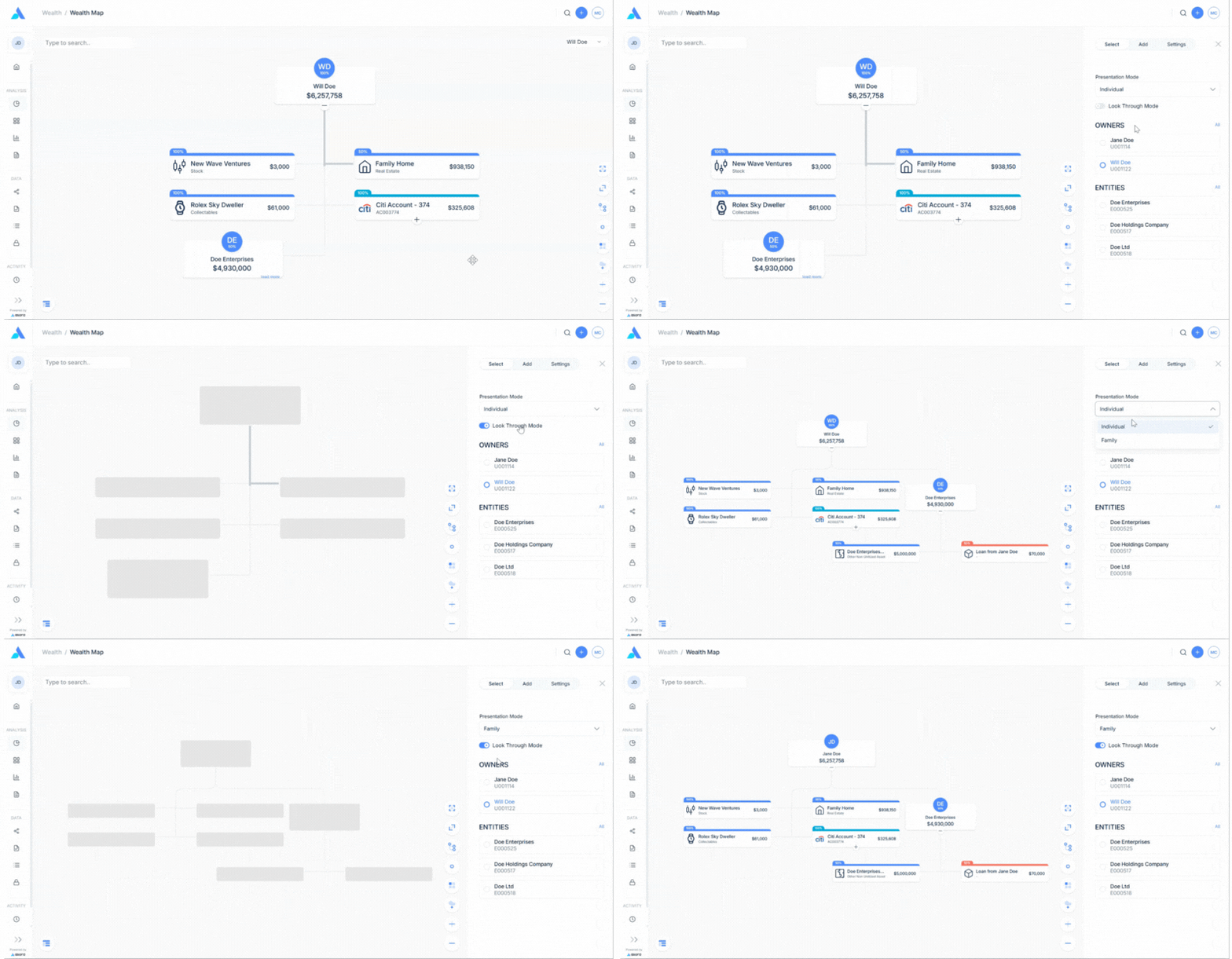
Asora approach: Asora’s Wealth Map visualizes ownership, showing how assets flow through entities to ultimate beneficial owners. Look-through views provide a consolidated picture of family wealth while preserving entity-level detail for governance and accounting. Create entity-specific reports to support external tax preparation, plus consolidated family views. (Reporting and exports only; tax filing is handled by your advisors.)
Asset Vantage approach: Asset Vantage emphasises a central system of record with an integrated general ledger and partnership accounting. It supports multi-level ownership allocations and look-through to ultimate beneficial owners, but its public materials do not explicitly indicate a visual ownership-map feature.
It provides the accounting depth that follows GAAP or other frameworks. This supports CPAs and business management firms serving family offices that require rigorous entity-level accounting tied to consolidated reporting, including routine financial tasks such as reconciliations and entity-level closes.
Key difference: Asora provides a visual Wealth Map to clarify ownership and consolidated reporting to support informed family decision-making. Asset Vantage provides accounting-first infrastructure with an integrated general ledger and partnership accounting for families that need, or whose advisors require, formal accounting at each entity level. Both support complex ownership; Asora focuses on visual clarity and roll-ups, while Asset Vantage focuses on accounting-grade entity records.
4. Reporting for Principals and Advisors
Your principal wants fast clarity via mobile: current net worth, how it changed this month, and upcoming capital calls. Your operations team needs analytics to answer detailed questions. External wealth advisors want exports they can incorporate into their analysis.
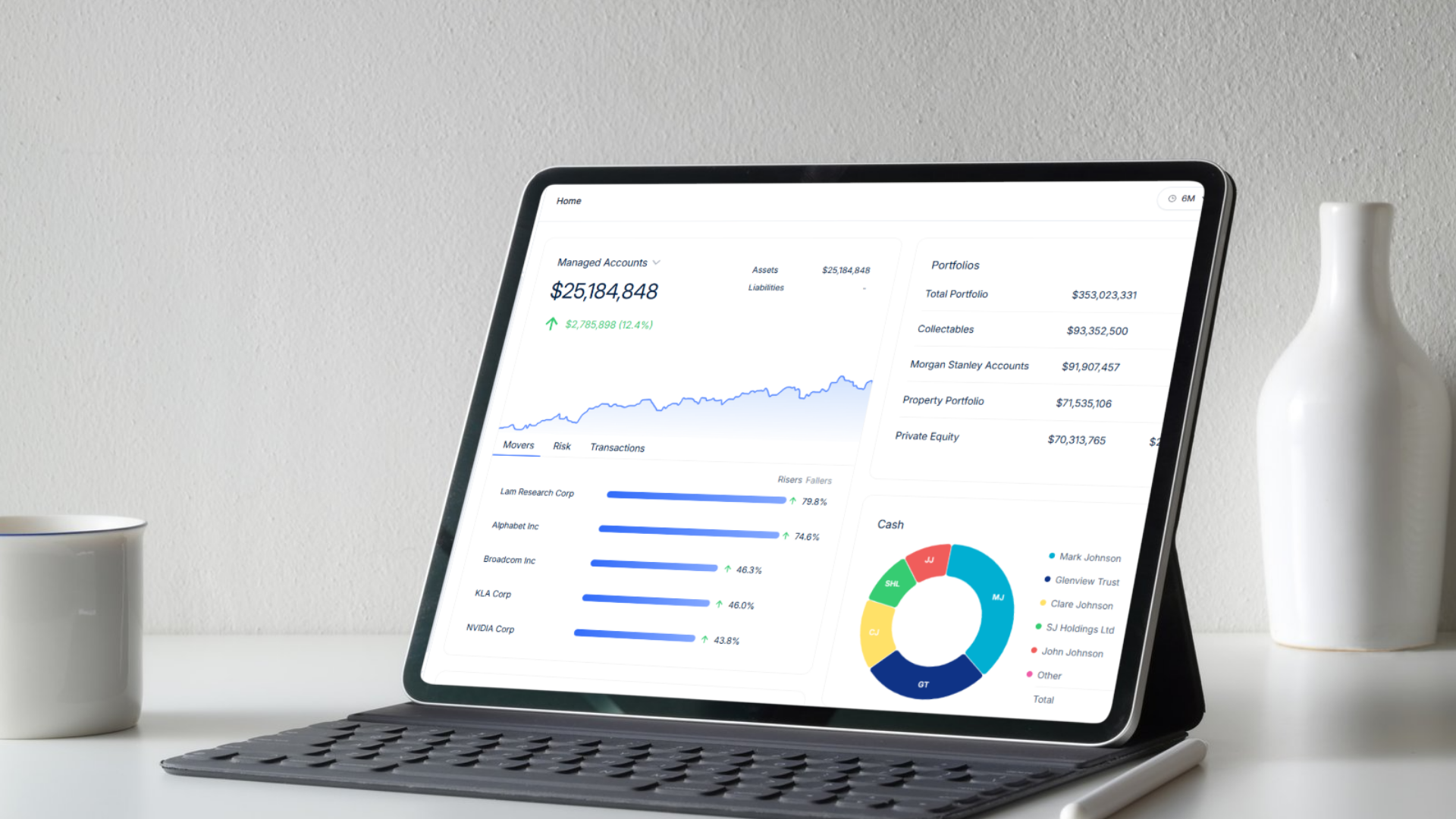
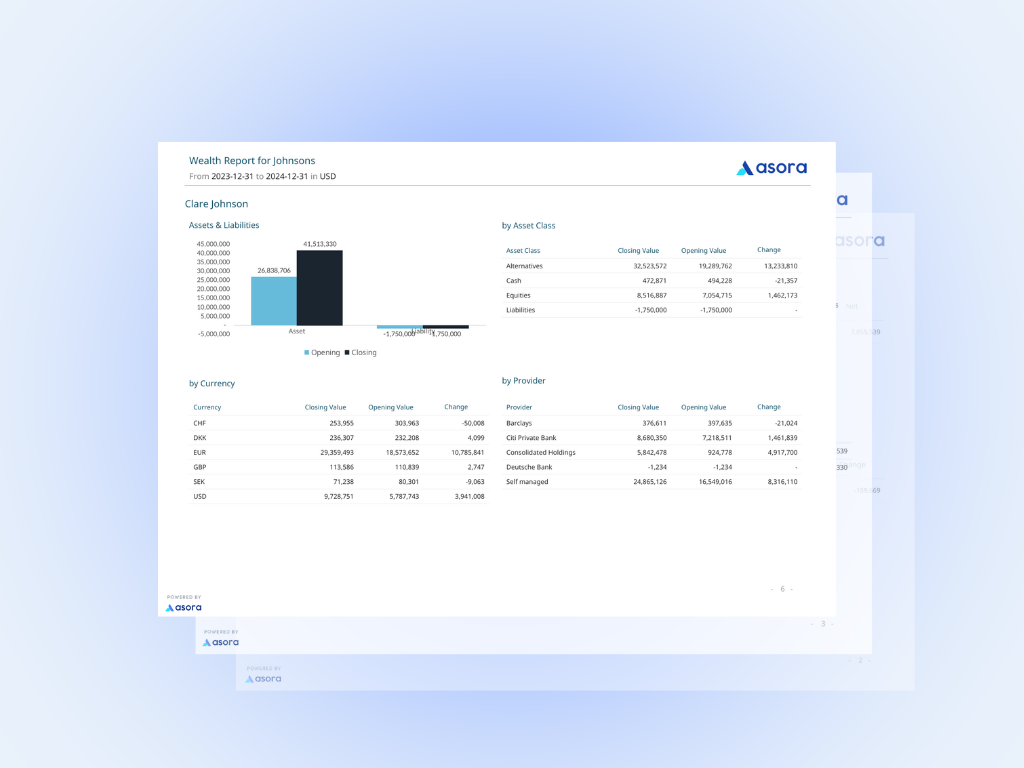
Asora approach: Principal-friendly dashboards surface what matters first: net worth, asset allocation, and recent changes, so each stakeholder sees the right level of detail:
- Principals: simplified, summary views
- Investment committees: detailed performance analytics
- Advisors: tailored data cuts for their remit
Asset Vantage approach: Asset Vantage highlights automated reporting and comprehensive portfolio performance reporting. Their platform offers drill-down analytics across all asset classes, with a focus on allocator-friendly formats. The AV Pro mobile app delivers an interface suitable for portfolio managers and allocators managing multiple relationships. Reporting integrates with their accounting processes to provide consolidated reports that tie out to the GL.
Key difference: Asora optimizes for principal accessibility and fast decision-making with a mobile-first design and deep reporting across entity and consolidated views, alternatives (commitments, valuations, capital calls, distributions), and performance metrics such as IRR and TWR. Asset Vantage provides comprehensive reporting tied to accounting records with an integrated general ledger and partnership accounting, emphasising depth and integration for firms serving multiple family office clients or needing auditor-ready financials.
5. Workflows & Documents
You need task management for monthly closes, capital call approvals, and deal pipeline tracking. Documents (LP agreements, appraisals, tax forms) should be secure, searchable, and linked to the holdings they support.
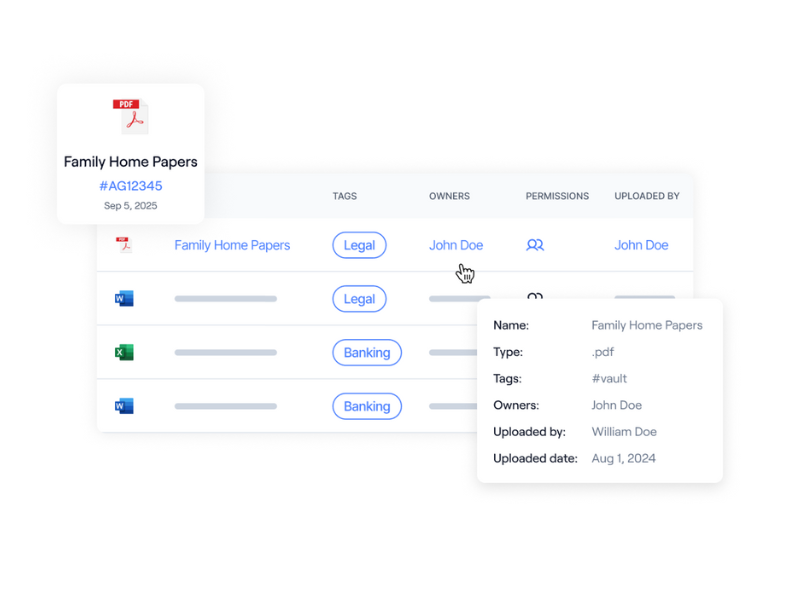
Asora approach: Workflows are built into the platform, allowing you to assign tasks, set deadlines, and track deals through customizable pipeline stages, from initial screening to close. Document management offers secure storage with role-based permissions, allowing users to view a document only if they have access to the linked account, asset, owner, or entity. Custom tags make the document vault easy to search.
Asset Vantage approach: Asset Vantage emphasizes collaboration and document sharing as integral components of its platform. Their document vault provides user access controls, allows remote service providers to access documents with appropriate permissions, facilitates easy tagging of documents, and maintains an audit trail and history for documents. This supports the operational efficiency needs of CPAs and business management firms managing documents across multiple client relationships.
Key difference: Asora integrates workflows and documents directly with portfolio holdings and reporting, treating them as operational infrastructure for portfolio oversight. Asset Vantage provides a secure document vault with role-based access controls, document tagging, and a full audit trail and history for documents. The platform supports collaboration with external service providers by granting controlled access to documents, and integrates document management with operational processes such as approvals and bill pay.
6. Onboarding Speed, Service, and Adoption
With a small team, you can’t spend six months on implementation or pull the CFO off real work. Go live fast, then add value step by step.
Asora approach: Implementation is typically measured in weeks. Onboarding prioritizes getting core functionality live fast: connect your major custodians, map your entity structure, set up baseline reporting, then expand. The product is clean and easy to use, with a mobile-first, principle-friendly UX that keeps complexity out of the way. The team understands SFO operations and provides role-based training for principals, staff, and advisors. Time to value is the priority, so you get operational quickly while maintaining quality.
Asset Vantage approach: Asset Vantage emphasizes modern UX design that should improve adoption. Their platform’s sophistication means implementation scope and timeline vary with depth, for example, activating consolidated reporting only versus implementing full general ledger and partnership accounting.
Asset Vantage notes that pricing and onboarding are discussed during demo conversations, with tiers shown publicly and customised quotes for firms serving multiple clients. They outline a three-step onboarding program and provide dedicated training and support, with timing dependent on scope and data complexity.
Key difference: Asora prioritizes rapid deployment for lean teams. Asset Vantage offers comprehensive functionality, and the depth of implementation varies with what you activate. Teams that turn on consolidated reporting only will typically have a lighter setup than those implementing the full general ledger, partnership accounting, and AP/bill-pay workflows, where timelines depend on entity count, history to load, and reconciliation needs.
7. Mobile Experience
Your principal travels constantly and makes investment decisions from airports, between meetings, and while on vacation. They require secure mobile access to review cash flows, check performance, approve capital calls, and retrieve documents when advisors request them.
Asora approach: iOS and Android apps provide role-based access to dashboards and data. Principals see a consolidated view with the ability to drill into entity or holding detail. MFA secures access. The mobile experience focuses on review and visibility, such as checking portfolio status, viewing performance, and accessing documents, rather than executing transactions. This reflects how family members use mobile devices: to stay informed and make strategic decisions, rather than to trade securities or initiate wire transfers.
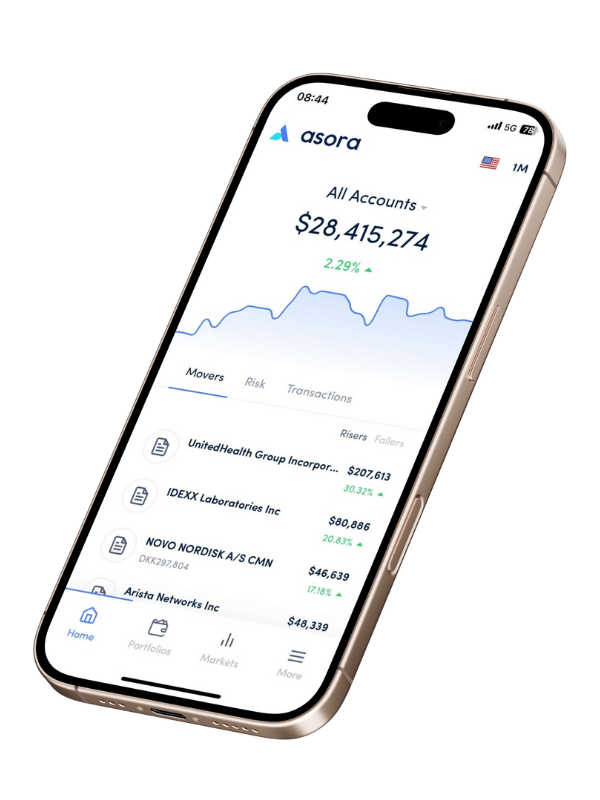
Asset Vantage approach: The AV Pro mobile app delivers functionality suitable for allocators and portfolio managers, providing access to portfolio performance, holdings across all asset classes, and reporting. The mobile interface supports the needs of wealth managers and asset managers who manage multiple client relationships and require comprehensive data access while on the go.
Key difference: Both platforms offer high-level views with drill-down in their mobile apps. Asora’s mobile app is described as “built for wealth owners,” providing secure access to portfolio, documents, and insights for principals and families. Asset Vantage’s AV PRO mobile app provides a 360° view of family wealth with portfolio access and key analytics for families and their advisors.
8. Pricing and Total Cost to Operate
You want predictable spend that scales reasonably as your portfolio grows, without surprises or complex pricing based on assets under management. You also want to minimize internal operational effort and the "hidden cost" of systems that require constant feeding and maintenance.
Asora approach: Transparent pricing aligned to single family office scale and structure. The model is designed for lean teams, with clear tiers based on portfolio size that make costs predictable as the team grows. No hidden fees for additional users or basic integrations, with optional add-ons available for advanced needs and priced transparently. The goal is straightforward: you know exactly what you're paying and what you're getting by reading the pricing page.
Asset Vantage approach: Asset Vantage positions itself as a modern, integrated platform for families and allocators. Specific pricing is published for single-family offices, while firms serving multiple clients are directed to contact AV for a tailored quote reflecting the broader range of use cases and client structures they support. The platform bundles general ledger accounting, performance reporting, partnership accounting, data aggregation, document vault, bill pay, and mobile, presented as a single, integrated solution rather than separate feature sets.
Key difference: Asora publishes transparent pricing designed for single-family offices. Asset Vantage shows SFO pricing on its site and handles multi-client firms through customised quotes, reflecting a single, integrated platform that serves lean SFOs through to larger, fully staffed operations and MFOs.
9. Security and Privacy for Financial Data
You're managing sensitive family financial data. You require enterprise-grade security, including robust access controls, encryption, and audit capabilities, as well as compliance with relevant standards. This isn't negotiable.
Asora approach: Role-based user permissions control who sees what data. Encryption protects data in transit and at rest. Role-based permissions control access to data. Encryption protects data in transit and at rest. MFA secures both the mobile app and the document vault. Asora maintains ISO 27001 certification and GDPR compliance, demonstrating a systematic approach to security management. The security program includes regular penetration testing validates security posture. The platform is hosted on Microsoft Azure to leverage their security infrastructure.
Asset Vantage approach: Asset Vantage maintains SOC 2 Type 2 compliance, a rigorous security standard for service organizations. Their security and privacy practices cover data protection, access controls, and regulatory compliance requirements. The platform is hosted on AWS, utilizing Amazon's cloud security infrastructure.
Key difference: Both platforms implement robust security protocols appropriate for family office data. Asora hosts on Azure with ISO 27001 and GDPR certifications. Asset Vantage is hosted on AWS with SOC 2 Type 2 compliance. Both provide enterprise-grade security suitable for protecting sensitive financial data.
Real-World Outcomes
Family offices using Asora report specific operational improvements:
- Bardfour Family Office: Full wealth structure mapped and live in four weeks or less. The Wealth Map became central to their estate planning activities—visualizing who owns what through which entities makes restructuring conversations concrete rather than abstract. Instead of hunting through operating agreements and entity documents, they reference the visual structure showing ownership across their family's holding companies and trusts.
- Capstone Family Office: Reporting time dropped from days to under 10 minutes. What used to require compiling spreadsheets, updating valuations, and building PowerPoint presentations now generates content on demand from the platform. This speed enables faster, clearer principal decisions. Family members access dashboards via a mobile app to check their portfolio status, rather than waiting for formal reporting cycles to occur. The shift from periodic reporting to continuous access changed how the family engages with their wealth.
Decision: Asora or Asset Vantage
Ultimately, do you need a comprehensive accounting and general ledger system, or are you primarily focused on data aggregation, reporting, and operational workflows?
Asset Vantage fits family offices (or CPAs and business management firms serving family offices) that need integrated investment accounting with GL functionality, partnership accounting for complex entities, and operational tools like bill pay. If your structure requires rigorous entity-level accounting or you're building accounting processes that tie to formal financial statements, Asset Vantage's comprehensive accounting and reporting platform provides the depth you need.
Asora suits lean single-family offices that need data capture across custodians, a consolidated view of performance across liquid and alternative investments, ownership mapping with look-through to beneficial owners, principal-friendly reporting on web and mobile, and workflow support for day-to-day operations.
If your priority is getting data aggregation live, creating customisable reporting for family members and advisors, and enabling strategic decisions with up-to-date information, Asora delivers focused functionality.
High-leverage checks for your live demo:
- Reporting depth and speed: Can you generate the specific reports your principals and advisors need? How long does it take to produce reports? Can family members access current information via the mobile app between formal reporting cycles?
- Entity accounting approach: Does the platform provide the accounting depth you need? If you require accounting and integrated GL, verify that functionality. If you primarily need ownership mapping and performance reporting, ensure that these functions work.
- Mobile coverage: Test the mobile experience with your actual use case. Can your principal check what they need while traveling? Does it provide sufficient analytics or just high-level summaries?
- Private assets handling: Walk through how you'd track a private equity investment from commitment through calls and distributions to performance calculation. Verify that the platform supports your specific asset types and reporting needs across all asset classes.
- Onboarding timeline and resources: Get specific about implementation: How many weeks to go live with core functionality? What internal resources are required? What does phased rollout look like?
- Total cost to operate: Understand all-in pricing, including software, implementation, and ongoing support. Factor in the operational efficiency gained through automated processes versus manual handling in spreadsheets.
Request an Asora demo to learn how we can help you better manage your family office's wealth.
FAQ
What's the main difference between Asora vs Asset Vantage?
Lorem ipsum dolor sit amet, consectetur adipiscing elit. Suspendisse varius enim in eros elementum tristique. Duis cursus, mi quis viverra ornare, eros dolor interdum nulla, ut commodo diam libero vitae erat. Aenean faucibus nibh et justo cursus id rutrum lorem imperdiet. Nunc ut sem vitae risus tristique posuere.
Which platform is better for private equity and alternative investments?
Both platforms handle private equity and alternative investments, but with different emphases. Asora's private assets functionality tracks commitments, capital calls, distributions, and valuations, along with IRR/TWR performance calculations and look-through reporting across entities. Asset Vantage positions itself firmly in alternatives visibility, offering dedicated equity tracking, accounting for fund structures, and integration with its general ledger for entity-level accounting.
How do onboarding timelines compare between Asora and Asset Vantage?
Asora measures onboarding in weeks with phased rollout: connect custodians, map entities, establish reporting, then expand functionality incrementally. This serves lean teams that can't dedicate months to implementation. Asset Vantage has a three-step rollout for onboarding, covering system configuration, data processing and reconciliation, and report generation, with dedicated training and support.
Which platform has better mobile access for principals?
Both platforms provide high-level views with drill-down in their mobile apps. Asora’s mobile app is built for wealth owners and principals, offering a consolidated view of net worth and allocation, performance summaries, drill through to holdings, secure document access, and MFA. Asset Vantage’s AV PRO mobile app provides a consolidated wealth view with portfolio access and key analytics for families and their advisors, supporting both principals and professionals. The better fit depends on whether you prioritise a principal's first experience or an app that also serves advisor workflows.
How does pricing compare between Asora and Asset Vantage?
Asora offers transparent pricing aligned with the scale of single-family offices, featuring clear tiers based on portfolio size, ensuring predictable costs. No hidden fees for additional users or basic data aggregation connections. This straightforward approach suits lean teams that want to understand the total cost to operate up front. Asset Vantage employs consultative pricing that requires a demo conversation to discuss requirements and provide a quote. Published pricing is available on the website for single family offices, while firms serving multiple clients receive tailored proposals.


.png)

.jpg)
.png)
.png)
.jpg)
.png)

.png)

.png)
.png)
.jpg)

.jpg)
.jpg)
.png)




.jpg)
.jpg)


.png)
.jpg)
.jpg)
.jpg)
.jpg)
.jpg)
.jpg)
.jpg)

.png)
.webp)


.png)
.png)
.png)
.png)
.png)
.png)
.jpg)
.jpg)
.png)
.png)
.png)
.png)
.jpg)
.png)
.png)
.png)
.png)
.png)
.png)
.png)
.png)
.png)
.jpg)
.png)
.png)
.png)

.png)

.webp)