
.png)
TL;DR
The best wealth tracking app for a family office goes far beyond tracking net worth. Unlike retail net worth tracking or budgeting apps, family-office-grade wealth tracking software supports complex financial accounts, private investments, multi-entity structures, and document-driven reporting. This guide compares leading wealth tracking tools, explains what family office-grade tracking means, and shows how family offices can implement a wealth tracker in 45–90 days to gain a clear picture of their financial situation.
Why “Wealth Tracking” Means More For Family Offices
Before comparing the best wealth tracking apps, it’s important to clarify what “wealth tracking” actually means in a family office context. Many popular apps focus on personal finance or money management for individuals. Family offices, on the other hand, manage an entire financial life spanning entities, generations, and asset classes.
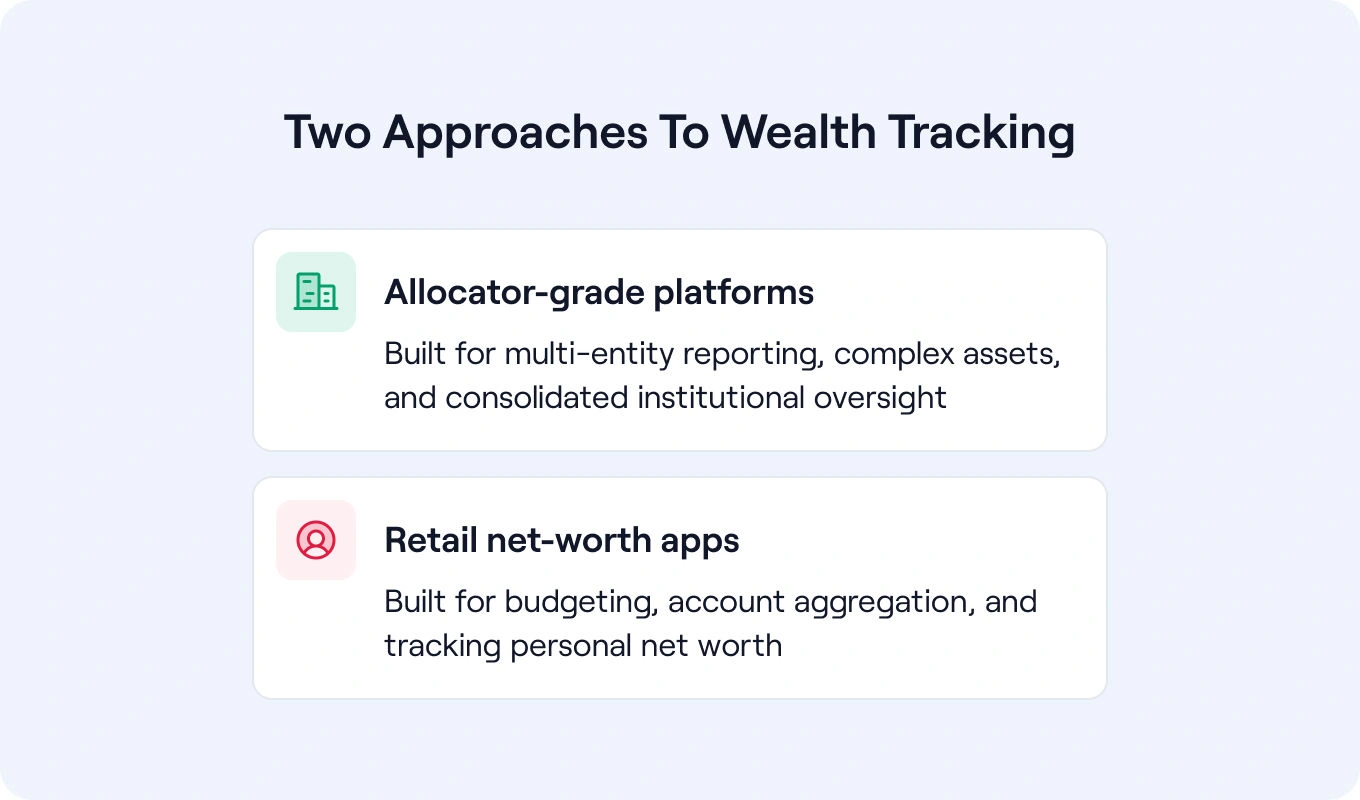
At a high level, wealth tracking tools fall into two categories: family office-grade platforms and retail net worth tracking apps, each serving a different purpose.
Family office-grade
Family office-grade wealth tracking software is built for complexity. It is designed for high-net-worth families and family offices that need a consolidated, reliable view across their entities, investments, and documents.
Rather than simply aggregating balances from bank accounts, these platforms focus on structuring financial information to support governance, reporting, and long-term decision-making. This broader shift reflects the wider benefits of using family office software, particularly when offices move beyond spreadsheets toward integrated, purpose-built platforms.
Typically, family office-grade systems support:
- Multi-entity structures, including trusts, limited liability companies (LLCs), and special purpose vehicles (SPVs)
- A wide range of assets and liabilities, from public investments to private equity, real estate, and operating companies
- Data ingestion that combines custodian feeds and APIs, statement imports, and administrator files for alternative investments, with normalization and reconciliation controls to maintain accuracy and reduce manual entry.
- Look-through reporting and asset allocation analysis where the underlying data is available
- Linked documentation such as financial statements (audited/reviewed where applicable), due diligence questionnaires (DDQs), side letters, K-1s/tax packs, and estate/tax planning documents
The result is more than a single dashboard; it becomes a structured reporting framework where performance, exposure, and governance metrics can be viewed in context.
Family offices gain a clear picture of their financial situation, investment performance, and exposure across a diverse portfolio. This supports informed financial decisions, improves coordination with financial professionals, and reduces reliance on time-consuming manual data consolidation and reconciliation in Microsoft Excel or Google Sheets.
Retail net-worth apps
Retail-focused net worth trackers and budgeting apps serve a different purpose. They are designed to help individuals manage day-to-day finances, track spending patterns, and monitor progress toward financial goals like retirement planning or financial independence. For individuals, using a wealth tracker app can simplify the process of monitoring financial health, calculating net worth, and making informed financial decisions about their banking, spending, saving, and long-term goals.
These apps generally offer tools that categorize spending, monitor cash flow, and support budgeting. Many wealth tracking apps include features that help users track progress toward financial goals, increase financial awareness, and optimize day-to-day financial behavior, such as:
- Aggregation of data from bank accounts, credit cards, and retirement accounts
- Budgeting tools and cash flow tracking by budget category
- Basic investment tracking and a visual net worth graph
- User-friendly interfaces built for quick setup and ongoing money management
There are many apps available for individuals who want to automatically track expenses, calculate their net worth, and monitor their overall financial health in one place. Calculating net worth regularly can help users gauge their financial situation and measure progress toward major financial goals such as retirement or financial independence. However, most of these apps are not built for multi-entity consolidation, complex ownership modeling, or audit-ready reporting.
For a family office managing substantial wealth, these entry-level tools may provide an additional layer of visibility for a principal, but they generally won’t serve as the office’s system of record for multi-entity, private asset, and governed reporting.
Top 10 Wealth Tracking Apps For Family Offices in 2026
With that distinction in mind, the list below highlights wealth tracker software commonly evaluated by family offices. Each platform approaches investment management, data aggregation, and reporting differently, so the best app to track wealth will depend on your structure, risk tolerance, and reporting needs.
1. Asora
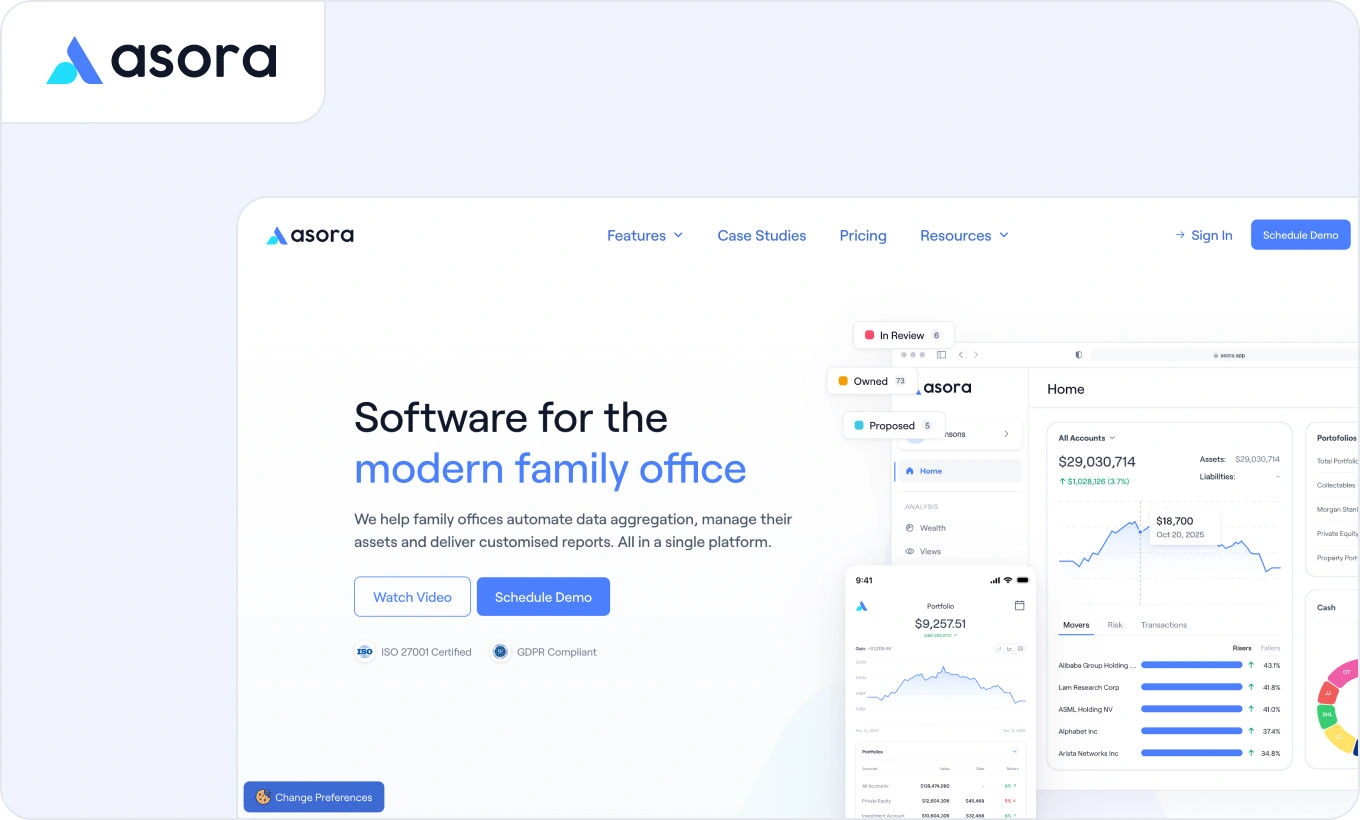
Asora is designed specifically as wealth tracking software for family offices seeking a structured, secure alternative to spreadsheets. It focuses on delivering a full picture across entities, investments, documents, and performance in a single platform.
Features
- Multi-entity tracking across trusts, SPVs, and operating entities
- Data aggregation from bank and custodian accounts
- Private asset registers with linked documents
- Investment performance reporting (TWR and IRR, where supported by cash-flow data)
- Asset allocation and exposure views across a diverse portfolio
- Multi-factor authentication and role-based permissions
Typical users
Single and multi-family offices, lean investment teams, and high-net-worth principals need clarity across complex wealth structures.
Pricing
Transparent, tiered pricing is available publicly. Plans are based on the number of entities, users, and overall data scope, making it easy for family offices to understand costs upfront and select the right configuration for their needs.
Pricing starts at $900 per month, billed annually, and gives access to all Asora features.
2. Masttro
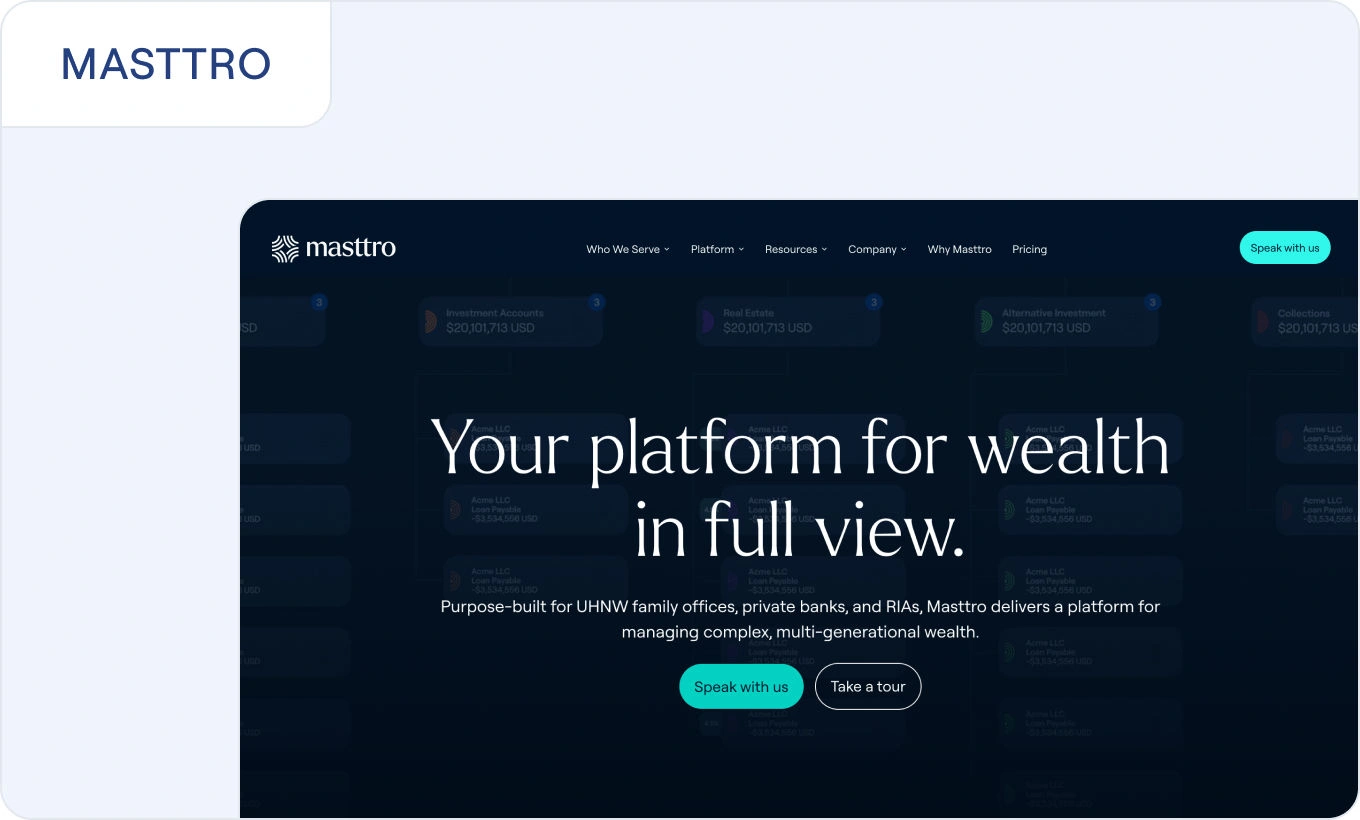
Masttro is positioned as a consolidated wealth tracker for complex family structures, with strong emphasis on net worth tracking and alternative investments.
Features
- Multi-entity consolidation
- Alternative asset tracking
- Customizable dashboards and reporting
- Document storage and sharing
Typical users
Larger family offices, UHNWIs, wealth managers, private banks
Pricing
Fixed pricing, not based on AUM. Contact vendor for pricing.
3. Private Wealth Systems
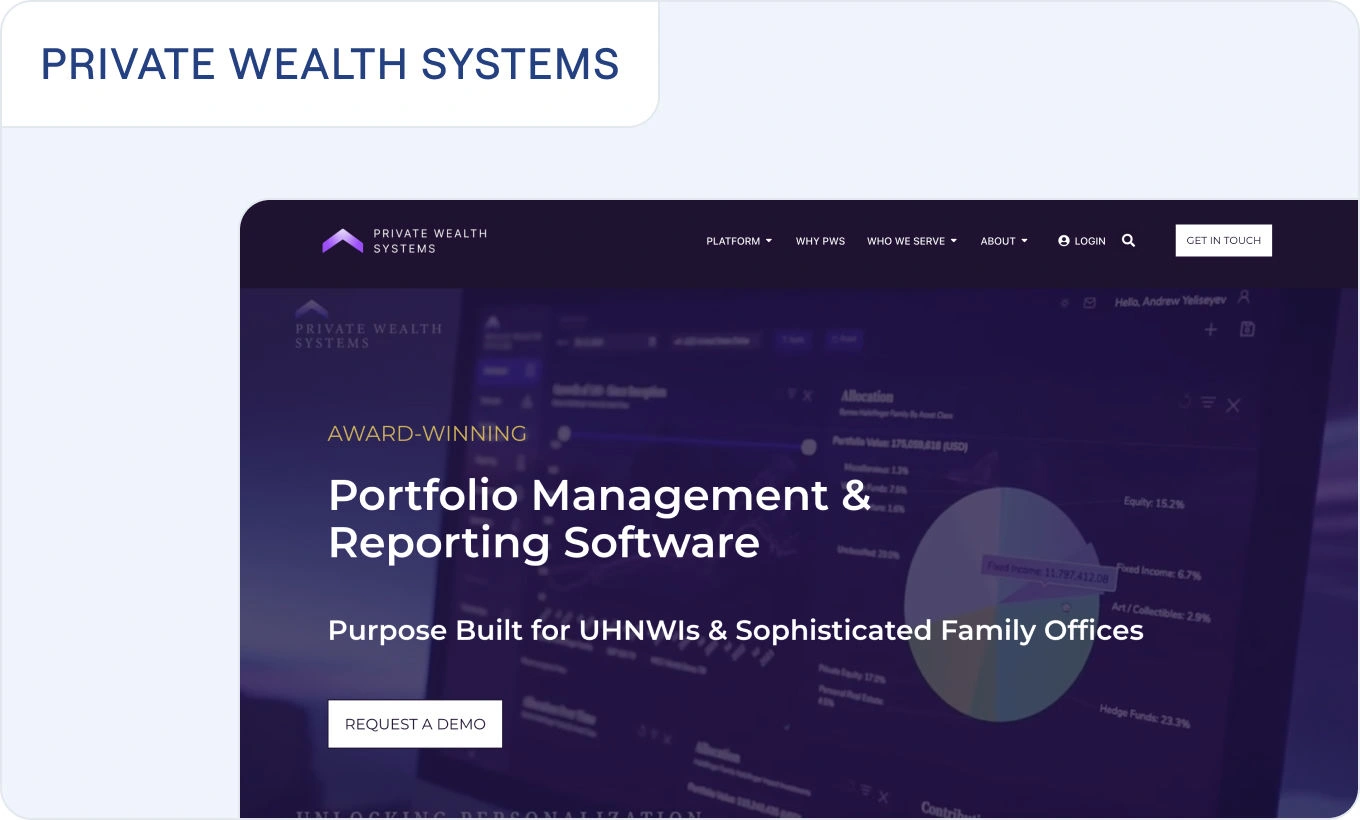
Private Wealth Systems focuses heavily on analytics and institutional-style investment management reporting. It is often selected by offices prioritizing granular investment performance insights.
Features
- Advanced performance measurement and benchmarking
- Detailed asset allocation and exposure analysis
- Aggregation from custodians and financial institutions
- Reporting for investment committees and boards
Typical users
Family offices with in-house investment expertise and performance-driven reporting requirements.
Pricing
Contact vendor for pricing.
4. Copia Wealth Studios
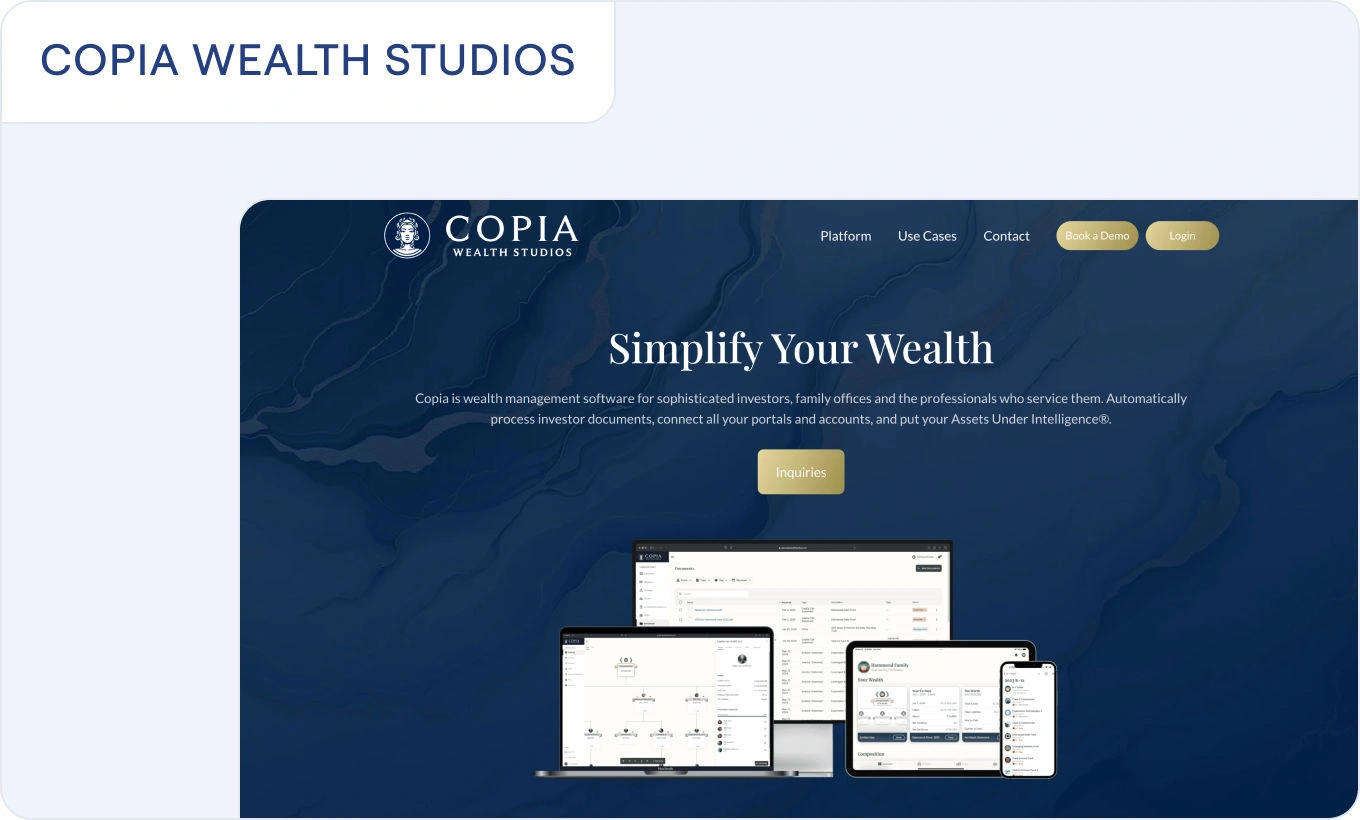
Copia provides wealth tracking tools focused on data normalization and performance measurement, helping teams move away from time-consuming spreadsheet processes.
Features
- Aggregation of bank and investment data
- Performance and exposure reporting
- Entity-level rollups
- Client and stakeholder reporting outputs
Typical users
Family offices and UHNWIs seeking streamlined net worth tracking and reporting.
Pricing
Contact vendor for pricing.
5. QPLIX

QPLIX offers modular wealth tracking software designed for sophisticated ownership structures and customized reporting needs.
Features
- Complex entity and ownership modeling
- Performance and risk reporting
- Consolidated assets and liabilities tracking
- Custom reporting modules
Typical users
Asset managers, family offices, and institutional investors
Pricing
Contact vendor for pricing
6. Landytech
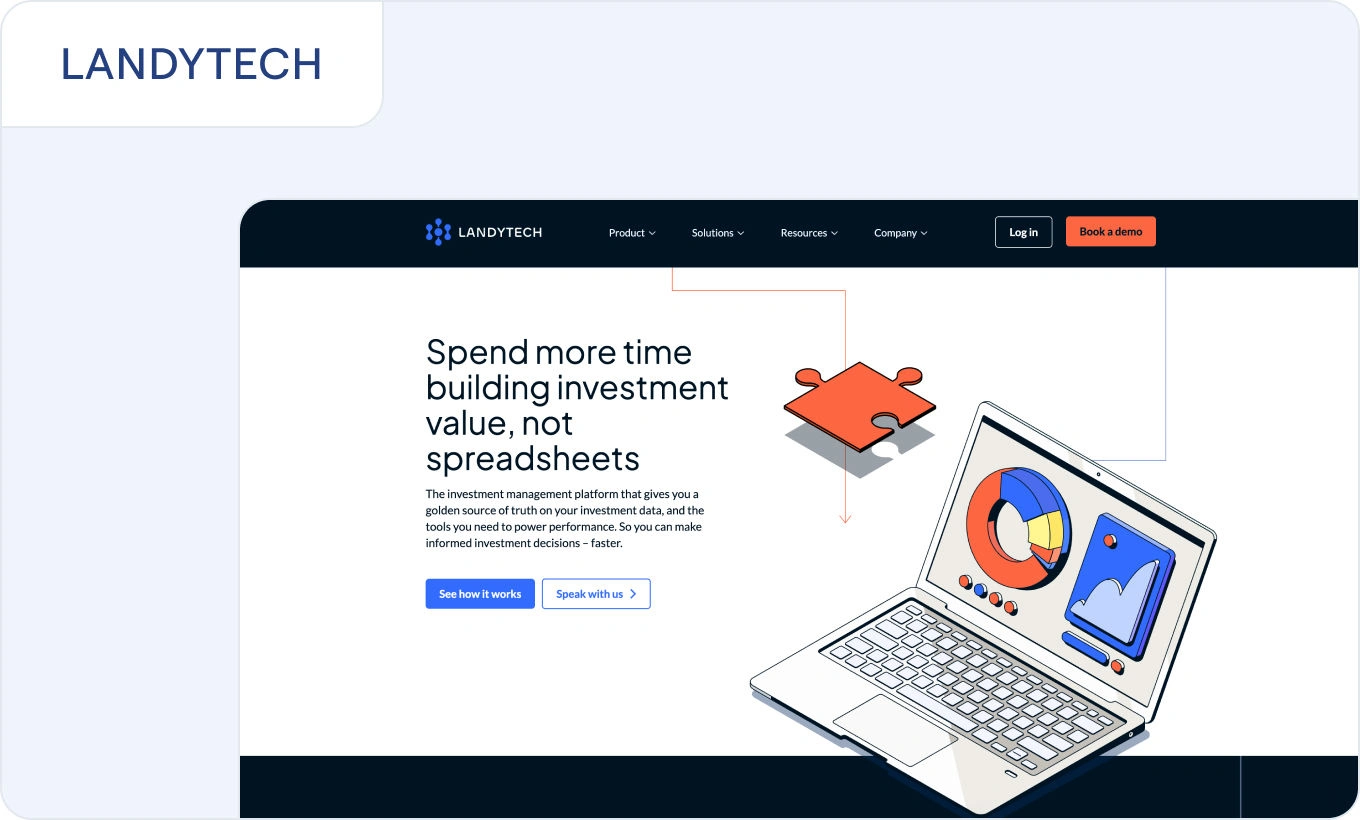
Landytech provides cloud-based wealth tracking software widely used for consolidated reporting and investment tracking.
Features
- Aggregation from multiple custodians and banks
- Performance analytics and benchmarking
- Net worth tracking across entities
- Reporting and sharing tools
Typical users
Asset owners, private banks, wealth managers, and family offices.
Pricing
Contact vendor for pricing
7. Dynamo
Dynamo is primarily an investment operations platform, often used alongside wealth tracking software to support private investment workflows and data management.
Features
- Private investment data management
- Workflow and CRM-style functionality
- Reporting tools for alternative investments
- Integration capabilities
Typical users
Family offices and private equity-style teams with significant alternative exposure.
Pricing
Contact vendor for pricing.
8. Asset Vantage
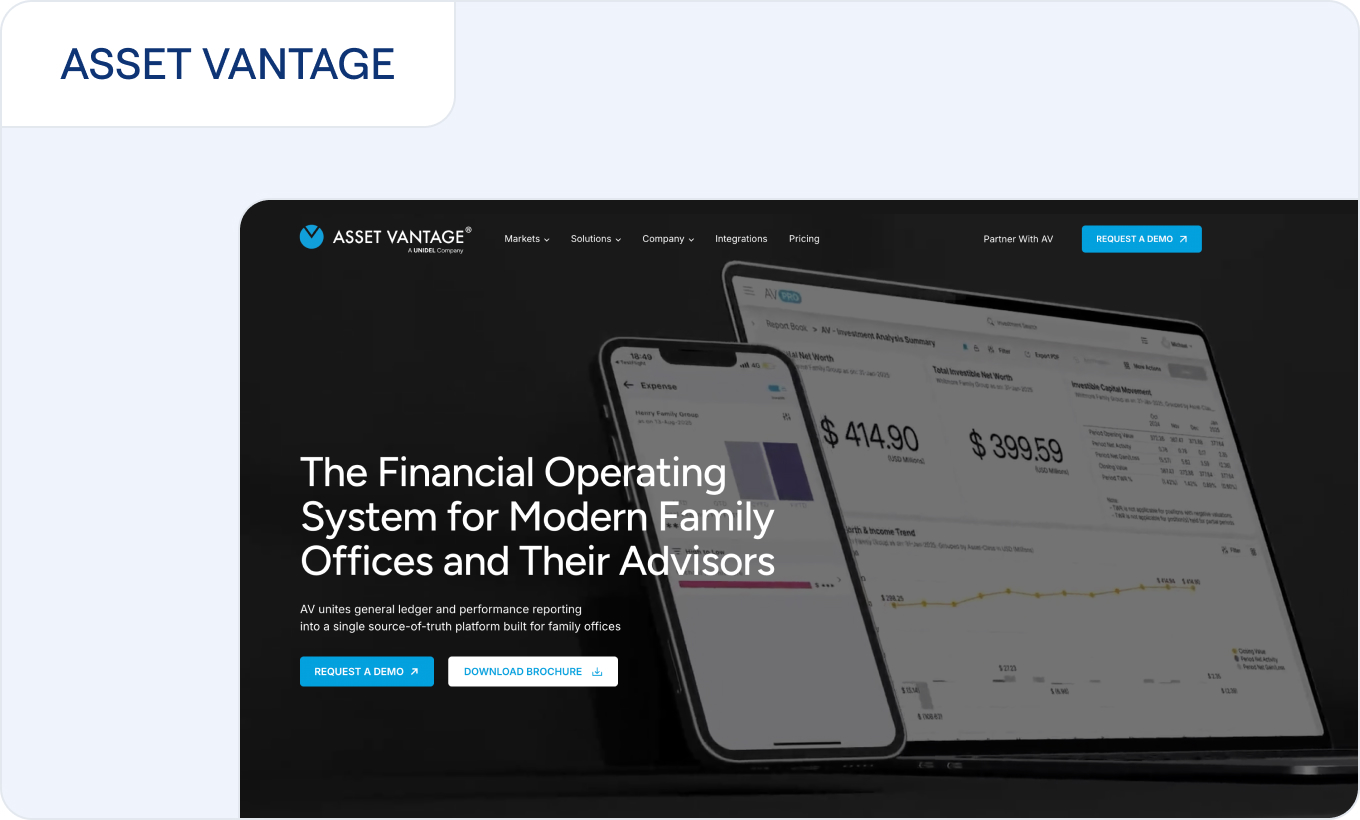
Asset Vantage is a long-standing wealth tracking platform offering accounting and reporting capabilities
Features
- Consolidated tracking of assets and total liabilities
- Entity-level reporting
- Performance and exposure analysis
- Document storage
Typical users
Mid-to-large family offices requiring detailed financial control and performance visibility in one system.
Pricing
Contact vendor for pricing.
9. Vyzer
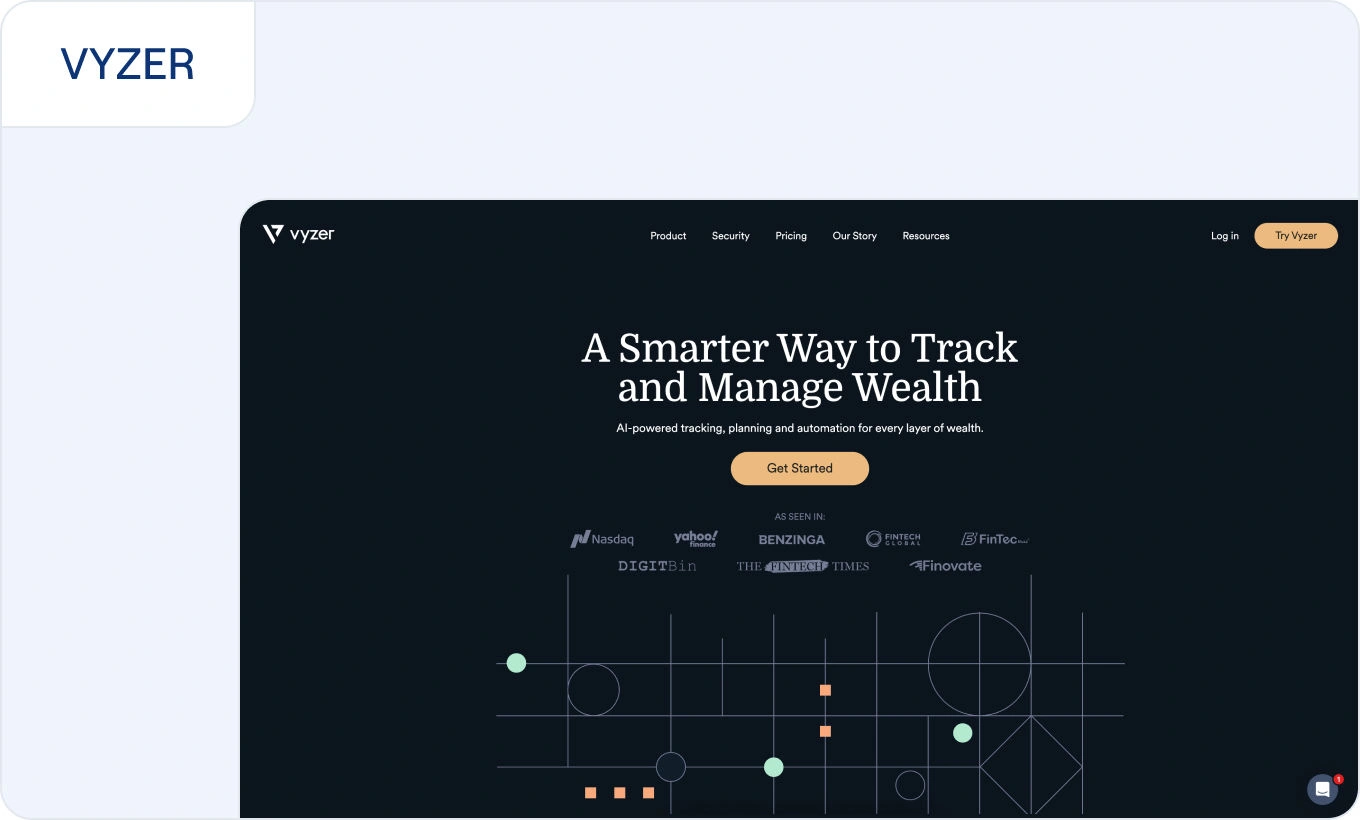
Vyzer is best positioned as a wealth tracker primarily built for individual investors, with some adoption among smaller family offices seeking a user-friendly overview of their investments. The platform focuses on providing consolidated visibility into financial accounts, alternative investments, and cash flow planning, with an interface designed for accessibility rather than deep institutional reporting.
Vyzer emphasizes portfolio tracking, net worth monitoring, and planning-style insights. While it can support multiple entities at a surface level, its capabilities are generally oriented toward delivering a simplified view of wealth rather than structured, family office-grade consolidation and governance workflows.
Features
- Net worth tracker with alternative asset visibility
- Investment tracking dashboards
- User-friendly interface for principals
Typical users
Individual investors and high-net-worth individuals seeking a simplified view.
Pricing
Vyzer offers a tiered set of plans catering to users across various stages of their wealth journey
10. Kubera
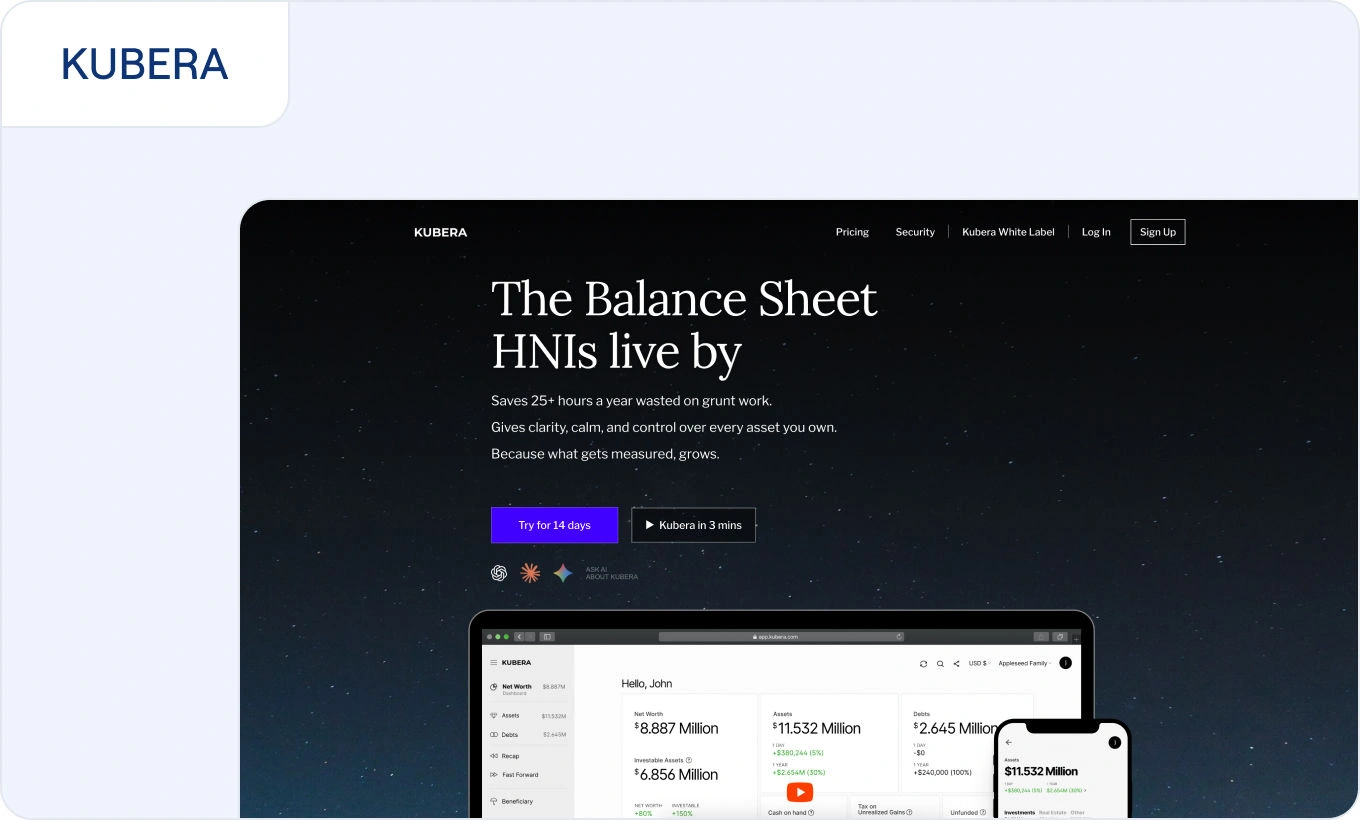
Kubera is a personal net worth and portfolio tracker app designed to consolidate bank accounts, investment accounts, crypto wallets, real estate, and other assets to deliver a picture of total wealth.
While not a full family-office platform, it may be useful for individuals or principals.
Features
- Aggregation of bank accounts, retirement accounts, and investments
- Visual net worth graph
- Basic document storage
- Clean, intuitive user interface
Typical users
Individuals and households focused on personal finances and tracking net worth.
Pricing
Kubera’s Essentials plan starts at $249 per year and includes all features except the premium additions. Kubera Black, their premium plan, is priced at $2499 a year and includes additional features such as nested portfolios and concierge onboarding. They also offer a business plan, Kubera White Label, with plans starting at $299 a year.
What a Family-Office-Grade Wealth Tracker Includes
Understanding what separates family office-grade wealth tracking software from consumer finance apps is essential before making a shortlist. While consumer tools focus on budgeting, tracking spending, and helping users hit personal money goals, family offices require systems that support complex governance, investment oversight, and institutional-level reporting.
At the family office level, it’s not enough to simply track spending or view a net worth graph. Users need to create a reliable system of record for assets, liabilities, performance, and documentation.
A family-office-grade wealth tracker should help teams move from fragmented data toward a structured, defensible view of their financial situation. That means supporting governance, reporting, and long-term investment management, not just aggregation.
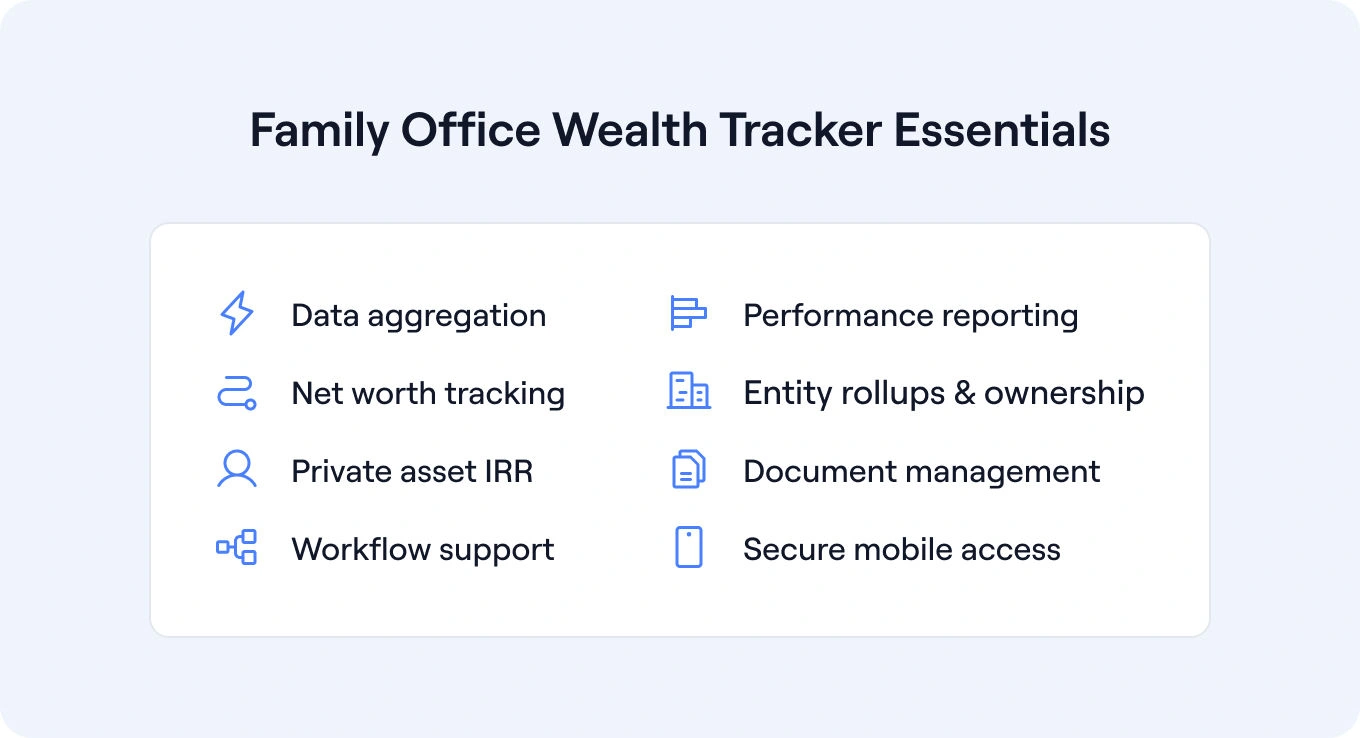
The most competitive wealth tracking apps for a family office typically include the following capabilities:
-
Data aggregation from banks and custodians with timely updates. This usually involves ingesting data from banks, custodians, and administrators, then mapping, cleansing, and standardizing it into a unified format.
-
Comprehensive net worth tracking across all assets and liabilities, including private investments, real estate, operating businesses, loans, and total liabilities, to provide a full picture in a single dashboard.
-
Investment performance reporting, including time-weighted return (TWR) at the portfolio level and internal rate of return (IRR) for private assets where cash-flow data supports it.
-
Entity-level rollups and ownership views, enabling consolidation across trusts, SPVs, and operating entities without requiring full general ledger accounting unless explicitly supported.
-
Private asset tracking, allowing teams to record commitments, capital calls, distributions, and exposure across a diverse portfolio.
-
Document management with structured linking, so DDQs, side letters, tax planning files, and other key financial information are attached directly to the relevant assets or entities.
-
Workflow support, such as task tracking, key dates, and reminders, without complex embedded approval chains.
-
Mobile access with strong security controls, typically dashboards supported by multi-factor or two-factor authentication for an extra layer of protection.
Beyond features, implementation discipline also matters. A strong wealth tracker software platform should reduce time-consuming manual processes, limit duplicate data entry, and improve confidence in reporting outputs. For offices evaluating operational efficiency more broadly, this often goes hand in hand with decisions around outsourcing for family offices, particularly where reporting, accounting, or data management can be streamlined through external support.
When properly configured, it enables financial professionals and principals to see investment performance, asset allocation, and exposure clearly, supporting more informed financial decisions about the family’s financial future. Making informed financial decisions becomes significantly easier when progress is measured consistently, and financial data is structured in a way that supports long-term strategic planning.
Decision Criteria Before You Shortlist
Once you know what “good” looks like, the next step is choosing the right wealth tracking app for your family office.
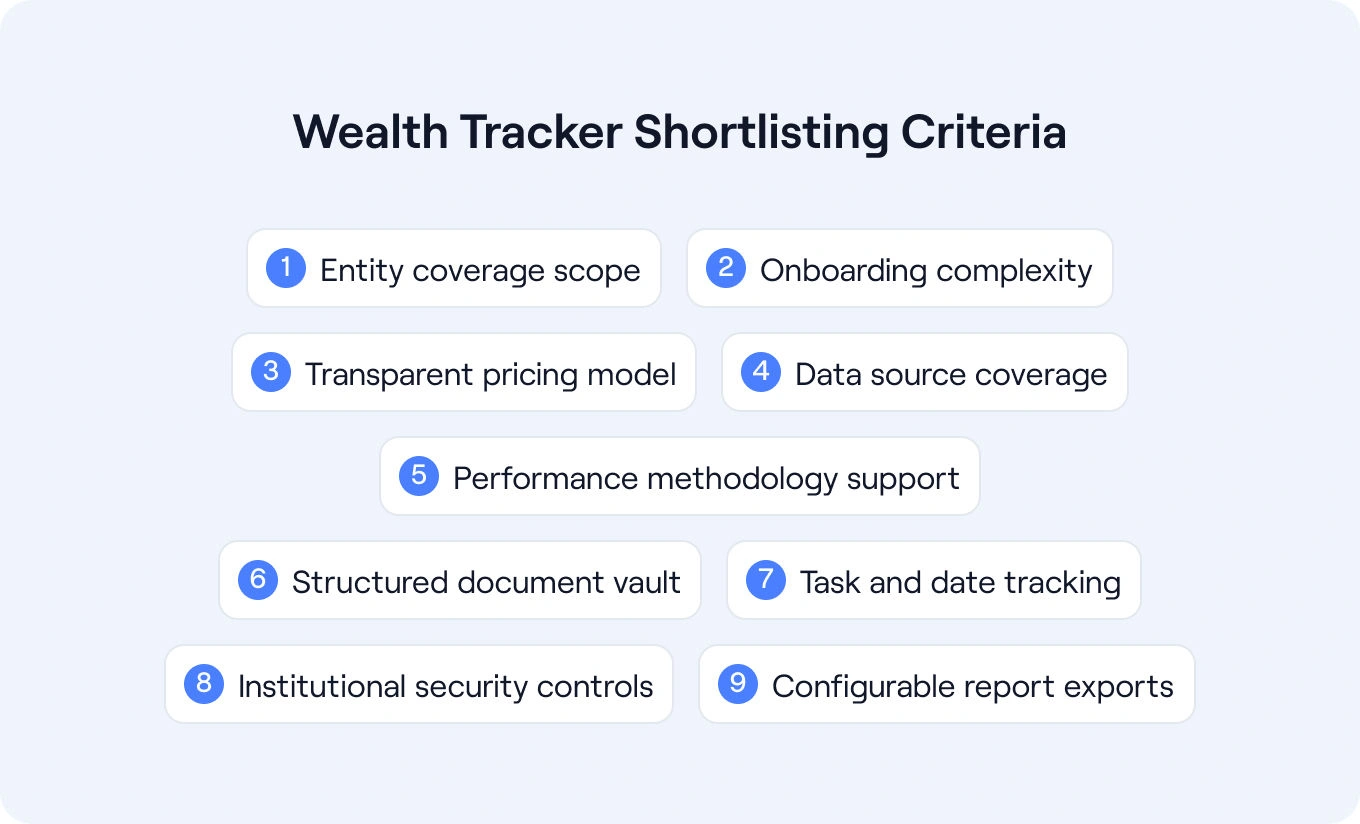
Key decision criteria include:
-
Coverage: Confirm that the platform supports all relevant entities, including trusts, retirement accounts, private funds, real estate holdings, and operating businesses, so you can consolidate the full scope of assets and liabilities in one system. This level of visibility is essential for effective consolidated reporting for family offices, particularly when multiple custodians, ownership structures, and private investments are involved.
-
Data & freshness: Understand which financial institutions and data sources are supported, how statement ingestion works, and how frequently balances and transactions are updated to maintain an accurate view of your financial accounts.
-
Performance: Evaluate whether the system provides portfolio-level TWR, IRR for private assets where cash-flow data is available, and policy benchmark comparisons to assess investment performance.
-
Documents: Let others send documents straight to the platform using secure, shareable upload links, no back-and-forth emails.
-
Workflows: Determine if the tool supports task tracking and key date reminders to help manage capital calls, reporting deadlines, and other recurring responsibilities.
-
Security: Review security controls such as multi-factor authentication (MFA), role-based access controls, device policies, and formal security certifications such as ISO 27001 or SOC 2. These standards provide additional assurance around how sensitive financial information is managed and protected
-
Exports & sharing: Check whether reporting outputs can be configured and securely shared with principals, financial professionals, advisors, and trustees in read-only or limited-access formats.
-
Implementation effort: Clarify the level of historical data required, the onboarding steps involved, and the amount of internal lift needed from your team during setup.
-
Pricing model: Examine how pricing is structured, including tiers, cost drivers (such as entities, users, or data feeds), what is included in each plan, and whether a free plan or trial is available. Like many retail wealth trackers, some plans are free, but advanced features will normally require a paid subscription.
Implementation in 6–12 weeks
Implementing wealth tracking software does not need to be disruptive if approached methodically.
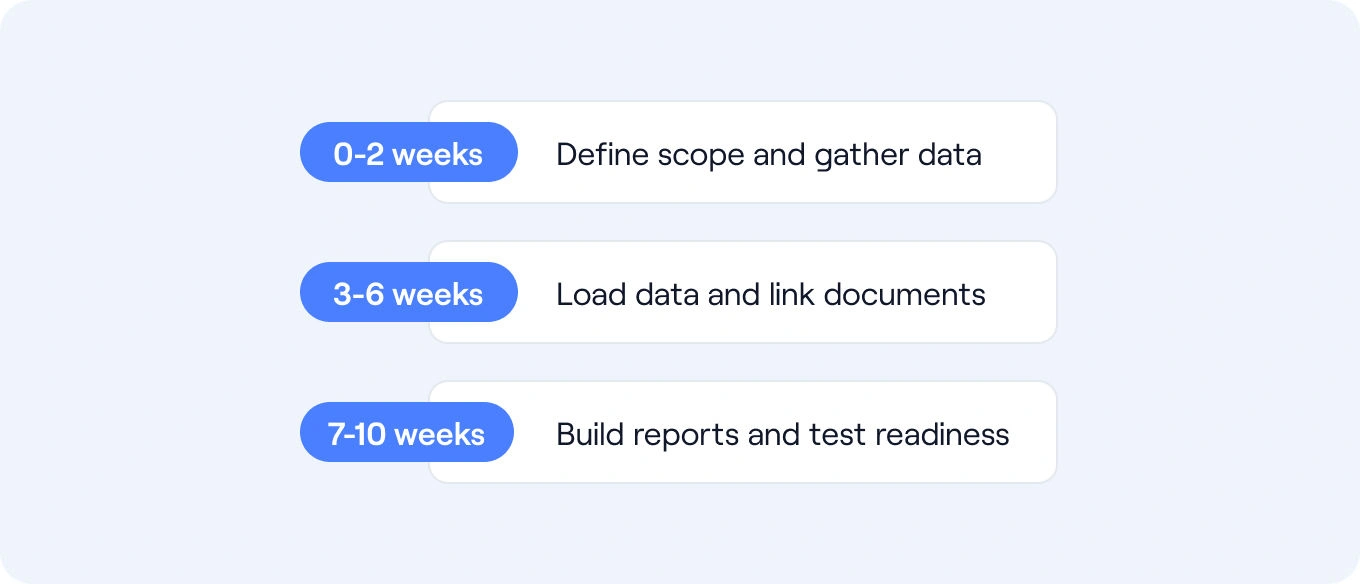
A typical implementation follows this timeline:
-
Weeks 0–2:
- Confirm entities, accounts, and financial information
- Inventory documents and define reporting priorities
- Select 12–36 months of historical data
-
Weeks 3–6:
- Load statements and establish automated balance and transaction feeds where available
- Map fee terms and benchmarks
- Link DDQs, side letters, and other important documents
-
Weeks 7–10:
- Build standard reports covering net worth, investment performance, and asset allocation
- Grant read-only access to stakeholders
- Dry-run quarter-end and board-style reporting
Security and governance checklist
Security and governance are essential when managing sensitive financial data.
A family-office-grade wealth tracker should support:
- Mandatory multi-factor authentication (MFA)
- Session controls and role-based access policies
- Compliance with relevant data protection regulations such as GDPR, where applicable
- Recognized security certifications such as ISO 27001 and/or SOC 2 to demonstrate independent controls and oversight
- Clear language around timely data updates (not real-time guarantees)
- Defined document ownership, data governance, and retention practices
Why Family Offices Must Choose the Best Wealth Tracking Software

Managing a modern family office means overseeing a financial life that spans bank accounts, retirement accounts, private investments, documents, and multi-entity structures, all while making informed financial decisions.
Yet despite advances in technology, operational inefficiencies remain common. According to the Campden Wealth Family Office Operational Excellence Report 2025, 42% of family offices cite reliance on spreadsheets as a frequent concern. Heavy dependence on tools like Excel for consolidated reporting and investment tracking can introduce errors, limit transparency, and slow critical decisions.
This reality highlights why choosing the best app to track wealth is about more than convenience. While many consumer platforms are marketed as the best apps for tracking wealth, most are designed for individuals managing personal finances, not for family offices overseeing complex ownership structures and institutional-grade reporting requirements.
The best wealth tracking software for family offices goes far beyond simple net worth or budgeting apps. It delivers a single source of truth across assets and liabilities, strengthening investment management, governance, and long-term strategic planning. More importantly, the best wealth tracker app for a family office ensures the software tracks net wealth across entities, investments, and financial accounts in a structured, reliable framework.
Unlike retail tools or disconnected spreadsheets, family office-grade platforms provide:
- Integrated performance reporting and asset allocation views
- Structured document linking and financial account consolidation
- Secure access controls and stronger protections for sensitive financial data
- Support for stakeholder reporting, multiple entities, and complex ownership structures
For family offices seeking to future-proof their operations and empower financial professionals, migrating from manual systems to a purpose-built wealth tracking platform is not simply about efficiency. It is about enabling better decision-making, stronger oversight, and long-term financial resilience.
Ready to experience a clearer, more organized approach to tracking wealth? Request a demo of Asora’s wealth tracking software and see how it can bring all your data, documents, and decisions together in one place.
FAQ
Can budgeting or net worth apps replace family office software?
No. While budgeting tools and net worth trackers are useful for personal finance, they lack support for private assets, complex ownership, and institutional reporting.
How long does it take to implement wealth tracking software?
Implementation timelines depend on complexity, data history, and reporting requirements. For many family offices, deployment can begin within approximately 6–12 weeks with proper planning and clearly defined reporting goals. More complex multi-entity structures, private asset portfolios, or extensive historical data requirements may take longer.
Do wealth tracking apps offer free plans or subscription options?
Some wealth tracking apps offer free plans with limited functionality, while others require a subscription to unlock advanced reporting, integrations, or additional tools. Retail apps often provide free versions to help users track their spending and manage retirement planning across linked accounts. In contrast, family-office-grade platforms typically operate on enterprise subscription models that reflect the complexity of tracking all your assets, entities, and investment structures in a secure, governed environment.
Can a budgeting app handle wealth tracking for a high-net-worth family?
A budgeting app can be useful for individuals who want to track their spending, monitor cash flow, and support retirement planning across linked accounts. Many of these apps include features such as spending categorization and new features designed to improve day-to-day money management. Some also offer additional tools to help users track their spending trends over time and gain visibility into all their assets in one dashboard. However, these apps are not built to consolidate multiple entities, manage complex ownership structures, or produce institutional-grade reporting.
.jpg)

 ISO 27001 Certified
 GDPR Compliant