
TL;DR
The best family office reporting software consolidates bank feeds, private assets, and multi-entity structures into one unified platform. Lean single family offices often look for solutions that aggregate data, link documents to assets, deliver customized reports, and calculate performance (TWR/IRR) without requiring expensive enterprise implementations.
Why Reporting Software Matters for Single & Multi-Family Offices
You started tracking your family office's wealth in spreadsheets because it seemed simple. One file for bank accounts, another for private equity commitments, a third for real estate holdings. But as your structure grew, adding trusts, holding companies, and cross-border entities, those spreadsheets turned into a maze of manual updates, version conflicts, and reconciliation headaches.
When quarterly reporting rolls around, your team spends days pulling data from custodian portals, chasing capital call notices, and matching transactions across entities. By the time the report lands, the numbers are already outdated.
That's the problem family office reporting software solves. Modern platforms automate data aggregation from banks and custodians, structure private asset tracking, link documents to holdings, and deliver consolidated reports that show what you own, who owns it, and how it's performing. The shift from spreadsheets to purpose-built software means moving from reactive month-end scrambles to proactive oversight backed by timely data.
This guide looks at modern family office reporting tools built for lean single-family offices.
What Family Office Reporting Software Covers
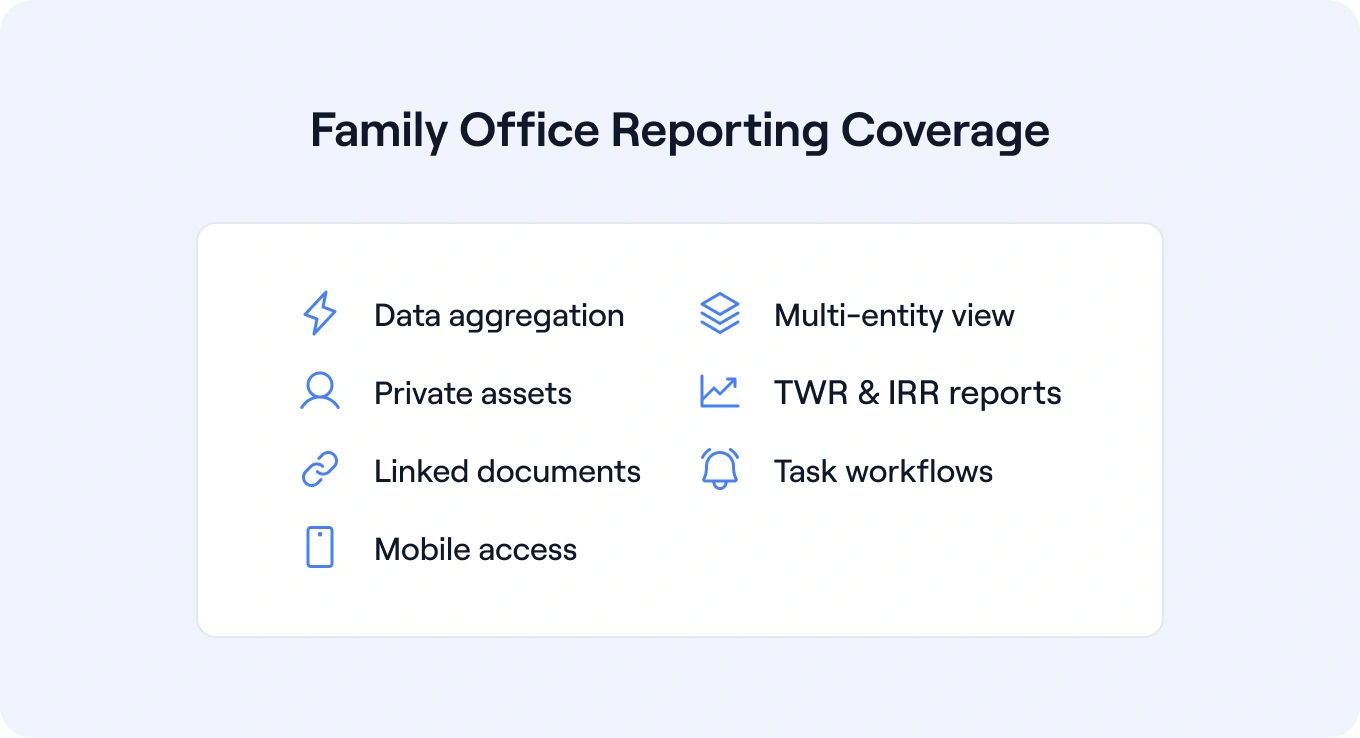
Family office reporting software is a centralized platform that aggregates wealth data, tracks performance, and produces consolidated reports across entities, asset classes, and currencies. It's purpose-built for the workflows family offices run: connecting bank and custodian feeds, capturing private asset data, financial performance monitoring, modeling ownership structures, generating customized reports, and providing timely insights for decision-making.
Scope includes:
- Data aggregation: Automated feeds from custodians, banks, and alternative investment platforms
- Multi-entity structures: Tracking assets held across individuals, trusts, holding companies, and partnerships
- Private assets: Manual or semi-automated capture of private equity, real estate, direct investments, and collectibles
- Performance reporting: Time-weighted returns (TWR), internal rate of return (IRR), and multi-period comparisons
- Document management: Linking statements, capital call notices, and legal docs to specific assets or entities
- Workflows: Task assignment, alerts for capital calls, and approval routing, where supported
- Mobile access: Secure portfolio views for principals and family members on iOS and Android, where available
What it is not:
- Tax preparation software
- Portfolio research terminals
- Generic general ledgers
- Accounting-only platforms that lack investment reporting
The outcome is a single live view of family wealth plus the ability to generate export-ready reports when needed, without rebuilding spreadsheets each quarter.
18 Best Family Office Reporting Software (2026)
This neutral buyer’s guide compares reporting platforms that unify banking, investments, and private assets into a single, clear view. Focus on the essentials: data aggregation, performance monitoring, accounting, private assets, documents, workflows, and mobile, then validate the fit for your structure and team.
1. Asora
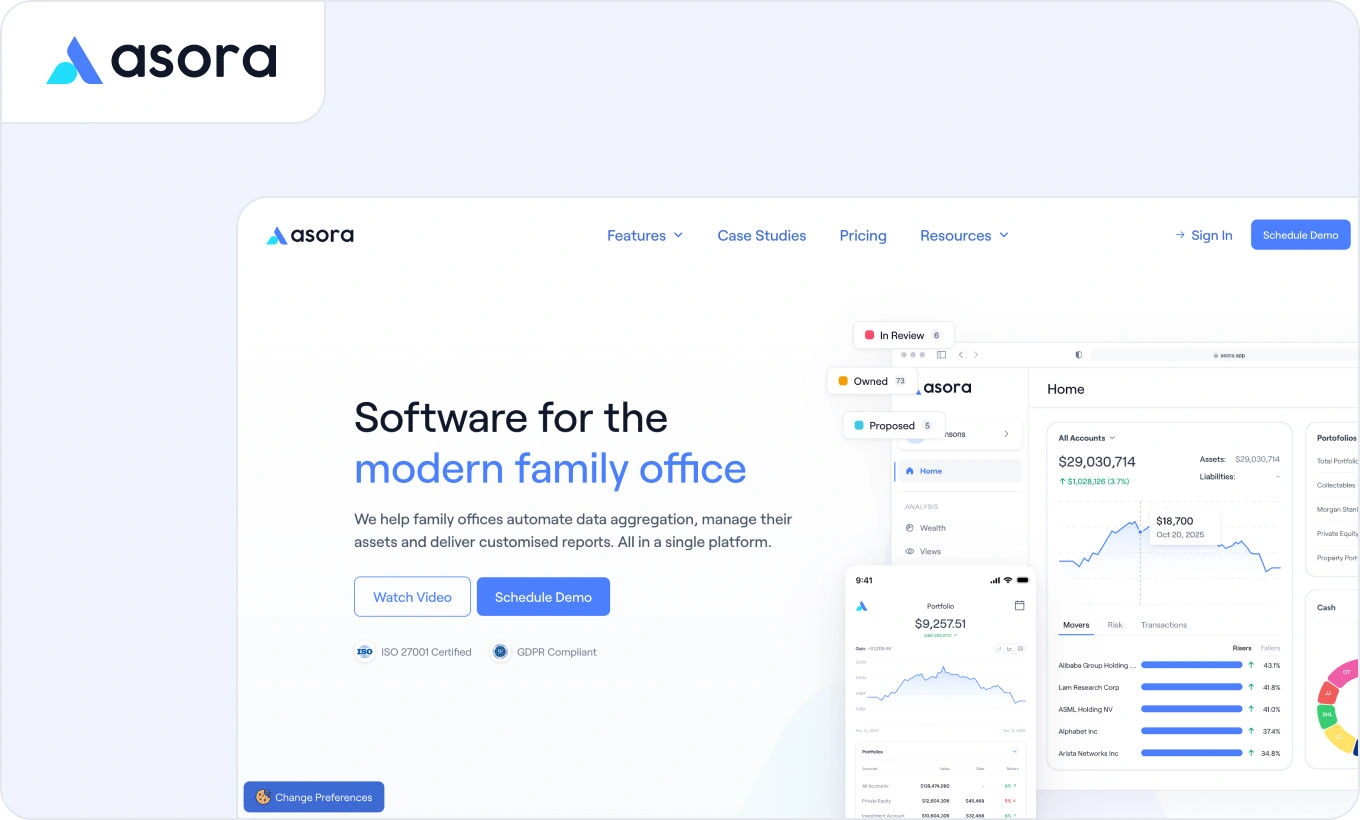
Asora is a family office software solution designed for single and multi-family offices managing $100M–$1B+ across 5–50 entities. The platform automates data aggregation from custodians and banks, tracks private assets, visualizes ownership structures via its Wealth Map, and delivers customized reporting for both liquid and illiquid portfolios.
Who it's for: Lean single family offices and UHNWIs seeking fast implementation, transparent pricing, and a unified platform for data aggregation, performance monitoring, and private asset tracking.
Core features:
- Data Aggregation: Automated feeds from banks and investment accounts; daily COB updates
- Wealth Map: Look-through ownership visualization across entities, accounts, and holdings
- Performance Monitoring: TWR for liquid assets; IRR and MOIC for private investments
- Private Assets: Manual entry templates; tracks committed capital, capital calls, and distributions
- Documents: Secure vault with tagging; link statements and docs to assets
- Accounting: Tranche-level cost basis; realized/unrealized gains tracking
- Workflows: Task management; pipeline tracking for deals under review
- Mobile: iOS and Android apps with MFA for portfolio access on the go
Deployment & integrations:
- Cloud-based (SaaS); ISO 27001 certified, GDPR compliant
- Integrates with Canoe Intelligence for automated alts document processing
- Typical implementation ≤4 weeks
Pricing:
- Tier-based starting at €800/month (~$900/month) for <€30M tracked; scales by asset size
- Includes all features, unlimited users, and 20 custodian connections
- See full pricing
Case study outcomes:
- Bardfour Family Office had its wealth structure mapped and live in ≤4 weeks
- Capstone Family Office reduced reporting time from days to under 10 minutes
- Omnia Capital Partners reduced files sent via email by over 50%
- Family Trust cut manual data gathering and reconciliation time by ~80%
2. Altoo
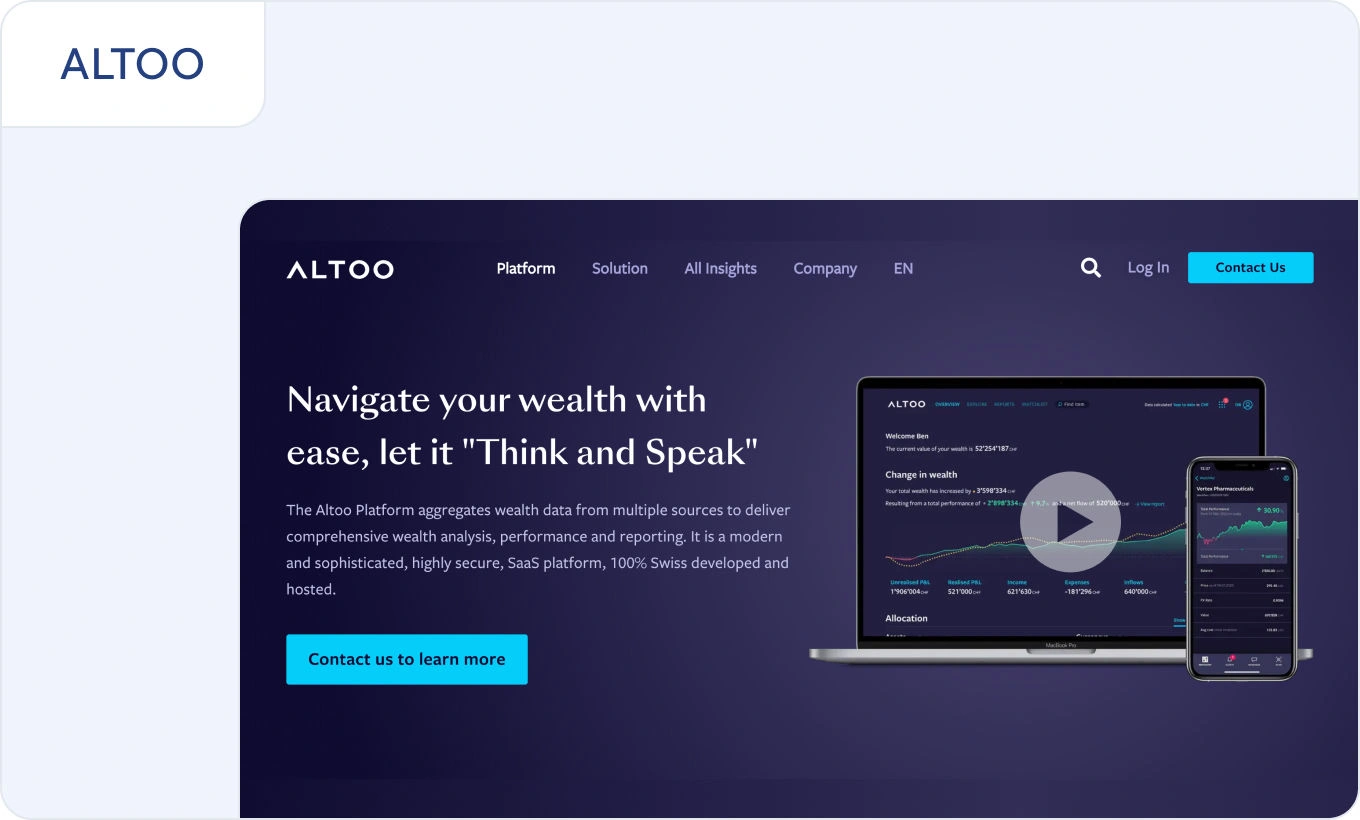
Altoo is a Swiss wealth management platform that aggregates bankable and non-bankable assets to deliver consolidated reporting and portfolio analysis. Developed and hosted in Switzerland, the platform emphasizes data accuracy, security, and intuitive design for ultra-high-net-worth individuals and family offices.
Who it's for: Ultra-high-net-worth individuals, single-family offices, multi-family offices, and private bankers seeking Swiss-hosted wealth aggregation with strong privacy standards.
Core features:
- Daily automated data aggregation for all asset types (bankable and non-bankable)
- Legal structure overview and cashflow analysis
- Consolidated reporting across entities, portfolios, managers, and currencies
- Secure file document storage
- Mobile app for portfolio monitoring and secure communication
Deployment & integrations:
- Cloud-based (SaaS); 100% Swiss-developed and hosted
- Connectivity to custodian banks depends on institutions
- GDPR compliant
Pricing:
- Pricing is based on complexity rather than on the asset volume. The complexity is determined by
- The number of custodian banks you need us to connect
- Whether you wish to input & maintain the data for non-bankable assets (such as real estate, art, and direct business investments) yourself or prefer to delegate this task to Altoo's skilled curators.
The annual software license is CHF 10'000 excl. the banking connections.
- 3. Black Diamond (SS&C)
The SS&C Black Diamond Wealth Platform is a cloud-native solution for family offices and RIAs that combines portfolio management, performance reporting, rebalancing, trading, and data aggregation. The platform offers customizable household reporting, alternative asset tracking, and an immersive client portal with connections to a vast ecosystem of integrations.
Who it's for: RIAs, single family offices, multi-family offices, and trusts needing comprehensive wealth management with integrated billing and operational tools.
Core features:
- Multi-channel data aggregation from custodians and alternative sources
- Customizable performance reporting
- Portfolio rebalancing and trade order management
- Alternative investment data aggregation
- Mobile support for agents and clients
Deployment & integrations:
- Cloud-based
- Integrates with MoneyGuidePro, Nitrogen, and RightCapital
- Typical implementation timeline varies by complexity
Pricing:
- Custom pricing based on requirements
- Contact the vendor for quotes
3. MSCI Private Capital Solutions (formerly Burgiss)
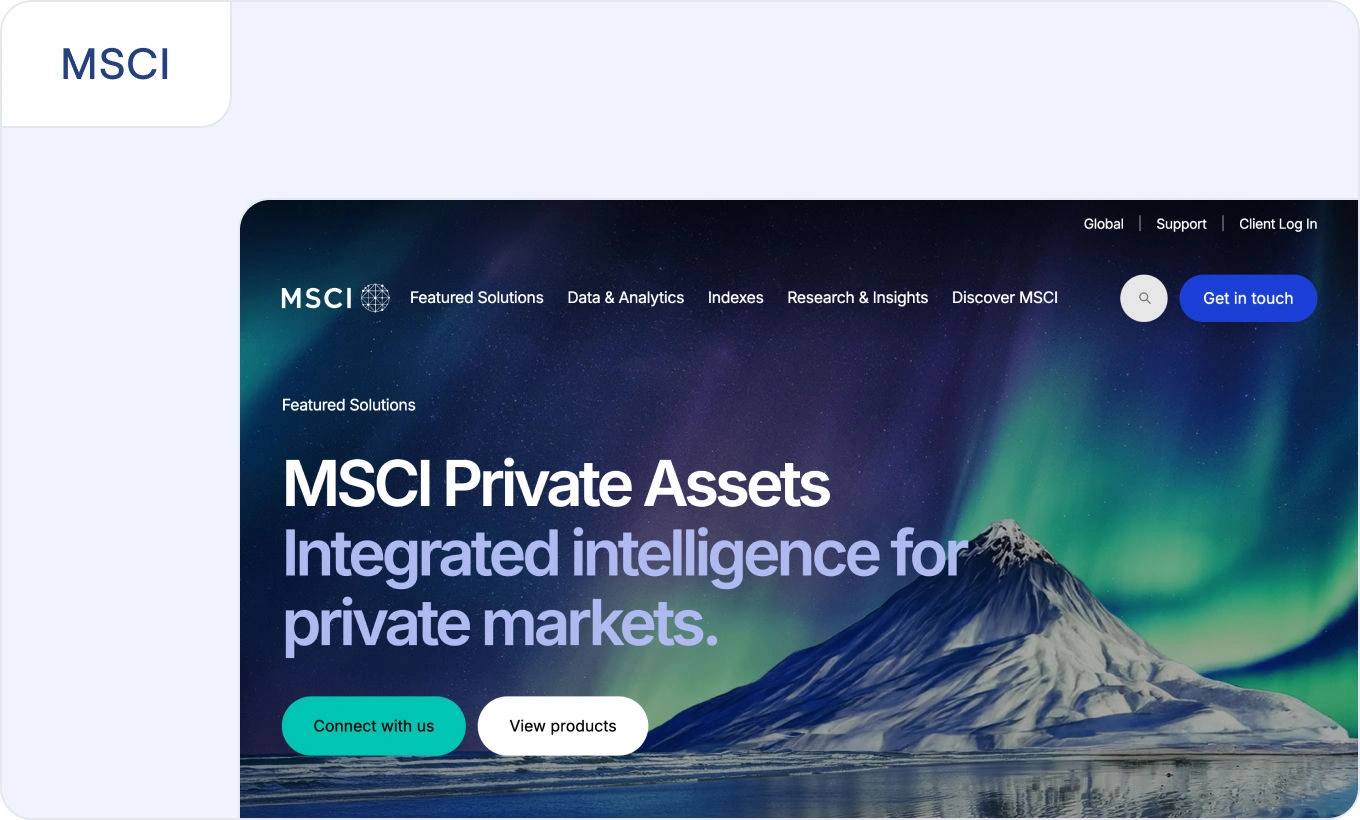
MSCI Private Capital Solutions is a private-assets data and analytics platform used by asset owners and managers for portfolio monitoring, benchmarking, and decision support across private equity, venture capital, and real estate.
Who it's for: Asset owners and managers, including family offices, seeking deep private-market analytics and peer benchmarking; MSCI also promotes a “Total Plan Manager for Family Offices” stack spanning public and private assets.
Core features:
- Private equity & venture capital performance analytics (e.g., IRR, benchmarking by vintage/region/strategy) backed by the Burgiss Manager Universe.
- Benchmarking against industry peers and research use in academia, leveraging LP-sourced cash-flow datasets.
- Cash-flow modelling and forecasting/use in reporting workflows (public descriptions emphasise modelling expectations and cash-flow-based analytics).
- Portfolio analysis, construction views and scenario-style comparisons (view by vintage, asset class, geography; decision-support analytics).
- Custom reporting for boards/investors, including delivery to third-party tools.
Deployment & integrations:
- Web-based/cloud delivery (Private i® described as a web platform).
- Aggregation from custodians, fund managers, administrators, designed to combine public and private holdings for family-office reporting.
- External integrations include a certified Bloomberg PORT Enterprise feed for custom private-asset reporting (incl. FIGI alignment).
Pricing:
- Pricing is not publicly listed; buyers are directed to contact the vendor.
4. Copia Wealth Studios
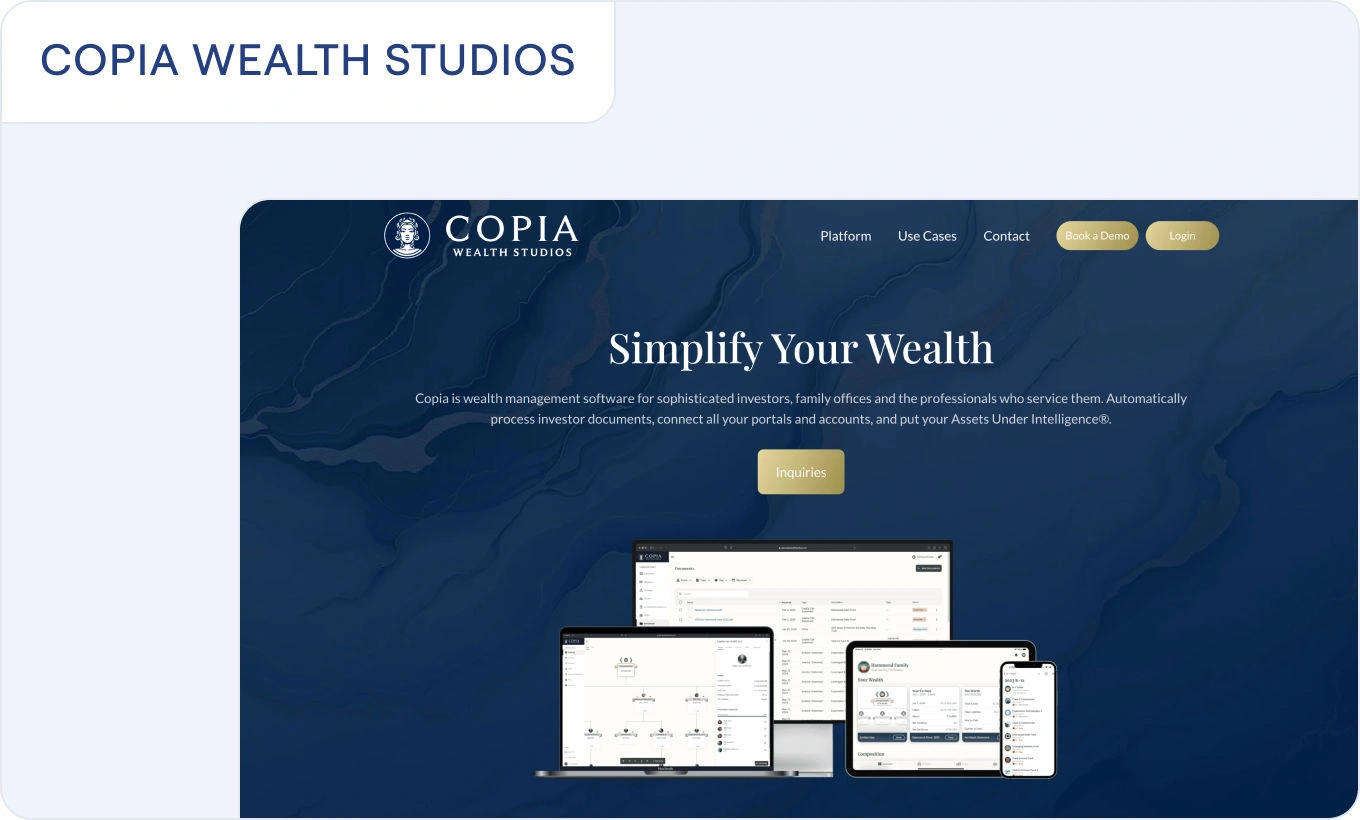
Copia Wealth Studios is an AI-powered wealth management platform that combines AI-powered document ingestion, portfolio aggregation, specialized planning tools, and operations automation. The platform serves sophisticated investors, family offices, multi-family offices, and institutions & RIAs.
Who it's for: Family offices and wealth professionals seeking mobile-first technology with AI-driven automation for document processing and planning workflows.
Core features:
- AI-powered document ingestion and processing
- Portfolio aggregation across asset classes
- Specialized planning tools
- Operations automation for routine workflows
- Mobile access-optimized interface
- Secure platform access to client portals
Deployment & integrations:
- Connects portals/accounts and automates document ingestion
- Implementation timelines are not publicly disclosed
Pricing:
- Contact the vendor for pricing
5. d1g1t

d1g1t is a cloud-native wealth management platform that modernizes user experience and visual analytics with streamlined workflows. The platform focuses on up-to-date interfaces and intuitive design as an alternative to traditional architecture.
Who it's for: Family offices seeking modern cloud-native architecture with emphasis on visual analytics and user experience.
Core features:
- Cloud-native platform architecture
- Modern user interface with visual analytics
- Streamlined workflow management
- Multi-asset portfolio tracking
- Customisable dashboards/client & advisor views
- Trading & rebalancing (differentiator vs. “reporting-only”)
- Billing (supports reporting + accounting narratives)
Deployment & integrations:
- Cloud-based
- Implementation details not publicly disclosed
Pricing:
- Contact the vendor for pricing
6. Dynamo
Dynamo provides CRM and investor relations software for private capital markets, including private equity, venture capital, and real estate firms. While primarily focused on GP workflows, the platform offers investor portal capabilities relevant to family offices as LPs.
Who it's for: Private equity and venture capital firms.
Core features:
- CRM for investor relationship management
- Deal flow tracking and pipeline management
- Capital call and distribution management
- Investor portal for LP communications
- Document management and secure sharing
- Fundraising campaign management
Deployment & integrations:
- Cloud-based; integrates with significant fund administration systems
- Implementation typically involves data migration and team training
Pricing:
- Contact vendor for pricing
7. Landytech
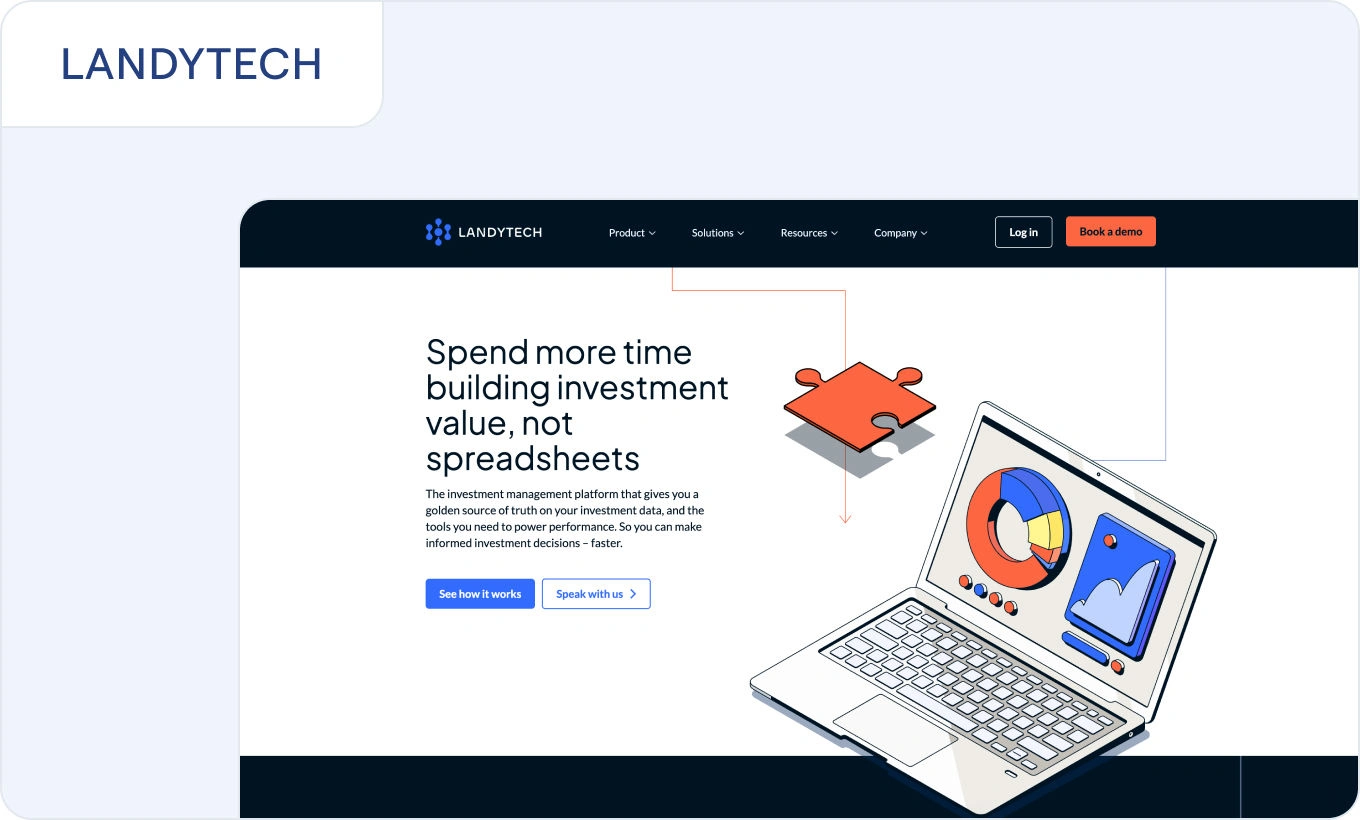
Landytech's Sesame platform helps family offices aggregate data and use analytics to make informed investment decisions. The UK-based company offers portfolio management, cashflow management, and reporting features designed for family offices managing complex wealth structures.
Who it's for: Family offices and wealth professionals requiring data aggregation and analytics for informed investment decision-making.
Core features:
- Automated data aggregation from multiple sources
- Portfolio management across asset classes
- Cashflow management and forecasting
- Custom reporting capabilities
- Look-through ownership structure visualization
- Private asset reporting
Deployment & integrations:
- Cloud-based; connects to 500+ custodians and offers client reporting/data APIs
- Implementation details not publicly disclosed
Pricing:
- Contact the vendor for pricing
8. Masttro
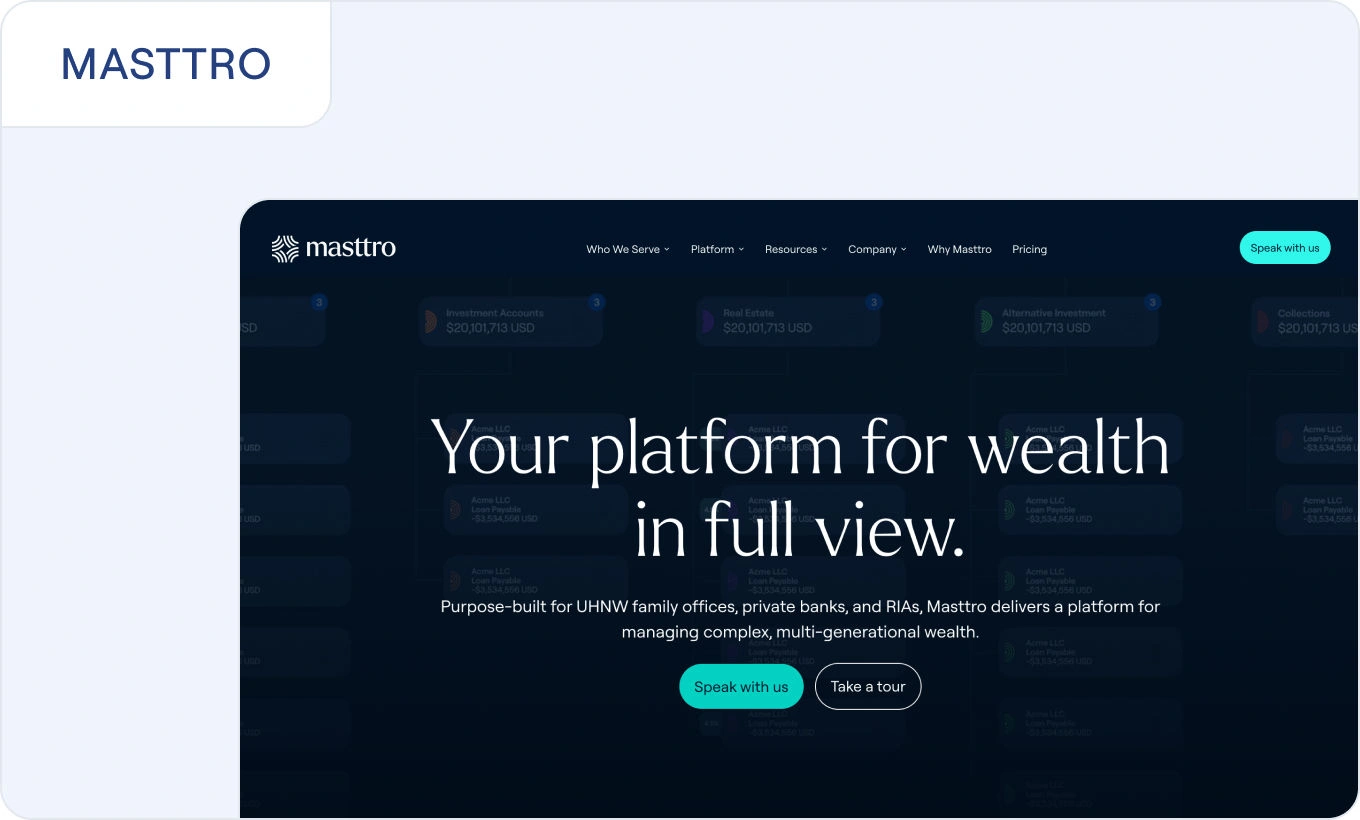
Masttro is a comprehensive wealth management platform that consolidates all asset classes, including liquid investments, alternative assets, real estate, private equity, and passion assets. The platform emphasizes security with military-grade encryption and offers AI-powered features through Masttro Intelligence.
Who it's for: Single and multi-family offices, wealth professionals, and larger institutions seeking comprehensive wealth visibility with strong data security.
Core features:
- Wealth Map visualization of ownership structures and entities
- Multi-asset portfolio management across public, private, and passion assets
- AI-powered document processing and report generation (Masttro Intelligence)
- Secure document sharing with stakeholders
- Platform integration with existing tech stacks
- Custom dashboards and templated reporting
- Direct ingestion from 6550+ custodian feeds
Deployment & integrations:
- Cloud-based; connects via direct custodian feeds and platform data aggregation
- Industry-leading security infrastructure standards
Pricing:
- Fixed annual pricing not based on AUM
- Contact the vendor for specific pricing details
9. Osyte
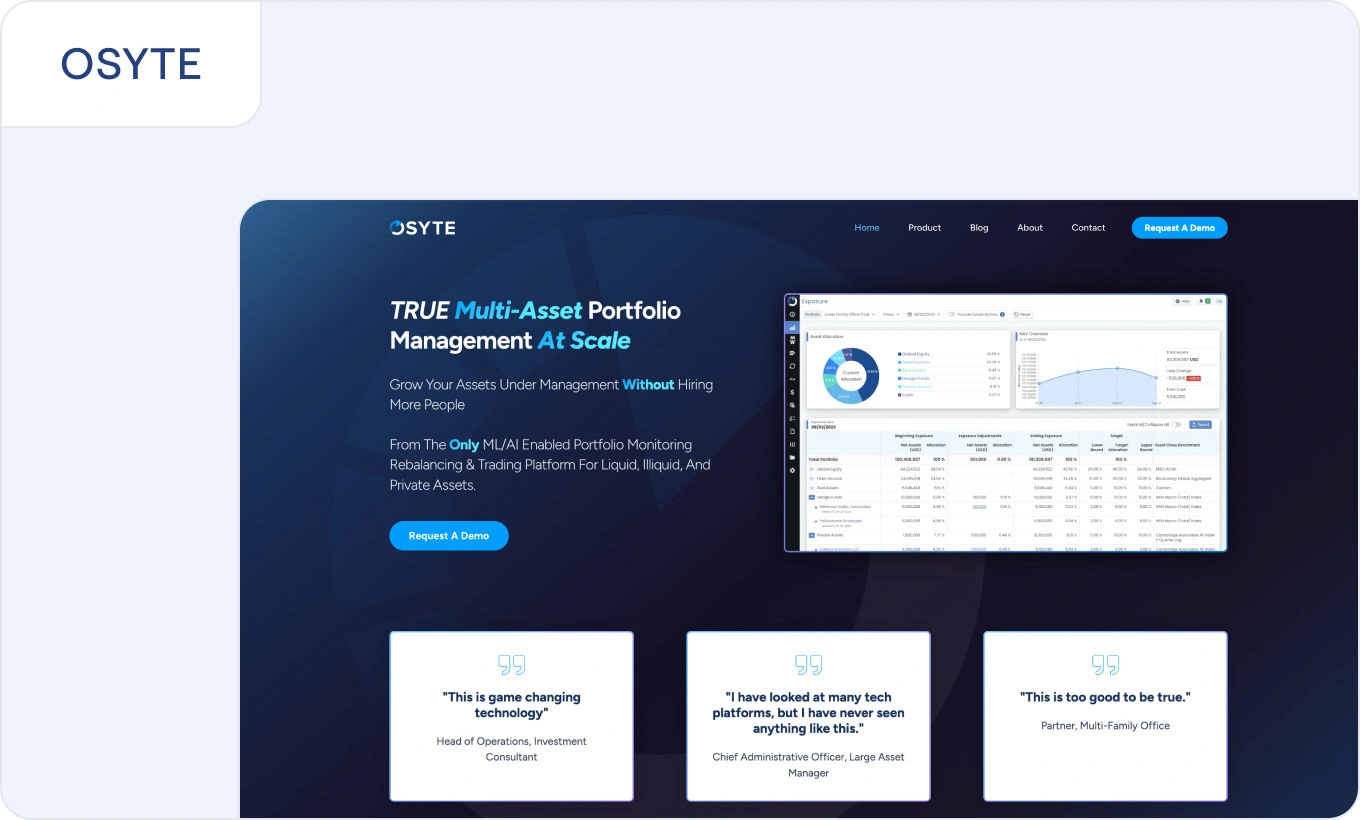
Osyte offers family office management software focused on operational efficiency and comprehensive wealth tracking. The platform provides tools for managing investments, entities, and family office operations.
Who it's for: Family offices seeking operational management tools alongside investment tracking capabilities.
Core features:
- Investment portfolio management
- Reporting across entities and asset classes
- Operational workflow support
Deployment & integrations:
- Cloud-based platform; integration details not publicly disclosed
- Implementation timeline varies by office complexity
Pricing:
- Contact the vendor for pricing
10. Private Wealth Systems
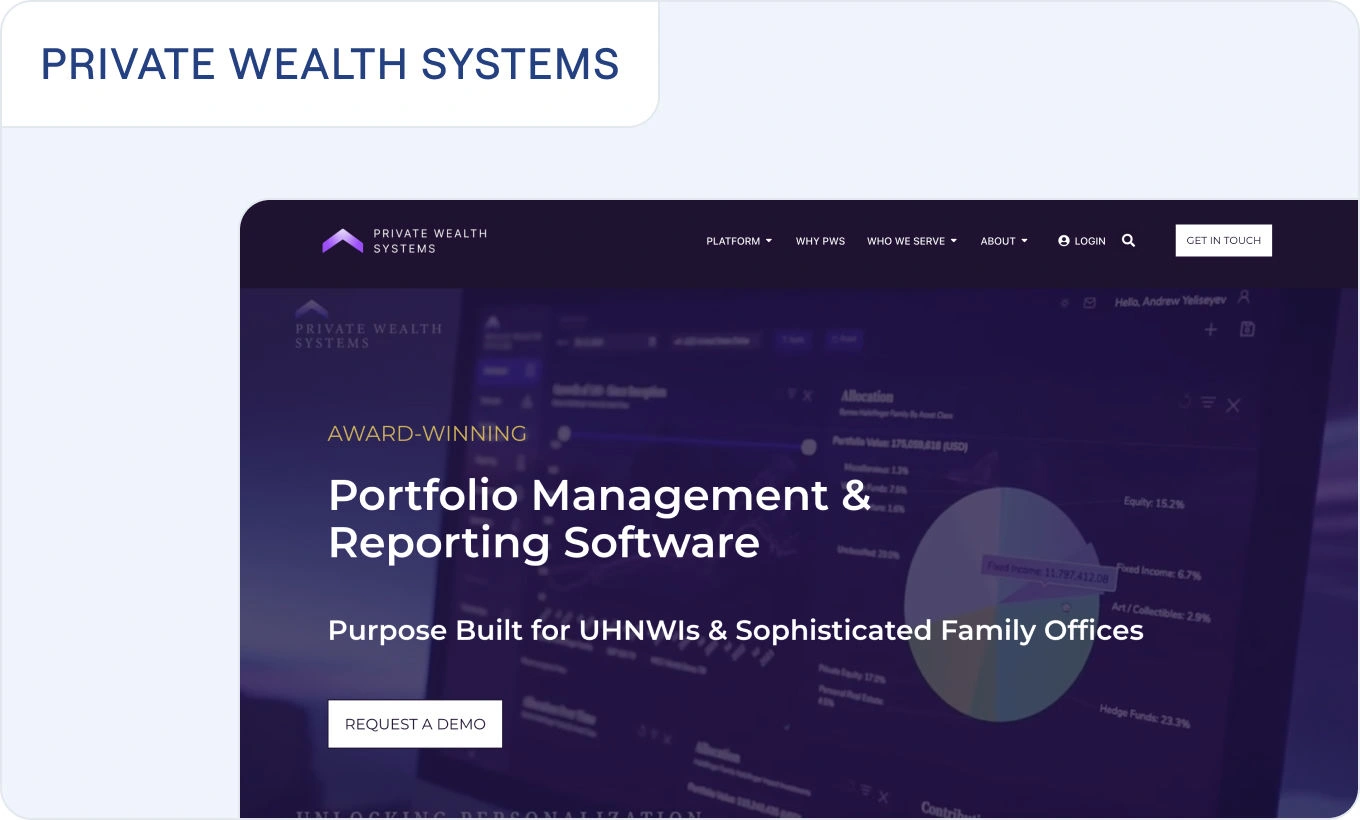
Private Wealth Systems is a cloud-based platform delivering portfolio management and reporting for ultra-high-net-worth individuals, family offices, and RIAs. The platform features intelligent aggregation across 400+ global data feeds and combines multi-asset, multi-currency holdings into a consolidated view.
Who it's for: Ultra-high-net-worth individuals and family offices requiring comprehensive performance insights with benchmark tracking and tax-lot level analysis.
Core features:
- Intelligent aggregation across 400+ global data feeds
- Multi-asset class support (public, private, fixed income, hedge funds, VC, real estate, derivatives, art/collectibles)
- Multi-currency holdings in a single consolidated view
- Proprietary ledger-backed data model for accounting integrity
- Real-time performance insights and benchmark tracking
Deployment & integrations:
- Cloud-based; integration with major custodians and data providers
- Implementation complexity depends on portfolio structure
Pricing:
- Contact the vendor for pricing
11. QPLIX

QPLIX specializes in performance attribution and risk analysis for family offices requiring institutional-grade analytics. The platform focuses on deep analytical capabilities typically reserved for enterprise accounts.
Who it's for: Family offices needing advanced performance attribution, risk analysis, and analytical depth beyond standard reporting tools.
Core features:
- Advanced performance attribution analysis
- Comprehensive risk analytics and modeling
- Institutional-grade reporting
Deployment & integrations:
- Cloud-based; integration with major data providers and custodians
Pricing:
- Contact the vendor for quotes
12. Solovis
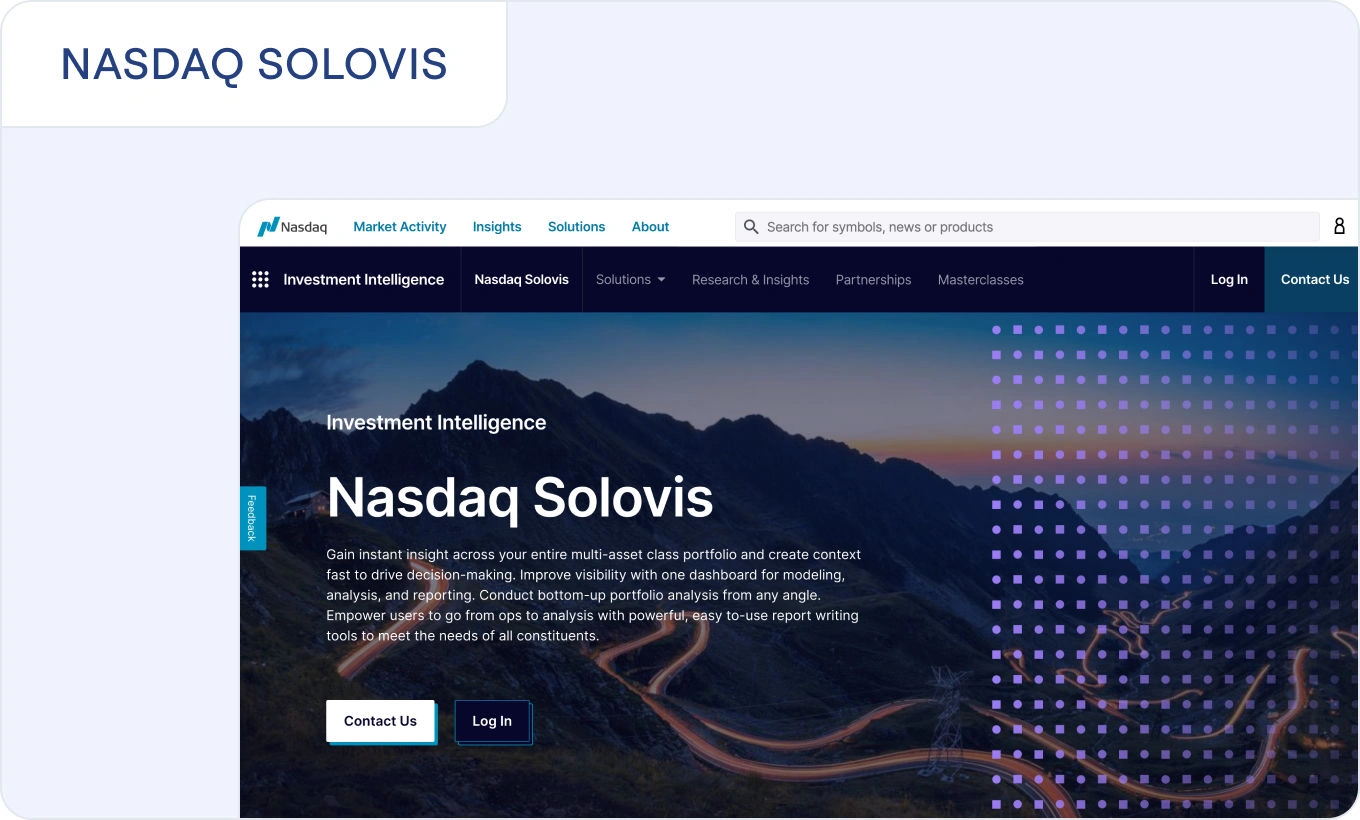
Solovis provides portfolio management and investment analytics software for institutional investors, including family offices. The platform focuses on comprehensive investment analytics and flexible reporting capabilities.
Who it's for: Institutional investors and larger family offices managing complex portfolios requiring advanced analytics and flexible reporting.
Core features:
- Portfolio management across asset classes
- Investment analytics and performance measurement
- Flexible reporting and dashboards
- Multi-currency and multi-entity support
- Alternative investment tracking
- Compliance and risk monitoring
Deployment & integrations:
- Cloud-based; integration with custodians and fund administrators
- Implementation timeline varies by portfolio complexity
Pricing:
- Contact the vendor for pricing
13. Venn by Two Sigma
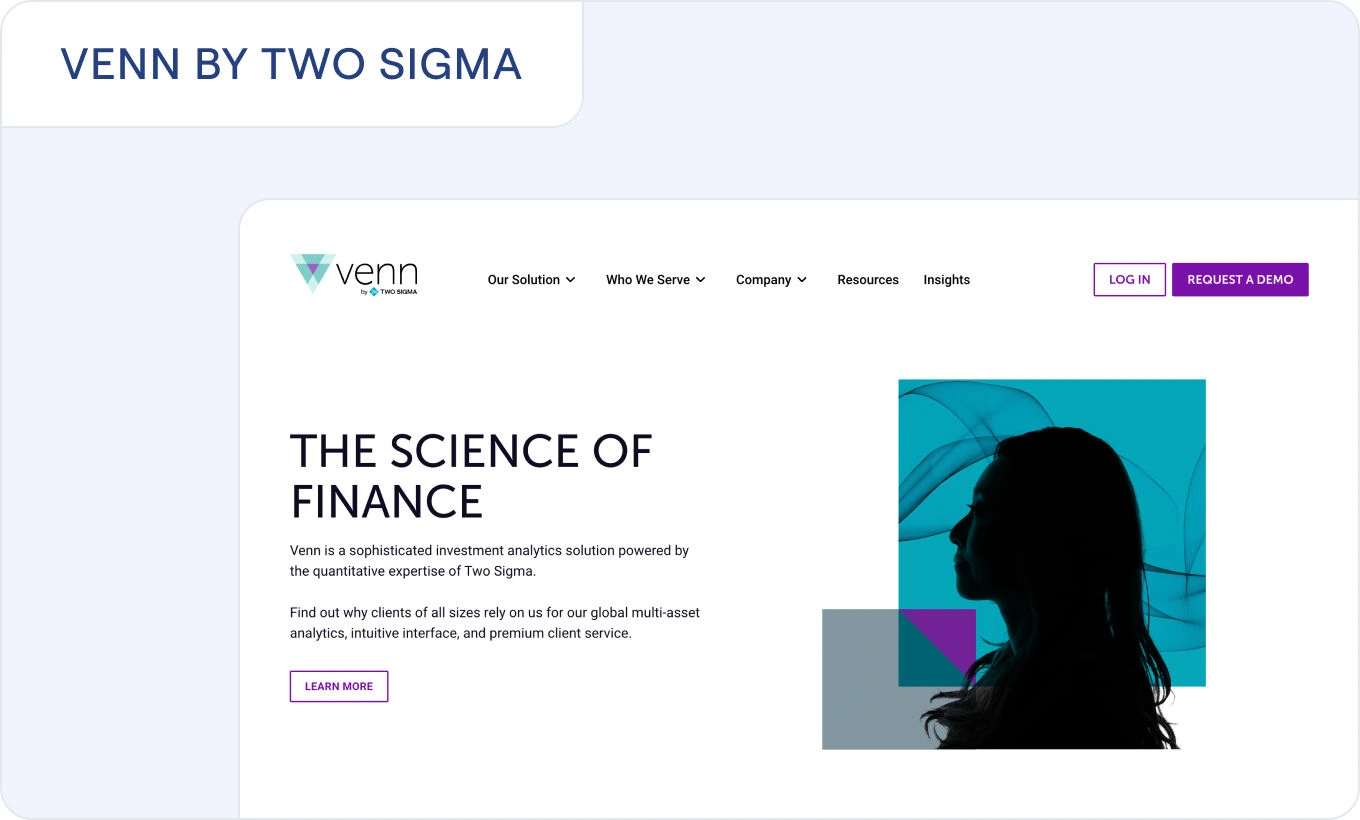
Venn by Two Sigma is a factor-based risk analytics platform that helps investors understand portfolio exposures and risk drivers. The platform applies systematic analysis methods developed by Two Sigma to help family offices and institutions evaluate portfolio risk.
Who it's for: Sophisticated family offices and institutional investors seeking quantitative risk analysis and factor-based portfolio insights.
Core features:
- Factor-based risk analytics
- Portfolio exposure analysis
- Systematic risk evaluation
- Scenario analysis
- Factor attribution reporting
Deployment & integrations:
- Cloud-based analytics platform
Pricing:
- Contact vendor for pricing; typically based on portfolio complexity and analytical requirements
14. FundCount
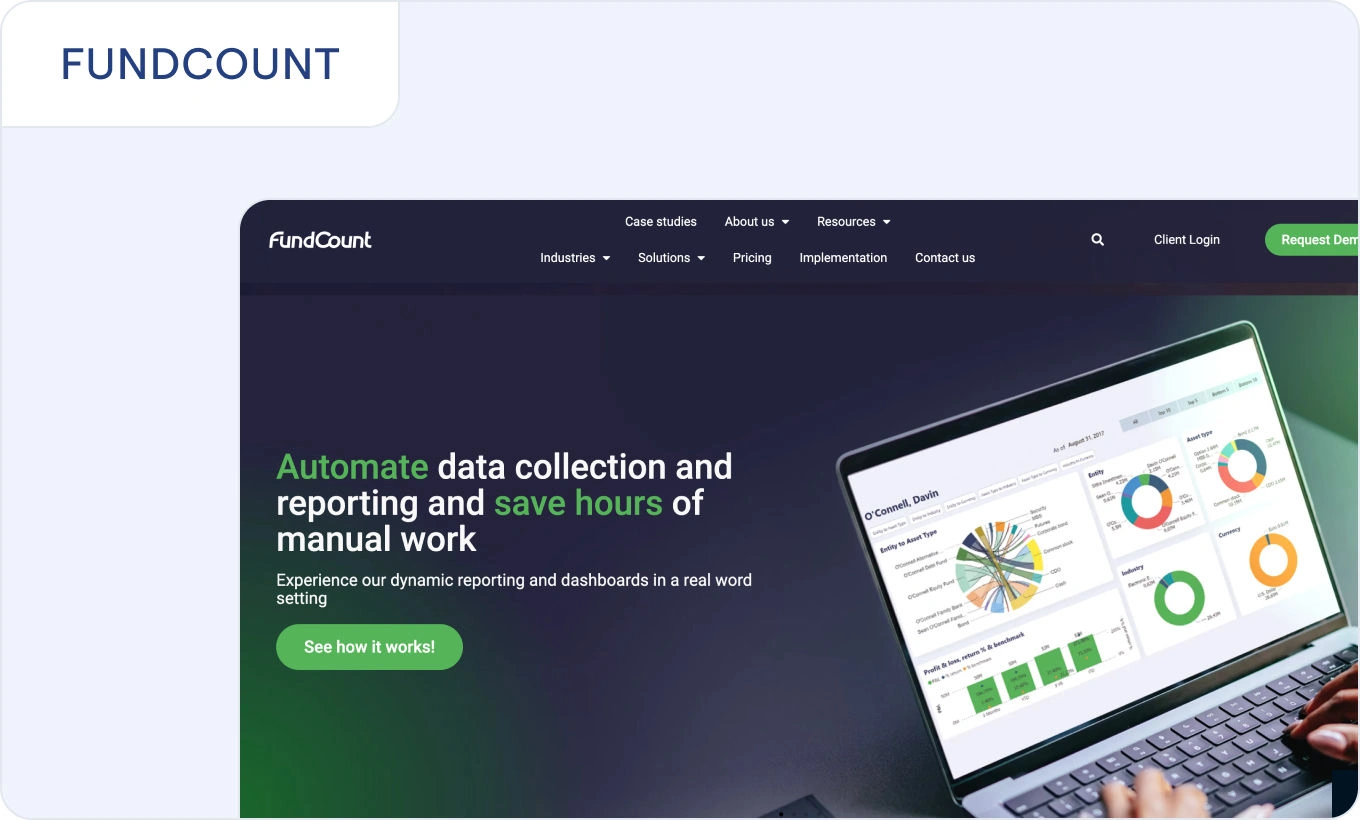
FundCount is a partnership accounting and analytical software that tracks, analyzes, and reports on complex investments. Suitable for fund administrators, family offices, hedge funds, and private equity firms, FundCount offers an integrated multi-currency general ledger and automated workflow tools.
Who it's for: Family offices, fund administrators, and private equity firms requiring integrated accounting and investment analysis with strong partnership accounting capabilities.
Core features:
- Integrated multi-currency general ledger
- Partnership and portfolio accounting
- Flexible reporting tools for customized client reports
- Consolidated reporting across investments
- Real-time data feeds and automated data aggregation
Deployment & integrations:
- Integration with fund administrators and custodians
- Implementation includes general ledger setup and data migration
Pricing:
- Based on the number of custodians, portfolios, legal entities, and assets
- Contact the vendor for specific pricing
15. Asseta
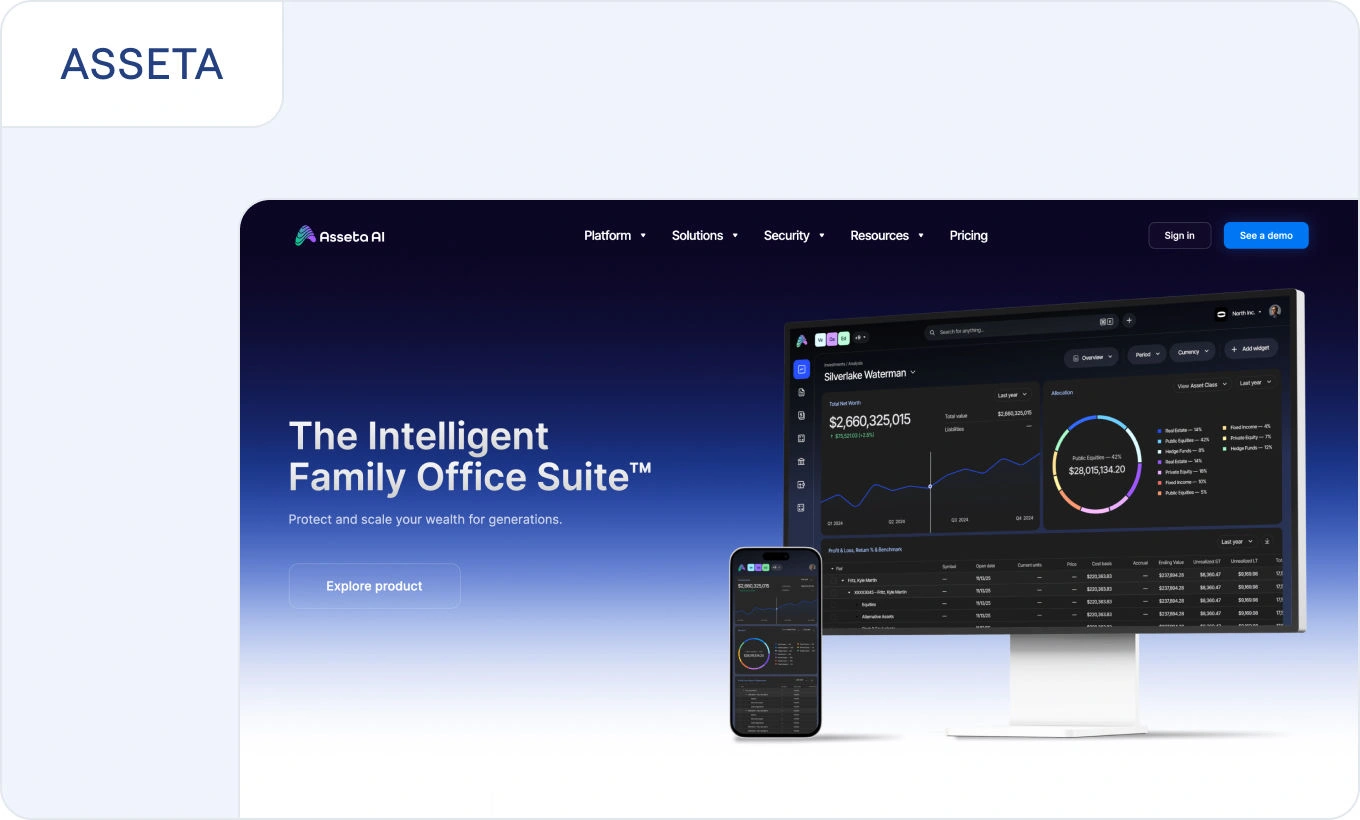
Asseta positions itself as "The Intelligent Family Office Suite," designed to protect and grow wealth for generations. The platform offers a unified suite to manage accounting, banking, investments, and core finance operations, with a general ledger specifically designed for family offices.
Who it's for: Single and multi-family offices seeking an integrated platform with a built-in general ledger and integrated platform for accounting, banking, investments, and multi-entity operations.
Core features:
- Family office-specific general ledger
- Multi-currency capabilities for global operations
- Automated intercompany transactions between entities
- Real-time visibility and reporting across every entity
- Integration with J.P. Morgan and other platforms
- Suite of modules (General Ledger, Reporting, Bill Pay, Document Storage, Banking, Forecasting, Investments) that can be adopted as needed.
Deployment & integrations:
- Cloud-based; integrates with numerous financial platforms
- Implementation timeline depends on the state of your data, technology needs, and resource capacity
Pricing:
- Contact the vendor for pricing based on the modules required and the office size
16. Archway

Archway provides portfolio management, reporting, and accounting software for family offices and wealth management firms. The platform focuses on multi-asset portfolio tracking, customisable reporting, and an integrated general ledger (GL) to support partnership accounting and entity-level books.
Who it's for: Family offices and wealth managers seeking straightforward portfolio management with customizable reporting.
Core features:
- Advanced account aggregation
- Automated data collection
- Comprehensive asset tracking
- Document management
- Client portal capabilities
Deployment & integrations:
- Cloud-based platform; integration details not extensively publicized
- Implementation timeline varies by portfolio complexity
Pricing:
- Contact the vendor for pricing
17. Canopy
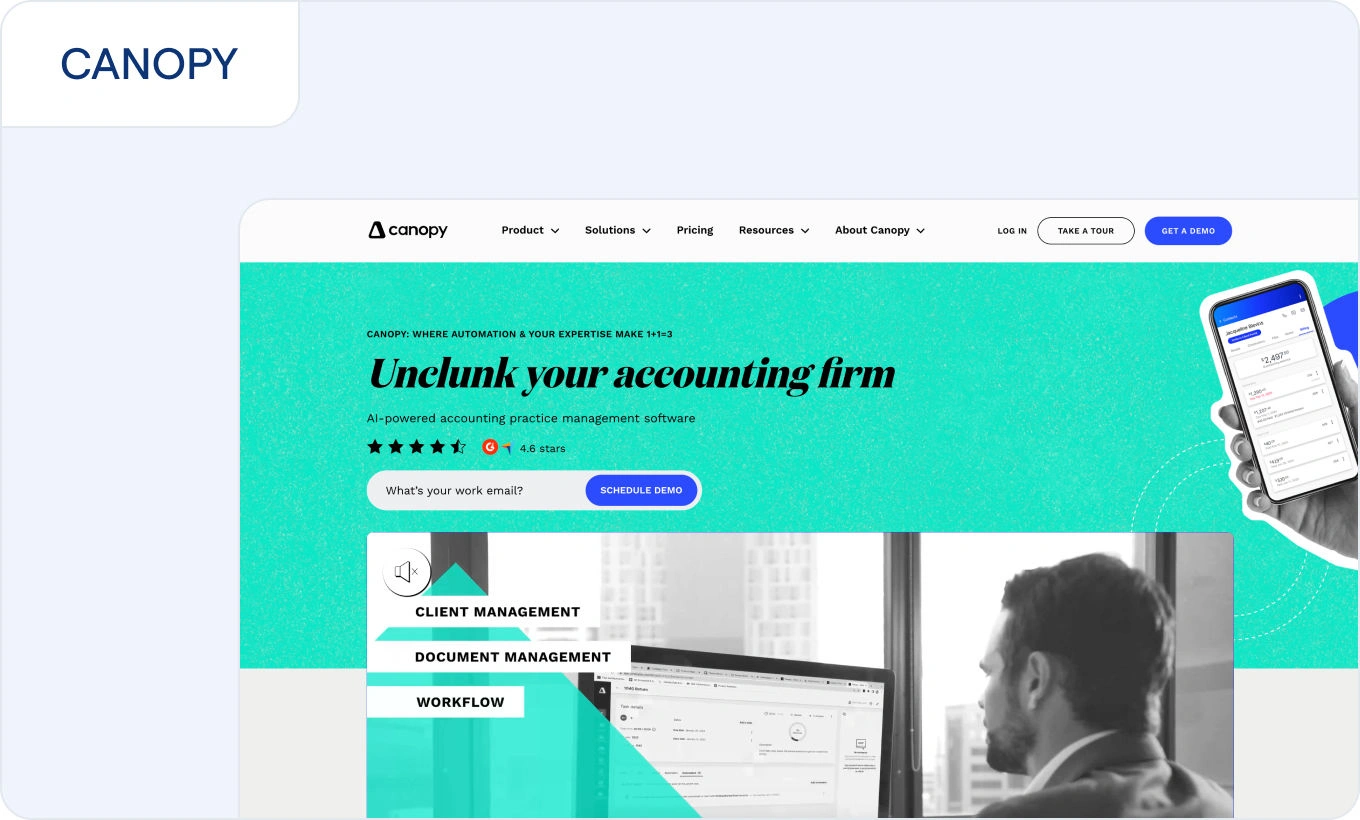
Canopy offers account aggregation, portfolio analytics, and client reporting solutions for financial institutions, wealth management professionals, and high-net-worth individuals. The platform focuses on data acquisition, cleansing, and reporting.
Who it's for: Wealth management professionals and family offices requiring robust data aggregation from multiple custodians with emphasis on data quality.
Core features:
- Data acquisition and automated aggregation
- Portfolio data cleansing and standardization
- Portfolio analytics and visualization
- Customized reporting capabilities
- Strategy construction and analysis
Deployment & integrations:
- Cloud-based; extensive custodian network for financial data feeds
Pricing:
- Contact the vendor for pricing
18. Hemonto

Hemonto is a Danish fintech founded in 2006 that delivers independent, consolidated wealth reporting through a digital platform and expert advisory team. With oversight of over $55 billion and management of assets exceeding $10 million per client, the platform processes complex wealth structures with institutional-grade reporting.
Who it's for: High-net-worth individuals and family offices seeking independent wealth reporting with advisory support and institutional-quality analysis.
Core features:
- Consolidated wealth reporting across custodians and asset types
- Independent quality controls
- Dynamic reporting dashboard accessible on web and mobile
- Dedicated advisory team for reporting setup and management
Deployment & integrations:
- Cloud-based with web and mobile access; integrates with business intelligence tools
- Implementation includes a reporting framework setup with a dedicated support team
Pricing:
- Contact the vendor for pricing
How to Choose: A Fast Fit Matrix for Lean Single-Family Offices
Choosing the right family office reporting software starts with matching your structure and pain points to the capabilities that actually solve them. This matrix helps lean single-family offices identify must-haves, nice-to-haves, and red flags.
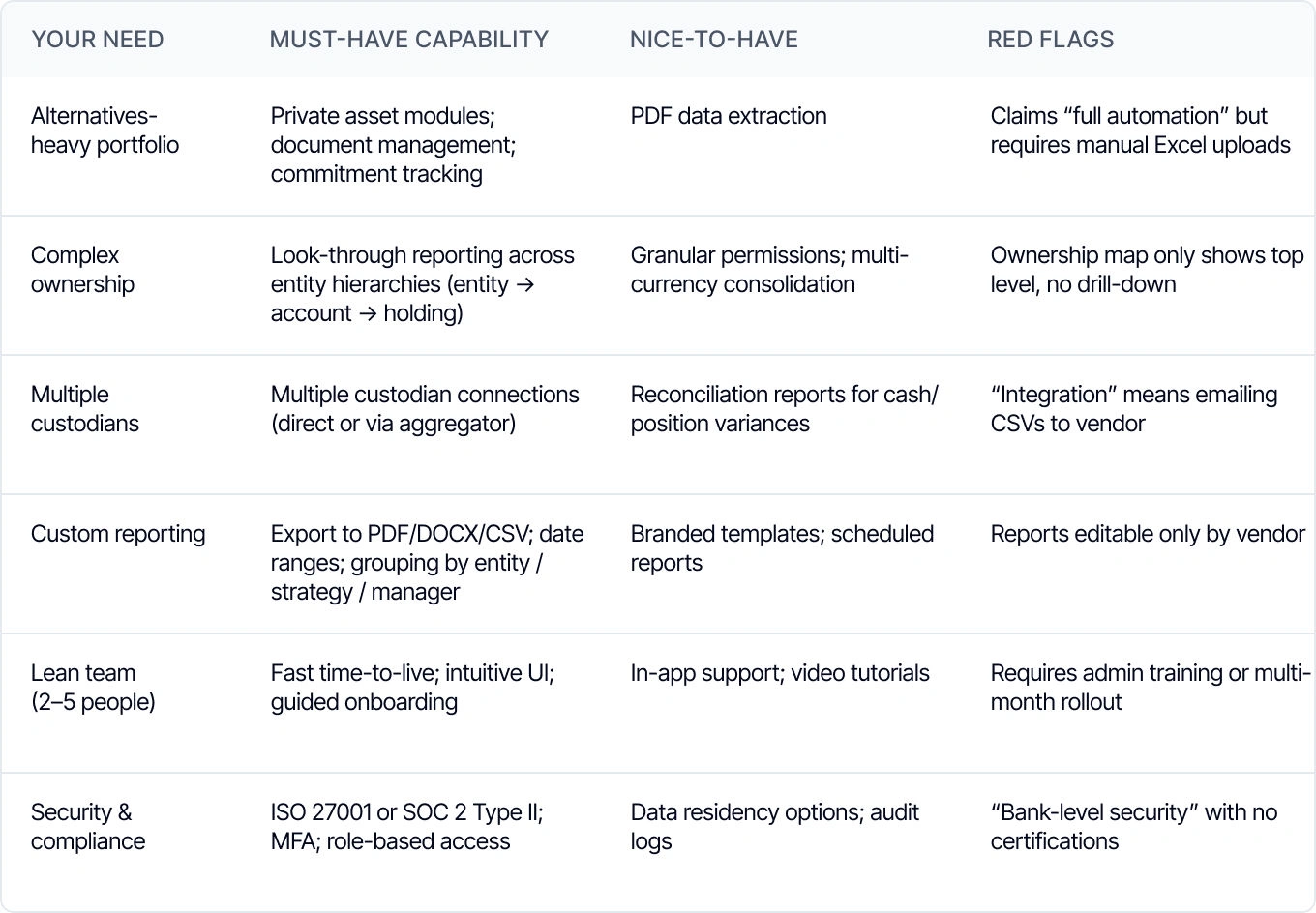
- Private asset depth: If >30% of your portfolio is in private equity, venture, or real estate, confirm the platform supports IRR/MOIC calculation, tracks committed vs. deployed capital, and links K-1s or investor statements to each holding.
- Mobile access: Principals increasingly want portfolio snapshots on mobile. Verify whether the platform offers a dedicated app (iOS/Android) with MFA, not just a responsive website.
- Approvals and workflows: Some platforms support task assignment and alerts; few offer in-app approval routing. If your office requires formal sign-offs, clarify whether approvals happen in the platform or via email/external process.
Evaluation Criteria
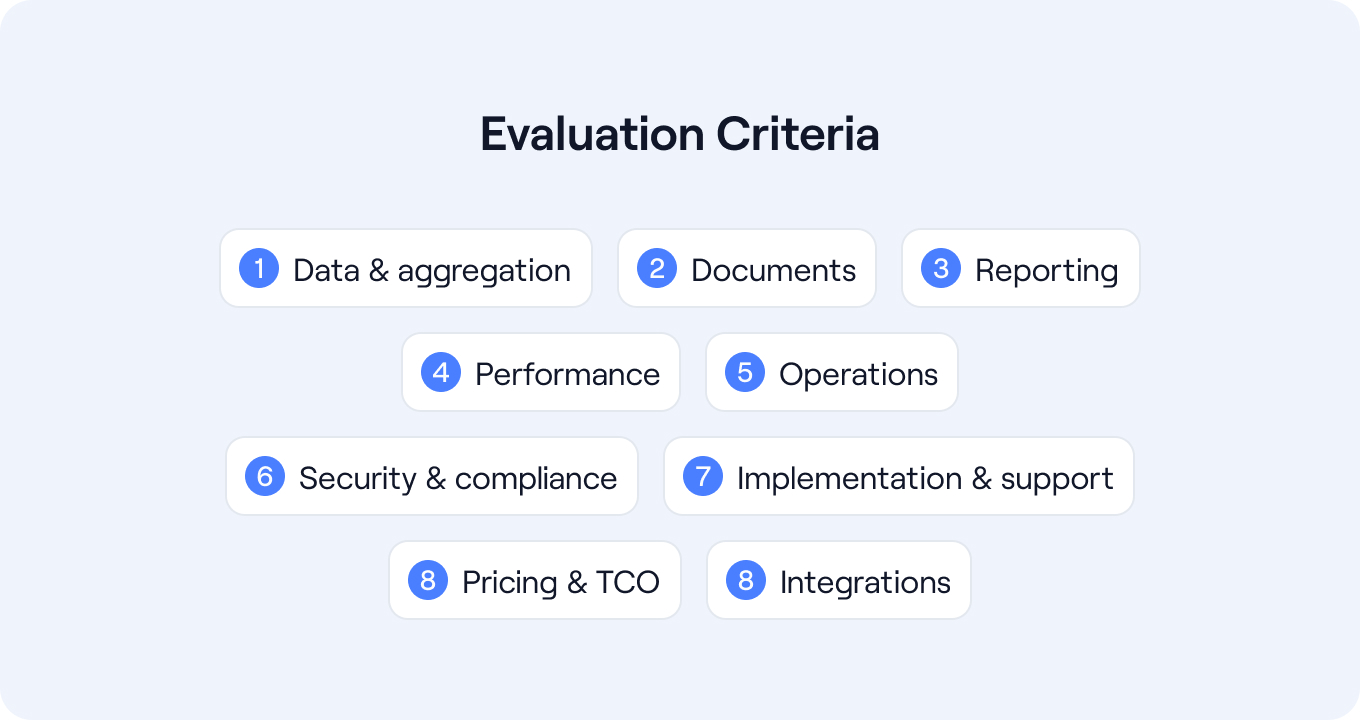
We evaluated family office reporting software on capabilities that matter to lean single family offices, where supported. Each criterion reflects real operational needs documented in industry research and case studies.
- Data & AggregationScore whether the platform ingests bank/broker feeds and private-asset data (with automation where available), normalizes it into a consistent, reconcilable view, and handles coverage gaps, refresh cadence (e.g., COB), and exception workflows.
- DocumentsEvaluate the ability to centralize statements, notices, and deal files; assess secure sharing, version control, tagging/search speed, and how well documents link to entities, transactions, and reports.
- ReportingAssess flexibility to produce branded consolidated and entity-level reports; check date-range options, unitization for pooled structures, custom templates, scheduling/exports, and audit-readiness of report packs.
- PerformanceVerify support for TWR on liquid assets and IRR/MOIC on privates; evaluate benchmark handling, time-bounded calculations, cash-flow conventions, and quarter-close workflows.
- OperationsScore how capital calls, valuations, renewals, and similar tasks are tracked; review workflow support (tasks, owners, due dates), alerts for deadlines or missing items, and status visibility across entities.
- Security & ComplianceConfirm certifications and controls (e.g., SOC 2, ISO 27001), SSO/MFA, permission granularity, data residency/hosting options, and admin policies for access and off-boarding.
- Implementation & SupportEvaluate time-to-live and onboarding approach (self-serve vs. vendor-led), data migration/reconciliation support, training materials, SLAs, and ongoing support channels/coverage.
- Pricing & TCOCompare pricing models (tiered, seat, custodian, AUM) and typical add-ons (integrations, custom work); estimate 1–3 year TCO including internal resourcing and change-management effort.
- IntegrationsAssess connectors to GL systems, cloud document storage, BI tools, and APIs; confirm the availability and fidelity of transaction-level exports for accounting/tax, and evaluate integration maintenance limits.
Choosing the Right Family Office Software
The best family office software depends on your portfolio composition, entity complexity, team size, and operational priorities. For family offices managing significant alternative investments, prioritize platforms with robust private asset tracking, IRR/MOIC calculation, and automated document processing capabilities. Platforms like Burgiss specialize in private capital analytics, while solutions like Asora and Masttro offer balanced coverage across liquid and illiquid assets.
When to shortlist Asora:
- You're a lean single family office seeking fast implementation.
- Your portfolio includes both liquid and illiquid assets, and you need automated data aggregation from custodians and manual capture for private assets.
- You want look-through ownership visualization (Wealth Map) that shows who owns what across entities, accounts, and holdings.
- Your team values transparent tier-based pricing starting at €800/month with no hidden per-custodian fees or AUM-based charges.
- You need mobile access for principals to view portfolios securely on iOS and Android.
- You require document management that links statements, capital call notices, and legal docs directly to assets.
- Your office operates with 2–5 people who need an intuitive platform that doesn't require dedicated admin training.
Request a demo to see how Asora handles multi-entity structures, automates custodian feeds, tracks private assets, and delivers customized reporting. Explore pricing for transparent costs that include all features, unlimited users, and optional add-ons for additional custodian accounts or alt data ingestion.
FAQ
What is family office reporting software?
Family office reporting software consolidates wealth data, tracks performance, and produces reports across entities, asset classes, and currencies. It brings bank and custodian feeds into a single view, structures private asset records, links documents to holdings, and calculates metrics such as asset allocation, TWR, and IRR to support decision-making and audit readiness.
How is family office reporting software different from family office accounting software?
Reporting software centres on investment oversight and consolidated wealth views, while accounting software focuses on ledgers and tax preparation. Many offices pair accounting software with a reporting platform like Asora to aggregate, perform look-through, and analyze performance across liquid and illiquid assets.
What features should I prioritise when selecting reporting software for my family office?
Look for strong data aggregation, multi-entity consolidation, look-through ownership, document-to-asset linking, customisable reports, and pricing that will not penalise growth.
How long does it typically take to implement family office reporting software?
Timelines depend on your structure and data sources. Lean platforms such as Asora are built for quick onboarding and often complete a typical single family office setup in 4 weeks or less.
What does family office reporting software typically cost?
Vendors price in different ways. Asora uses transparent tiers based on tracked assets and includes core features for unlimited users, with optional add-ons as needed. You will also see AUM-based pricing, per-custodian fees, and enterprise-style custom quotes. Clarify what is included and any limits on users or entities.
How does look-through reporting work in family office software?
Look-through traces ownership from principals and trusts down to entities, accounts, and underlying holdings. Look for a platform where you can follow the chain from a trust to a holding company to a brokerage account to a fund and its securities, then report at any level without manual stitching.
What security standards should I expect from family office reporting software?
Expect third-party certifications such as ISO 27001 or SOC 2 Type II, multi-factor authentication, role-based access, encryption at rest and in transit, and audit logs.
Should my family office use a specialised reporting platform or a comprehensive wealth management platform?
Choose based on scope and team size. Many lean single family offices prefer a focused reporting solution to manage multiple entities for aggregation, performance, and workflows, then pair it with accounting systems, if required. If you require trading, rebalancing, or a full general ledger inside the same system, consider a broader suite.
.png)
.jpg)
 ISO 27001 Certified
 GDPR Compliant