
.jpg)
TL;DR
Spreadsheets often struggle in the wealth management industry once portfolios span multiple banks, entities, and private assets. Errors creep in, evidence fragments, and review cycles slow. A software-led operating model in wealth management replaces fragile files with a single source of truth, a shared taxonomy, and linked evidence. A consistent dataset enables movement bridges to explain change, while entity, consolidated, and beneficial-owner views stay consistent.
The Problem With Spreadsheet Analytics
The wealth management sector has matured into a complex, data-rich environment. Relationship managers, portfolio managers, and operations teams typically coordinate across custodians, funds, SPVs, and currencies. In that setting, Excel delivers quick one-offs but becomes brittle as logic is copied, versions multiply, and data accuracy drifts. When edits aren’t tracked, history is unreliable, and the same security appears under multiple labels, your reports won’t reconcile. That isn’t data analytics; it’s data maintenance.
A software-led operating model solves structural issues. Data management shifts from download-and-paste to timely updates. Ownership is mapped centrally. Evidence sits with the numbers; it substantiates. Some offices keep approvals/sign-offs in external governance tools; others use in-app approvals where supported. With those basics in place, wealth management analytics supports data-driven decision-making across investment strategies, risk assessment, and client relationships.
What Data Analytics Really Means
Data analytics in the wealth management industry is the disciplined practice of standardizing inputs, applying consistent methods, and explaining both level and change, at a minimum. It combines bankable assets and private assets, respects multi-entity structures, and separates FX from performance, depending on methodology used. Every essential figure ties back to a policy, file, or calculation note. The platform enables users to link documents to transactions, rather than implying the software does this automatically.
The outcome provides actionable insights that enable wealth managers to make informed decisions, manage risks effectively, and enhance client satisfaction. In this context, both data analytics and wealth management practices, as well as big data analytics in wealth management initiatives, should start with clean foundations rather than tool-first experiments.
Family office software helps create a single source of truth across listed and private holdings. Capabilities to evaluate include: timely data aggregation with bank/investment feeds; document linking to positions; workflow tasking and alerts; and ownership visualisations (e.g., wealth maps). These tools should complement existing teams and systems; approvals, reconciliation, and policy can remain in the office’s external processes.
The Operating Baseline
Data analytics in wealth management scales only when the five basics are in place. First, establish a single source of truth: a live position-level register with one row per position, linked to the owning entity, account, instrument identifiers, valuation basis, and look-through ownership, with sub-records at the lot/leg level where required.
Second, a common taxonomy standardizes the language for data analysis (asset class, strategy, region, liquidity, and wrappers), ensuring that filters and rollups behave consistently every time.
Third, timely updates bring bankable data in on a predictable cadence, while private-asset evidence arrives through periodic statements (often quarterly) and periodic valuations/appraisals.
Fourth, linked evidence stores statements, fee files, appraisals, and FX sources with the holdings they substantiate, turning reviews into verification rather than searches.
Fifth, workflow support makes preparation and review visible through notifications and task tracking, while approvals and reconciliation stay in the external process to preserve controls.
With this baseline in place, the following section’s 10 moves are straightforward upgrades, each extending the same spine, illustrating how spreadsheet-era processes can become a disciplined analytics practice.
10 Ways to Move Beyond Excel and Into Family Office Software
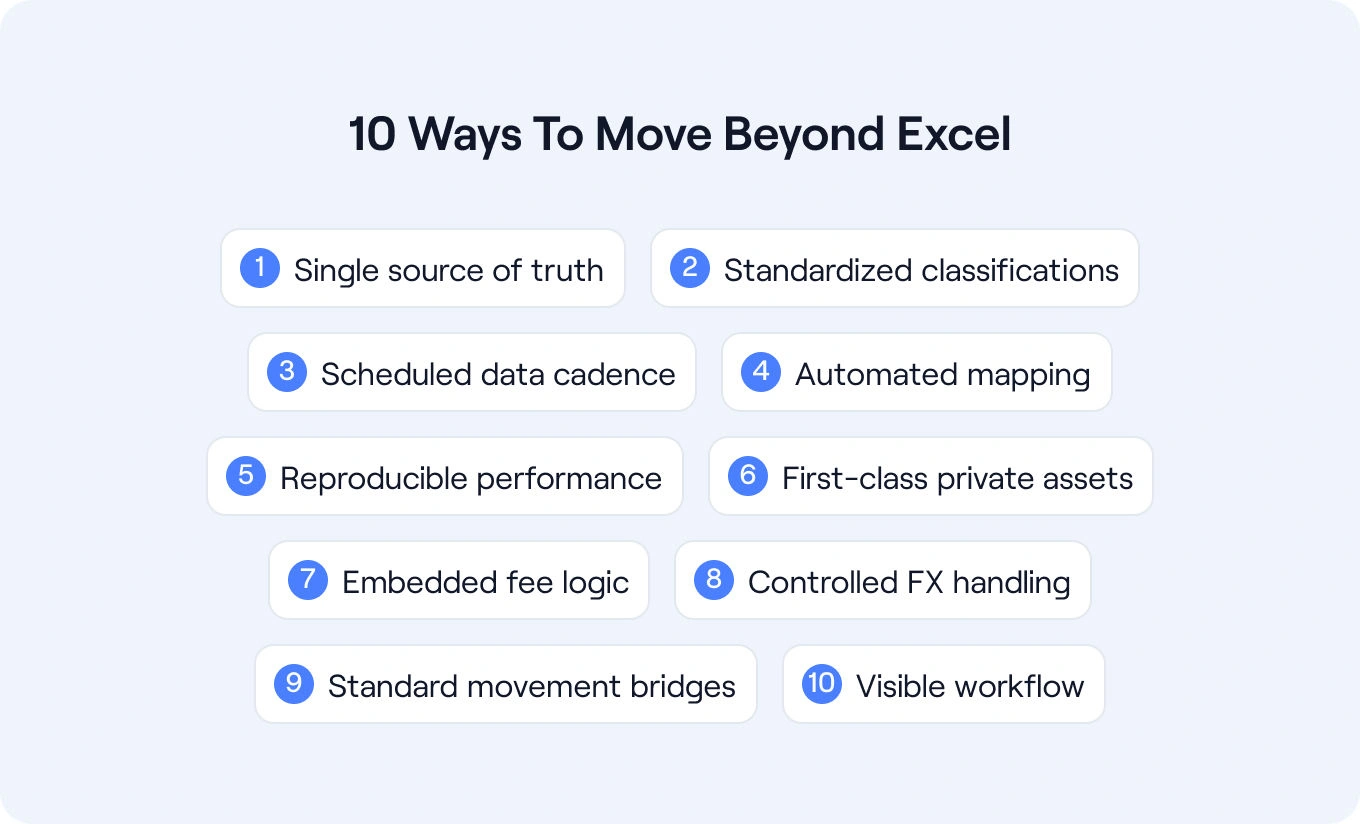
The goal is eventual replacement, not coexistence. The moves below replace spreadsheet-era habits with a single source of truth that is consistent, reviewable, and easier to maintain. The operating model is software-first, featuring a live holdings register, timely feeds for bankable assets, linked evidence for private assets, and streamlined workflow support for preparation and review.
1) Create a Single Source of Truth
Spreadsheets scatter positions across tabs; family office software can maintain a single register across entities and accounts, with identifiers, valuation basis, currency, and ownership links stored in a single place. In this model, the register serves as the live record, allowing positions to roll up cleanly, data points to be reconciled once, and reviewers to know where to look.
Asora supports this pattern by maintaining a single source of truth, a centrally stored register that links statements, capital accounts, and other documents, so the evidence stays with the numbers it substantiates.
2) Standardize Classifications at the Source
Inconsistent labelling causes drift. The fix is twofold: enforce a single identifier set (ticker/ISIN) and a shared classification taxonomy (asset class, strategy, region, liquidity). Consistency at both layers makes ownership maps reliable and reduces rework.
Asora supports storing these classifications with each holding and allows manual entry where required; the team defines and maintains the taxonomy.
3) Lock a Timely Cadence, Not Ad-Hoc Refreshes
Manual pulls create timing mismatches and stale cells. Asora automates scheduled bank and custody updates and links private asset evidence to capital accounts, NAVs, and appraisals. Data arrives on a predictable rhythm, so relationship managers focus on client conversations, not file wrangling.
4) Automated Ownership Mapping
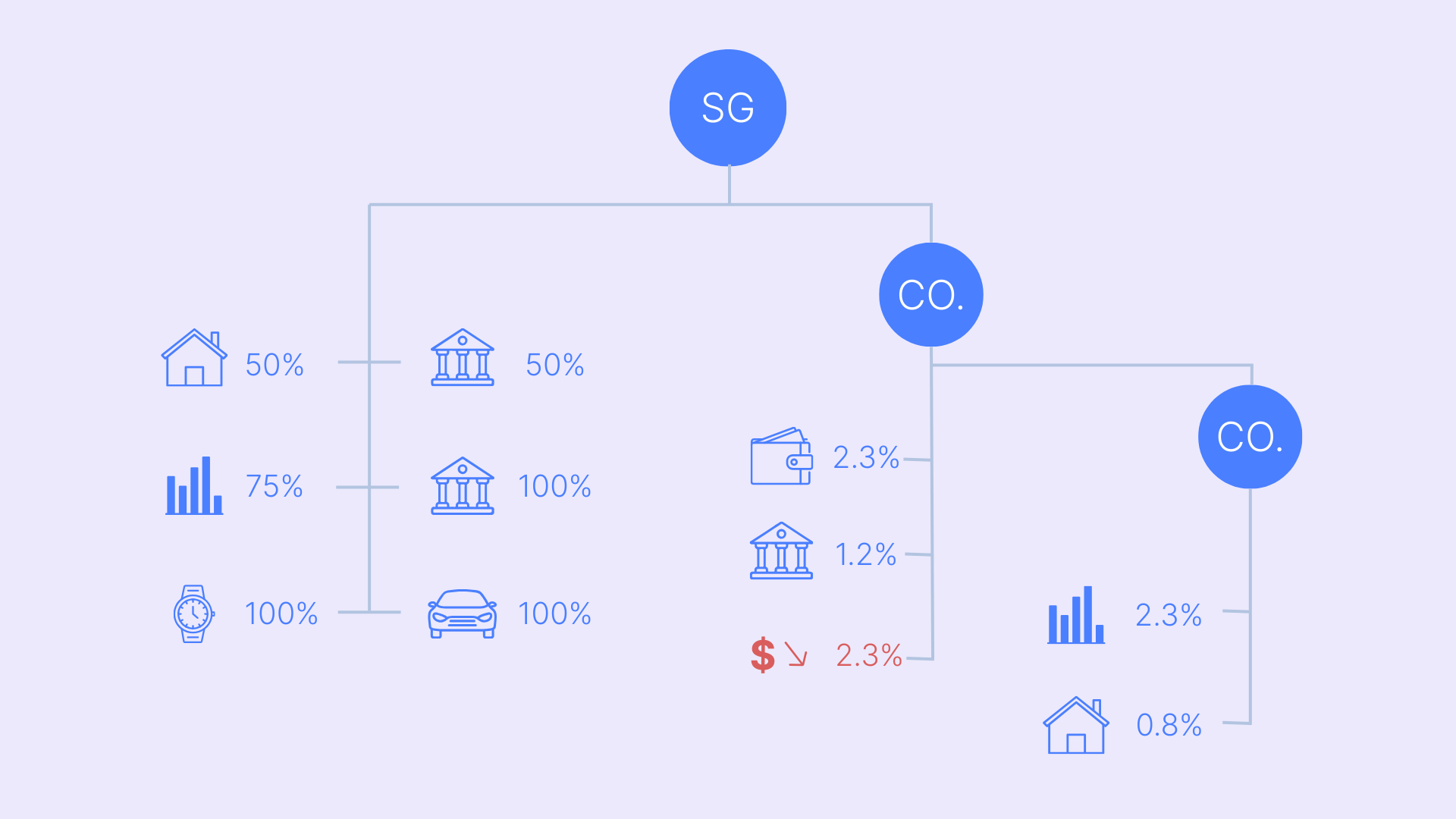
Look-through logic rebuilt in every file is fragile. Software maintains a single ownership chart across trusts, SPVs, and holding companies and reuses it across reporting views within the defined scope. Asora’s Wealth Map provides that ownership chart; paired with the register, owner exposure, and client portfolios, it becomes a standard output, making complex structures easier to explain.
5) Make Performance Methods Reproducible
A good operating model documents performance methods by asset type, keeps inputs consistent, and produces a movement bridge that separates flows, valuation changes, FX effects, and other drivers. This reduces disputes that arise when formulas are buried in tabs.
Asora keeps inputs and supporting documents with each holding; teams export the views they need, so reviews focus on decisions rather than formulas.
6) Treat Private Assets As First-Class Data
In spreadsheets, PE, VC, private credit, and real estate live in side files. Software keeps private asset support materials with each position, including capital account statements, valuation support, rent rolls, and covenant documents. Where supported, key fields can also be captured in structured form. A concise status view of unfunded commitments, call expectations, when provided by managers, and near-term distributions becomes routine practice.
Asora helps support Private Asset tracking with a central source of truth and document linking.
7) Store Fee, Carry, and Expense Logic with the Record
Ad-hoc fee tabs are error-prone. Asora stores fee and carry documents with the relevant position or vehicle, including brief accrual notes, sources, and effective dates, so evidence stays with the register. Calculations for fees or carry can remain external unless enabled within the platform.
8) Handle Multi-Currency with Saved FX Files
Copy-pasted FX rates undermine comparability. Asora supports a robust process by storing FX source files with timestamp and method through document linking, applying valuation-date spot rates in reporting, and isolating FX impact in movement bridges to improve currency risk management.
9) Present Bridges and Variants, Not Just Levels
Static levels force guesswork in meetings. The operating model supports a standard movement bridge and consistent variants, including by entity, consolidated group, and beneficial owner, with concise notes on the major drivers. Clarity enhances client relationships and streamlines acquisition conversations.
Asora keeps evidence and inputs next to each holding so teams can assemble a consistent bridge in the reporting pack.
10) Keep Work Visible with Workflow Support
Email threads and hidden to-dos slow the cycle. Asora uses tasks, owners, due dates, and notifications to make responsibility clear and timelines predictable, while files stay attached to the holdings they substantiate. Reviews speed up without sacrificing control.
Where Analytics Delivers the Most Value
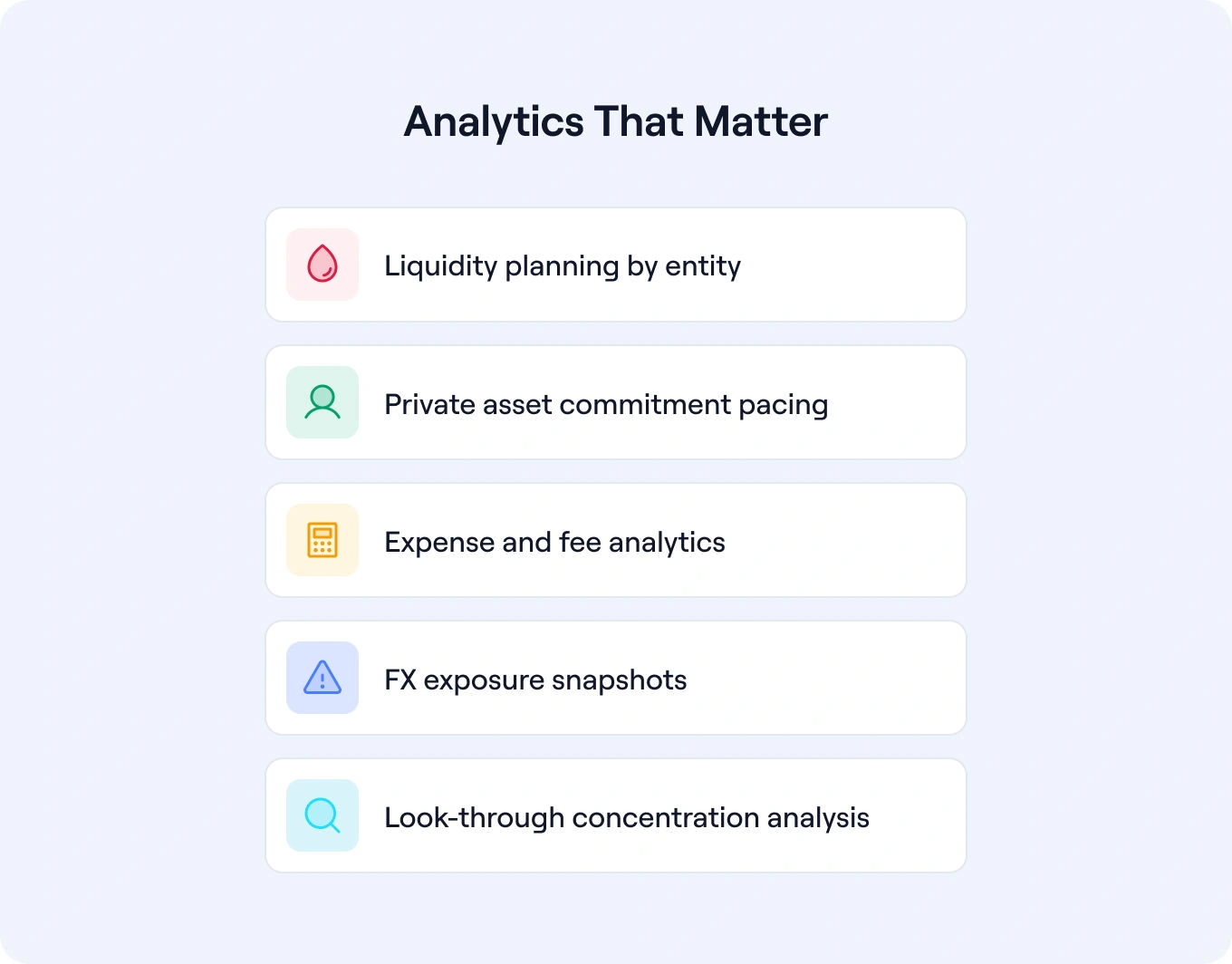
A strong analytics baseline earns attention when it changes outcomes. The following use cases apply across firms, from boutiques to the largest wealth management firms, and help serve modern clients effectively with concise, defensible views.
Liquidity Planning By Entity
Clarifies cash sources and uses over the next several weeks to months (e.g., 30–90 days or longer depending on needs), tying bank balances, expected fund distributions, bond maturities, and near-term outflows together. Linked evidence streamlines sign-off and enhances informed investment decisions regarding capital calls or redemptions.
Commitment Pacing For Private Assets
Aligns expected calls and distributions to manage cash drag while maintaining adequate liquidity buffers. Predictable pacing supports investment strategies and reduces last-minute transfers that disrupt client relationships.
Expense and Fee Analytics
Reveals run-rate costs by entity and strategy, including admin, management, and performance fees. Stable measurement helps explain variances and elevates data-driven decision-making during quarterly reviews.
FX Exposure Snapshots
Quantifies risk when the base currency moves. Clear views of net exposure by currency reduce surprises in board packs and support hedging conversations, a practical risk assessment tool for relationship managers.
Look-Through Concentration Analysis
Shows true sector or issuer exposure when multiple vehicles own the same underlying assets. Concentration becomes a data point, not a suspicion, helping manage risk and inform client preferences conversations.
These examples demonstrate analytics for wealth management focused on action, not decoration. They also fit within an overall banking context where entity rules, custody feeds, and family governance matter as much as charts.
Operating Model and Roles
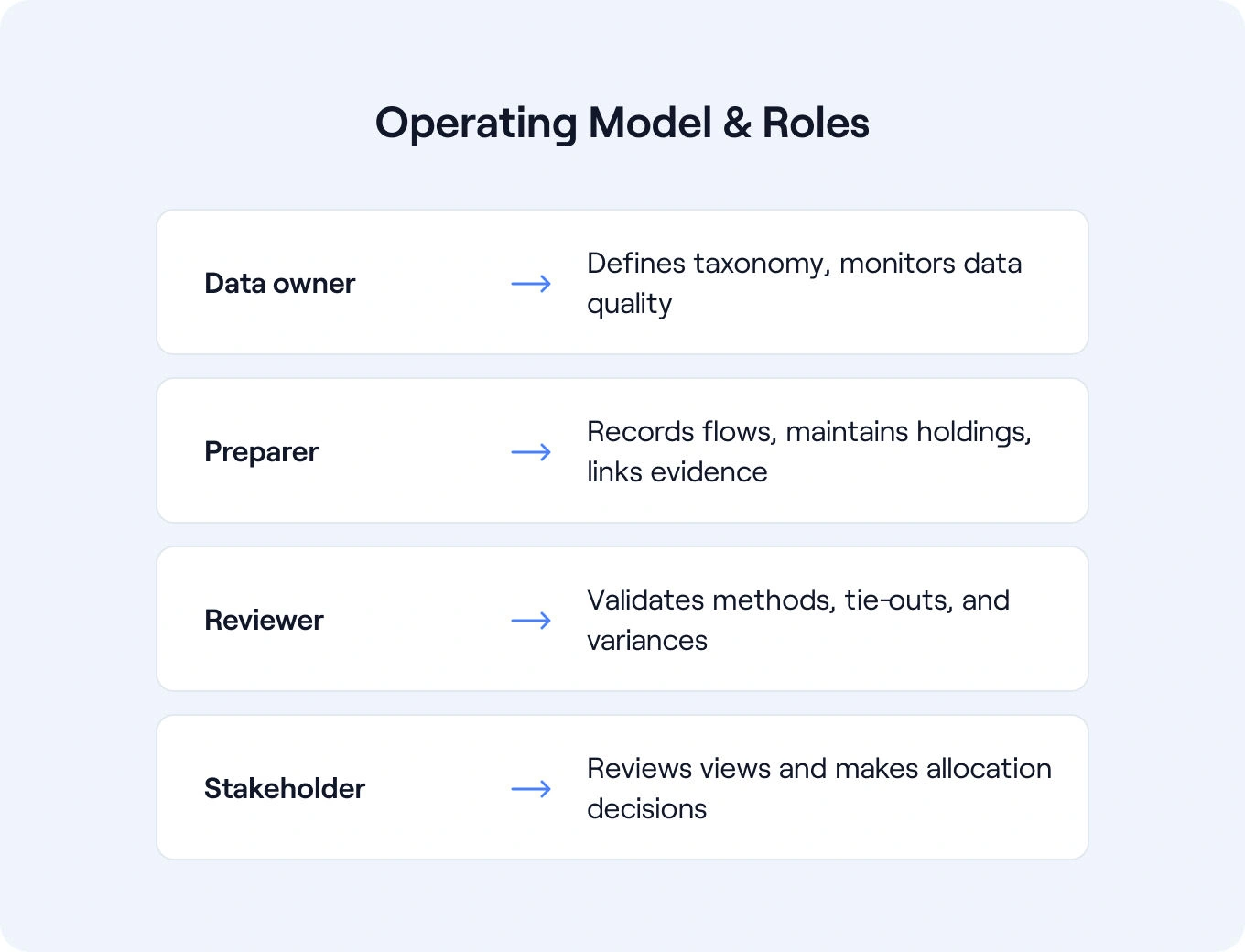
Turning those use cases into routine outputs requires clear ownership and accountability. The same roles that maintain the accuracy of the register and link evidence also ensure that liquidity, commitments, fees, FX, and concentration views are up to date each period. Convert the 10 ways to move beyond Excel and into Family Office Software into a predictable delivery of the liquidity, commitments, fees, FX, and concentration views highlighted above.
- Data owner maintains the taxonomy and definitions, monitors data quality across sources, and decides when a convention change becomes policy in coordination with governance committees. This keeps asset-class labels, regions, and liquidity tags stable for bridges and rollups.
- Preparers record flows, maintain the holdings register, and attach evidence from custodians, managers, and other external partners. This enables the liquidity schedule, commitment pacing, and fee analytics to refresh on cadence.
- Reviewers validate tie-outs, methods, and variances; request clarifications; and confirm the pack within firm governance. This ensures that FX snapshots and concentration views reflect the agreed-upon methods before circulation.
- Stakeholders (principals and committees) consume entity, consolidated, and owner views to make allocation, liquidity, and risk calls; feedback informs next-period priorities.
Migration Path Beyond Spreadsheets
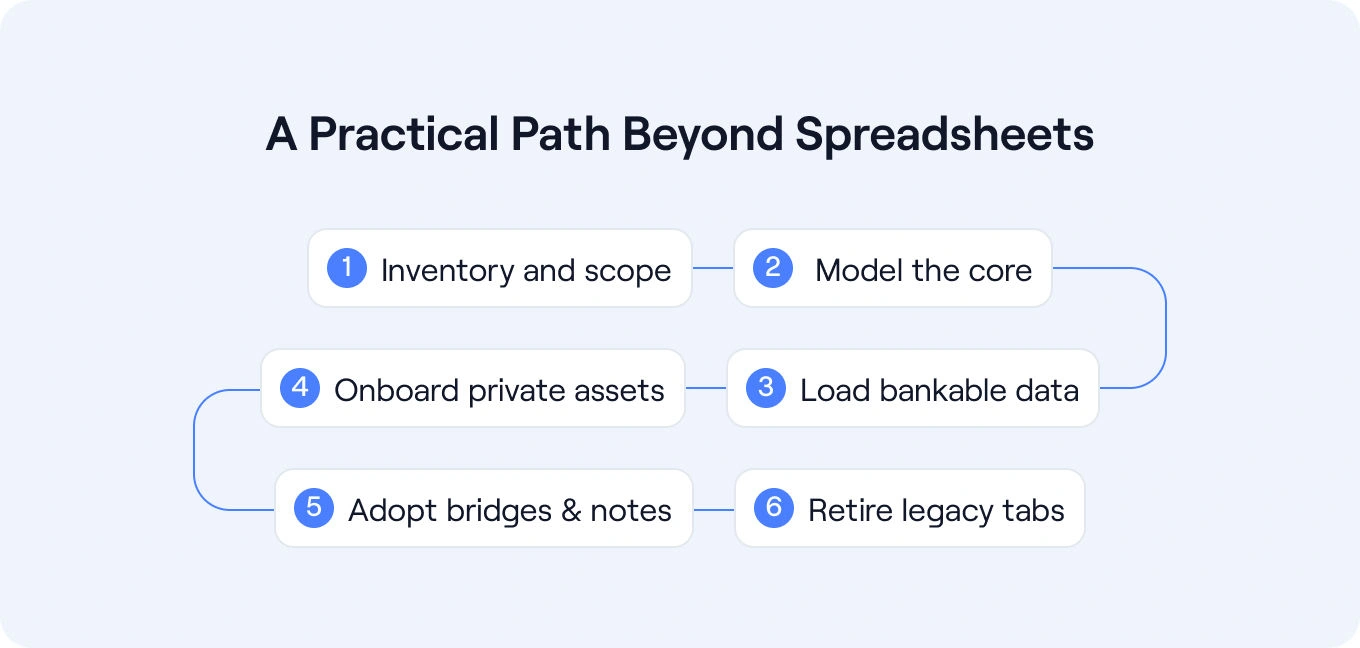
Leaving Excel behind is the goal. The path works best when the scope starts narrow, the cadence is steady, and visible wins arrive early. The runbook below replaces a patchwork of files with a single, software-recorded truth, making that record the sole location where work occurs.
1) Inventory & Triage
Catalog the workbooks that drive reporting, including owners, dependencies, refresh cycles, and associated risks. Select a small perimeter for Phase One, typically core entities and the main bankable accounts, so that the first cutover is fast and confidence-building. Note any legacy systems that still feed reports and decide which to integrate and which to retire later.
2) Model the Core
Define the holdings register (entities, accounts, and positions), stable IDs, and a shared taxonomy for asset classes, strategies, regions, liquidity, and wrappers. Establish file and folder naming conventions to ensure evidence is predictable. Lock valuation policy and FX treatment for the initial scope, and document where external data (manager letters, capital accounts, appraisals) enters the process to protect data accuracy.
3) Load Bankable Data
Turn on timely data aggregation for banks and custodians. Verify balances to statements and close exceptions before adding scope. Establish a lightweight daily check that flags missing feeds: simple data governance that prevents silent gaps and maintains a dependable live record.
4) Onboard Private Assets
Enter capital accounts, link valuation support and appraisals, and establish a review cadence for each position. Track unfunded commitments, expected calls, and near-term distributions so cash planning aligns with client portfolios and investment decisions. Keep all support with the position to avoid side files.
5) Adopt Bridges & Notes
Standardize a movement bridge (flows, valuation change, FX, other) and require brief reviewer notes for large drivers. Bridges transform meetings from number recitations into data-driven decisions, making change as clear as a level across the entity, with consolidated and owner views.
6) Retire Legacy Tabs
As register-based outputs meet the same need, decommission workbook logic rather than running systems in parallel. Archive with a short read-me so historical data remains accessible without live dependencies. The software record will become the single source of information going forward. Guardrails for compliant analytics
Guardrails for Defensible Analytics
Strong analytics rests on traceable evidence. Source files sit with the holding they support, and notes stay brief and specific. This enhances data accuracy and transforms reviews into robust analytics verification, rather than relying on manual review. Freshness is apparent with timely updates, not real-time claims, so teams and existing clients know how current the numbers are. Store method notes in a controlled location (in-app if supported, or in external documentation linked to holdings.
Good governance keeps the process reliable. Preparers and reviewers have distinct roles, with workflow tasking making handoffs visible while approvals remain in the external process. Any change in method or parameters is recorded in methodology notes on the relevant position or vehicle, with links to source documents and a dated change log or workflow comments for traceability over time. Together, these guardrails support data governance and make board reviews and audit preparation simpler without adding complexity.
Common Pitfalls To Avoid
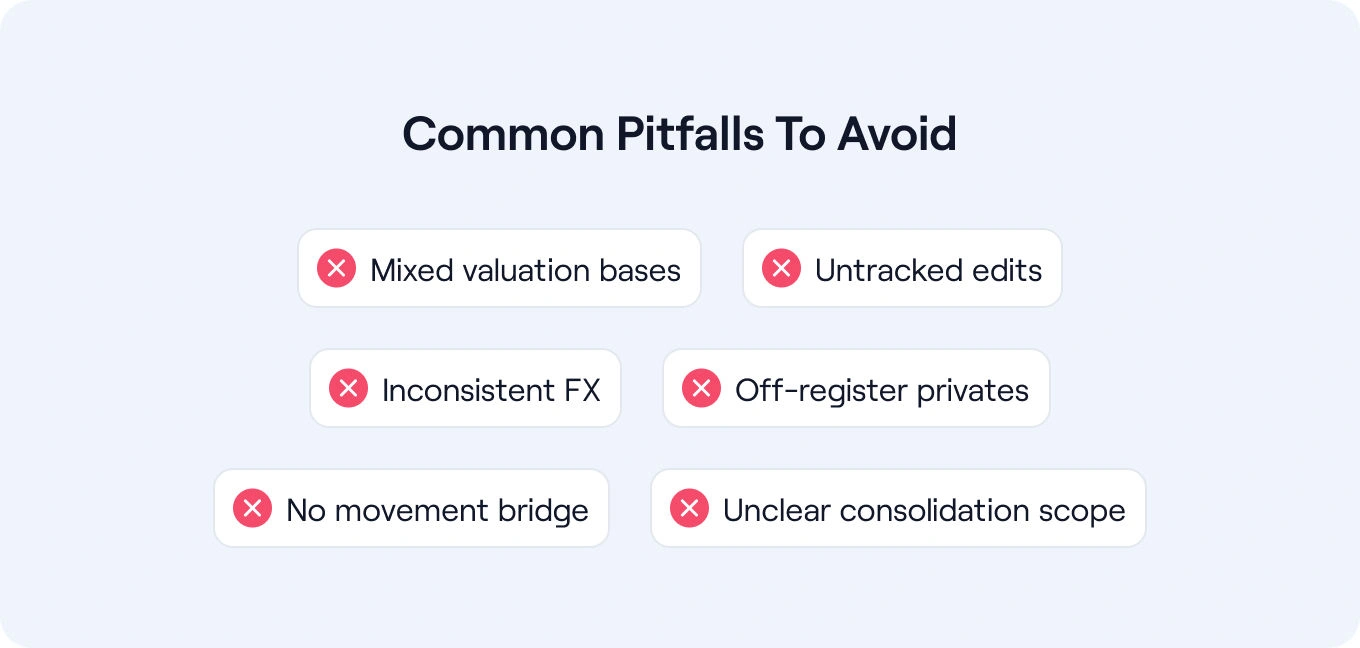
Before sign-off, small process slips cause most rework. The items below are the traps that recur in multi-entity reports and private-asset workflows. Addressing them early keeps the software record clean and ensures predictable review cycles.
- Mixing book and fair value. Readers lose context. Label each column and state the basis for every line.
- Untracked edits across versions. Traceability blurs. Keep changes in the register and link the source file.
- Inconsistent FX sources and timestamps. Periods become incomparable. Store the provider file with the date and method.
- Private assets outside the register. Side files hide risk. Bring PE, VC, credit, and real estate into the same record with linked evidence.
- Levels without a bridge. Movement is unclear. Show flows, valuation change, FX, and other drivers every period.
- Ambiguous perimeter and consolidation rules. Scope drifts. Fix the entity list, eliminations, and cut-off policy at the start of each cycle.
A short preventive checklist within the workflow, backed by linked documents and a fixed FX source, helps contain these risks and preserve client trust through more transparent reporting.
From Data to Decisions
Data analytics in wealth management delivers when ordinary steps repeat themselves every period. A central holdings register, a stable taxonomy, timely data aggregation, and linked evidence turn scattered inputs into a single source of truth. Bridges explain change, and entity, consolidated, and owner views translate complexity into action.
With that base in place, teams can add advanced analytics where it adds signal, not noise. Once methods, sources, and evidence are consistent, add light automation to support judgment. Examples include simple rate or FX shocks, flags for unusual fees or cash flows, and alerts for missing statements or NAVs. The payoff is a more straightforward narrative, faster reviews, stronger risk management, and better alignment between client behavior, client preferences, and the business model.
Request a demo to see how Asora replaces spreadsheets with a live register, linked documents, and workflow support, so wealth managers gain valuable insights, drive business growth, and serve modern clients effectively with a disciplined, software-led approach.
FAQ
Q: How can data analytics improve reporting efficiency for family offices?
A: Efficiency comes from a single record of truth, not from spreadsheet consolidation. With timely feeds for bankable assets, private-asset records kept in the same register, and evidence linked to each position, recurring reports become faster to prepare and easier to review. Asora supports this flow with a register, linking source documents, and providing workflow tasking, allowing teams to track handoffs. Performance and bridges are prepared within the team’s process. This reduces manual rework and ensures reports are delivered on time without promising real-time or full automation.
Q: How should data governance and security be handled in high-net-worth settings?
A: Pair clear definitions and stable methods with predictable data freshness and traceable evidence. Maintain a shared taxonomy, store method notes at the holding level (valuation basis and FX treatment), and link supporting files to the register. Protect access with MFA and role-based permissions, keep detailed activity logs, and apply least-privilege and segregation of duties. Run approvals, role-based sign-offs, and reconciliation within the firm’s established governance process, with the system serving as the system of record. Include data residency controls, encryption in transit and at rest, vendor attestations such as ISO 27001 or SOC 2, periodic access reviews, and a tested incident-response plan.
Q: What analytics matter most for private and alternative investments?
A: Useful views include capital-account roll-forwards, unfunded commitments, call/distribution cadence, valuation support tracking, and simple cash-flow projections. For transparency, keep private-asset files (capital accounts, appraisals, covenants, rent rolls) linked to the position and present movement bridges that separate flows, valuation change, and FX.
Q: What are the biggest challenges when implementing data analytics in wealth management?
A: Typical hurdles include fragmented sources, inconsistent classifications, and spreadsheet dependency. A staged cutover helps: define the register and taxonomy, turn on timely feeds, onboard private assets with linked evidence, standardize movement bridges, and then retire legacy tabs. Choose a platform that replaces spreadsheet sprawl while the team retains approvals, reconciliation, and policy externally.

.png)
 ISO 27001 Certified
 GDPR Compliant