
.png)
TL;DR
A family office portal centralizes secure access to documents, reporting outputs, and advisor communication across entities and custodians. Acting as the front door to aggregation and reporting systems, it strengthens governance, clarifies role-based access, and reduces operational friction during year-end close, tax, entity administration, due diligence, and generational transition cycles.
What is a family office portal and why does it matter?

Many single family offices operate across emails, shared drives, custodian portals, and spreadsheets. This fragmentation is one of the core drivers behind the broader shift toward dedicated family office software. Over time, this leads to:
- Version drift
- Unclear permissions
- Manual fulfillment of document requests
- Delays during reporting cycles
A family office portal links documents, tracks tasks, and surfaces portfolio and entity information in one place. It provides controlled access for principals, internal teams, and external advisors. In some platforms, such as Asora, the portal layer sits above data aggregation, performance monitoring, and document management, presenting structured outputs through a single, secure interface.
Modern drivers include:
- Multi-entity complexity across trusts, limited partnerships, and holding companies
- Increased allocation to private equity, venture, and direct deals
- Outsourced Chief Investment Officer (OCIO) and multi-advisor models
- Heightened cyber risk
- Engagement from next-generation family members
When structured correctly, a family office client portal reduces back-and-forth emails, supports faster access to consolidated reports during quarter-end, and clarifies ownership of documents and requests.
Portal vs reporting vs aggregation
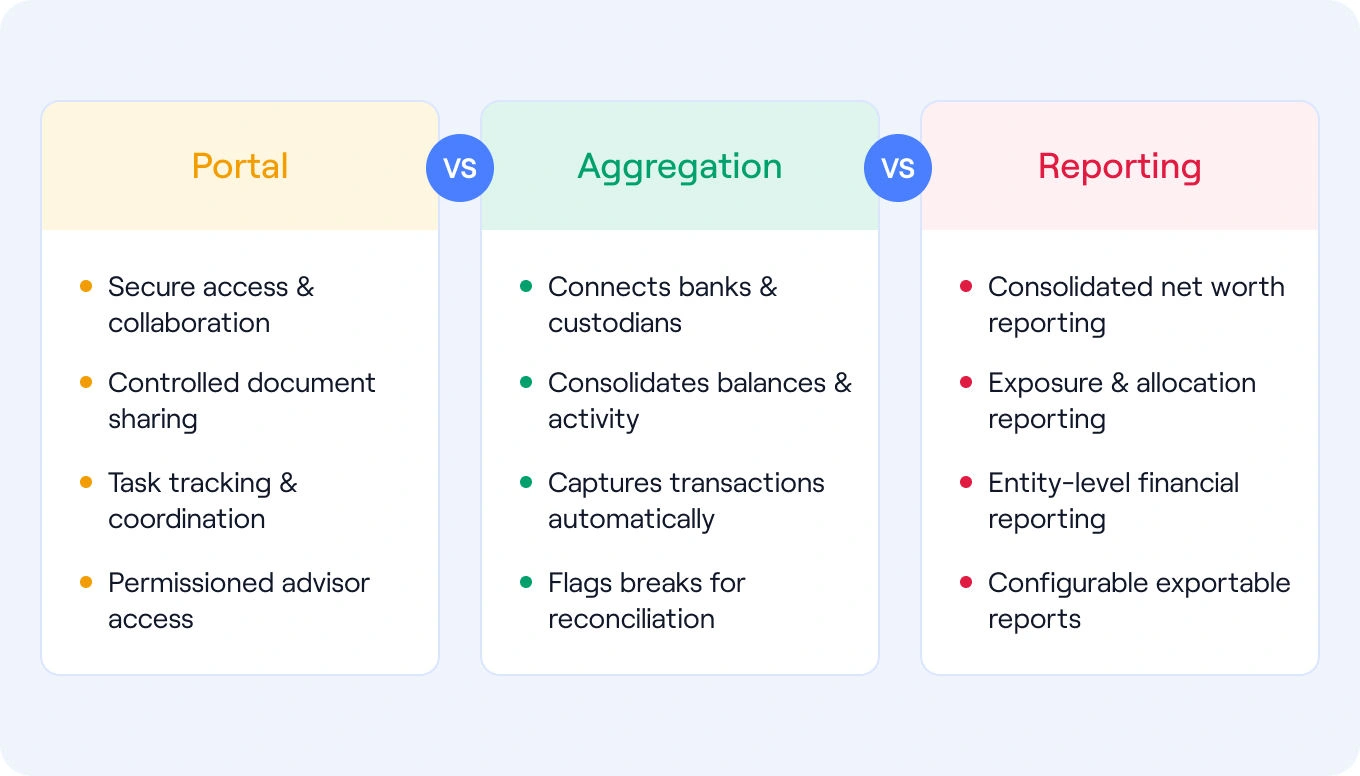
The term “family office portal” is often used broadly. In practice, several components may sit underneath it.
Family office portal
The secure access and collaboration layer.
- Document access
- Structured communication
- Task support
- Controlled sharing with advisors
It is typically the front door for principals and advisors.
Data aggregation engine
The data ingestion layer.
- Connects to banks and custodians
- Consolidates balances and transactions
- Surfaces data gaps or inconsistencies to support reconciliation workflows
This operates behind the portal interface.
Portfolio management system
The calculation layer.
- Performance calculations (e.g., IRR, TWR)
- Cost basis and lot tracking
- Capital call and distribution tracking (where supported, often via private markets modules)
This may sit within or alongside the reporting layer.
Consolidated reporting platform
The output layer.
- Net worth reporting
- Allocation and exposure summaries (with look-through depth dependent on available data)
- Entity-level financial views
- Exportable reports
In many modern setups, the portal presents outputs from the aggregation and reporting layers underneath.
For lean single family offices managing multi-entity structures across jurisdictions, these components may be integrated into one platform or combined across vendors.
Custodians vs portals: role clarity

Custodians hold and safeguard assets. They provide:
- Trade execution and settlement
- Asset safekeeping
- Statements for assets held at that institution
However, custodians generally don’t provide full consolidation across multiple custodians and held-away/private assets without additional tools or integrations. A family office portal:
- Centralizes access across custodians
- Surfaces consolidated reporting outputs
- Links documents and entity structures
The portal does not replace the custodian, but it sits above custodial relationships to provide structured visibility.
8 core jobs a family office portal should support

A family office portal is not simply a document repository. It is the coordination layer across entities, advisors, custodians, and reporting systems.
Before evaluating vendors, define the operational jobs the portal must perform within your structure. For most UHNW individuals and lean single family offices, these jobs fall into eight categories.
1. Access
At its foundation, a family office portal should centralize access across entities and financial institutions (custodians, banks, administrators). This includes:
- Statements from multiple custodians
- Capital account reports from private funds
- Legal documents across trusts and holding companies
- Historical reporting packs and archives
The goal is not just storage, it’s structured retrieval.
When a principal asks for the latest consolidated performance report, or an advisor requests prior-year trust documents, the portal should provide a single, controlled access point, without relying on inbox searches or shared drives.
For multi-entity families in the US and Europe, entity-level organization is critical. Trust A, Holding Company B, and Direct Investment SPV C should not blur together. Structure reduces friction during reporting cycles and tax season.
2. Communication
Family offices often operate through fragmented communication:
- Email threads
- Ad hoc WhatsApp or SMS messages
- Separate custodian portals
- Offline spreadsheets
A structured family office client portal centralizes communication tied to context. Instead of “can you resend that K-1?” buried somewhere in your emails, communication should link directly to the underlying document or entity. Requests, updates, and follow-ups should sit alongside the relevant record.
Date-based task support also improves reporting discipline. For example:
- Quarterly consolidated reporting deadlines
- Capital call payment windows
- Tax document delivery tracking
This shifts the operating model from reactive to structured.
3. Reporting
A family office investment portal should surface reporting outputs clearly and consistently. This does not replace custodians or accounting systems. Instead, it centralizes visibility across them.
Reporting jobs typically include:
- Consolidated net worth views
- Exposure reporting by asset class (and geography, where data supports it)
- Performance summaries across public and private investments
- Entity-level financial visibility
Many offices surface this through structured family office dashboards that centralize exposure, performance, and liquidity visibility.
For families allocating to private equity, venture, real estate, and direct deals, consolidated reporting reduces reliance on manually assembled spreadsheets.
Export capability remains important, though, as many offices still distribute PDF reports to investment committees, trustees, family councils, and/or advisors during quarter-end cycles.
The portal should present reporting clearly, while the aggregation and calculation layers operate underneath.
4. Document control
In many single family offices, document control becomes the hidden operational risk. Common pressure points include:
- Passport copies, KYC/AML records, and identity documents
- Insurance certificates
- Trust deeds and amendments
- Subscription agreements and side letters
- Tax forms such as jurisdiction-specific partnership tax statements (UK/EU) or Schedule K-1s (US)
Without structure, expiry dates have to be manually tracked, document versions can drift, and advisors request items repeatedly.
A structured portal should aim for operational clarity, not just storage volume. It should support:
- Logical folder taxonomy
- Entity-based folder structure (and tagging where useful)
- Expiry flagging
- Clear document ownership
5. Governance and role-based access
As family structures grow, governance complexity increases. A portal should reflect the legal and operational structure of the family office. This means:
- Role-based permissions
- Least-privilege access
- Separation between principals, internal team members, trustees, and advisors
- Clear delineation between read-only and contributor access
For example:
- An external accountant may require access to financial statements but not personal identification documents.
- A next-generation family member may receive read-only visibility to consolidated net worth but not detailed side letters.
Governance in a family office portal should mirror the legal structure of the entities it represents. Clarity here reduces both operational friction and risk exposure.
6. Security posture
A family office portal concentrates highly sensitive information:
- Financial data
- Legal documentation
- Personal identification records
- Entity structures
Cybersecurity is therefore an essential infrastructure. Key considerations include:
- Multi-factor authentication (MFA)
- Encryption in transit and at rest
- Secure cloud hosting architecture
- Role-based access controls
- Vendor certifications and compliance with recognised standards such as SOC 2 Type II and/or ISO 27001 (where applicable), plus GDPR compliance posture and data processing terms
For principals operating across the US, Europe, and other jurisdictions, secure remote access is a baseline requirement.
Security should be embedded into access architecture, not layered on afterward.
7. Travel and mobile
Many UHNW principals travel frequently or maintain residences across regions. In practice, this means:
- Reviewing consolidated reports while abroad
- Sharing documents with advisors across time zones
- Accessing trust records outside the office
A family office portal should support:
- MFA-protected mobile access
- Secure viewing of documents and reports
- Reduced reliance on unsecured email attachments
Mobility is less about convenience and more about controlled access outside the physical office environment.
8. Next generation engagement
Wealth transition introduces new operational requirements. Next-generation family members often require:
- Educational visibility into asset classes
- Read-only access to consolidated net worth
- Structured exposure to entity structures and governance
A portal can support staged access. For example:
- Phase 1: read-only reporting
- Phase 2: structured involvement in specific entities
- Phase 3: broader governance participation
This controlled onboarding supports continuity without exposing sensitive records prematurely.
For families planning succession across jurisdictions in the US and Europe, the portal becomes part of the long-term governance infrastructure.
9 ways to centralize communication and access
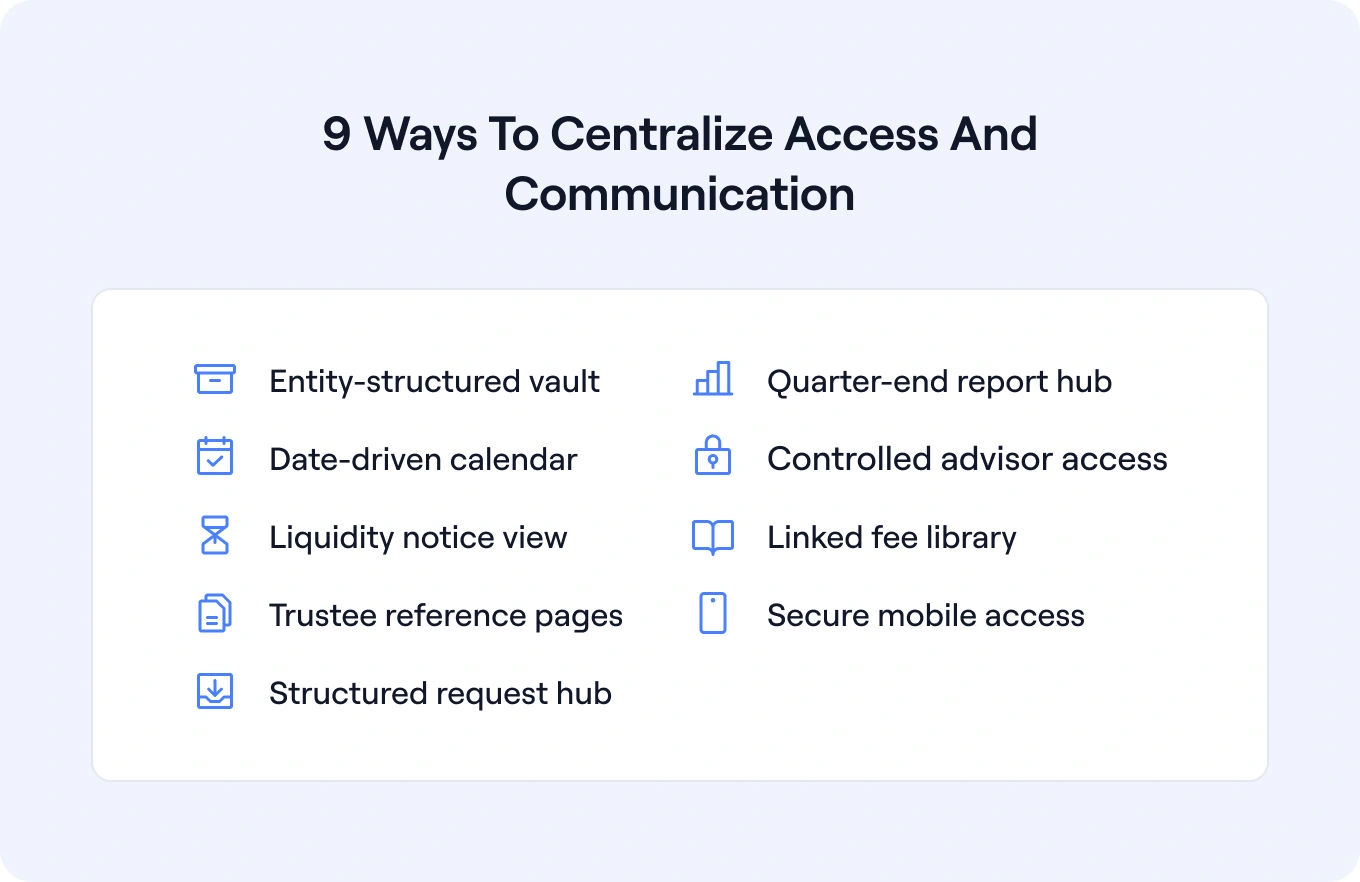
Centralisation is not achieved by uploading documents into a shared folder; it requires deliberate structural decisions about how entities, investments, reporting cycles, and advisors interact.
Below are nine structural practices used by modern single family offices to turn a family office portal into an operational control layer rather than a passive storage tool.
1. Shared document vault structured by entity and asset
The most effective document vaults mirror the legal and investment structure of the family office. Instead of organizing by document type alone (e.g., “Statements” or “Legal”), structure by:
- Entity (Trust A, Holdco B, SPV C)
- Investment within that entity
- Supporting documents linked to each investment
This approach enables contextual retrieval. A side letter sits alongside the fund it modifies. A subscription agreement links to supporting fund documents and reporting outputs (such as capital account statements, notices, and related records).
The result is reduced friction during audits, tax preparation, and due diligence reviews. Advisors do not request documents in isolation; they access them within a structural context.
2. Quarter-end reporting hub
Quarter-end is where fragmentation becomes visible, and many offices formalise this process around defined reporting standards and review cycles. A structured reporting hub centralizes:
- Capital account statements
- Net asset value (NAV) updates
- Consolidated performance reports
- Allocation breakdowns
- Benchmark-relative summaries (where applicable)
Publishing these outputs in a single controlled environment reduces repeated email distribution and version confusion.
For families operating across US and European structures, quarter-end discipline supports trustee reporting, investment committee reviews, and cross-border tax coordination.
The portal becomes the single reference point for “the latest finalized reporting set.”
3. Date-driven operational calendar
Liquidity windows, filing deadlines, insurance renewals, and document expiries create operational pressure. A date-driven layer within the portal should provide visibility and track:
- Capital call deadlines
- Redemption notice periods
- Tax filing milestones
- Compliance document refresh cycles
When deadlines sit inside inboxes, institutional memory becomes fragile. When they sit in a structured calendar tied to entities and investments, accountability becomes clear.
For portfolios with significant allocations to private markets, redemption and notice tracking can materially affect liquidity planning.
4. Controlled advisor access model
Family offices increasingly operate in multi-advisor environments:
- Custodians
- External accountants
- Legal counsel
- Investment advisors
- Outsourced CIOs
Centralisation does not mean broad access. It means controlled access aligned with governance.
A mature portal setup defines:
- Who can view which entities
- Who can access legal documents versus financial statements
- What is read-only versus contributor-level
This reduces the need to resend documents repeatedly and limits unnecessary data exposure.
The portal becomes the controlled collaboration layer across advisors, rather than an email relay system.
5. Liquidity and notice visibility across alternatives
Illiquid investments introduce timing complexity. Private equity, venture capital, real estate, and hedge funds often include:
- Lock-up periods
- Notice requirements
- Staggered capital calls
- Distribution notices, expected timing, and realized cash flows
Centralising liquidity and notice information allows the family office to maintain a forward view of capital commitments and potential cash inflows.
This is particularly relevant for lean teams managing 5–50 entities. Visibility reduces reliance on memory and spreadsheet trackers.
6. Fee and side letter library linked to funds
Fee structures in private markets are rarely uniform. Side letters may modify:
- Management fee terms
- Incentive allocations
- Co-invest rights
- Reporting requirements
A structured side letter library linked directly to the underlying fund provides reference clarity during performance review and audit discussions.
It also supports governance oversight. Principals and COOs can verify that fee treatment aligns with agreed terms, without searching archived correspondence.
7. Owner and trustee reference pages
Trust and holding company structures often span generations and jurisdictions. A portal can support central reference pages for:
- Trust deeds and amendments
- Trustee contacts
- Beneficiary structures
- Governance summaries
This does not replace trust administration systems. It centralizes structural awareness.
For cross-border families operating in the US and Europe, this reference layer reduces ambiguity during estate planning discussions and governance reviews.
8. Mobile-secure principal access
Mobility is an operational reality for many UHNW principals. A secure portal should support:
- MFA-protected access
- Viewing consolidated reports while travelling
- Secure document retrieval without forwarding attachments
This reduces dependence on unsecured file transfers and supports continuity across time zones.
Access control and mobility should operate together, not in tension.
9. Structured request hub
Document and reporting requests often originate from:
- Auditors
- Trustees
- Tax advisors
- Investment committees
- Family members
Without structure, these requests create duplicated effort and fragmented follow-up.
A request hub centralizes intake and links requests to the relevant entity or investment. Summaries can be exported for reconciliation within the office’s external workflow. This creates a documented pathway from request to fulfillment, reducing ambiguity around ownership.
Why a family office portal strengthens governance and operational control
When these nine elements operate together, a family office portal becomes more than a document repository. It functions as a governance and coordination layer across entities, custodians, advisors, and reporting systems. Structured document vaults, quarter-end reporting hubs, date-driven oversight, and controlled advisor access collectively create an environment where information flows through defined channels rather than fragmented inbox threads.
Importantly, a family office portal does not replace custodians, accounting systems, or performance engines. Custodians continue to hold and safeguard assets. Portfolio management and accounting systems continue to calculate performance, track cost basis, and record transactions. The portal sits above these components, centralising secure access to their outputs and linking them within the context of the family’s entity structure.
For UHNW individuals and lean single family offices, this architectural clarity reduces operational risk. It limits version drift during reporting cycles, clarifies document ownership during audits, and supports structured access during generational transitions. By acting as the secure front door to the broader reporting and aggregation stack, the family office portal strengthens accountability without duplicating underlying systems.
Vendor shortlist to evaluate
Selecting a family office portal is normally more about architectural fit than any one single feature. Some families prioritise communication and document governance. Others need deeper performance calculations across private markets. Others will require entity mapping across complex trust and holding structures.
In many cases, what is described as a “family office portal” may actually combine a data aggregation engine, a portfolio management system, and a consolidated reporting layer under one interface.
The vendors below are commonly considered by UHNW individuals and lean single family offices. Each approaches the portal layer differently; some emphasise collaboration, others performance analytics, and others governance infrastructure. The capabilities described are based on publicly available vendor materials.
1. Asora
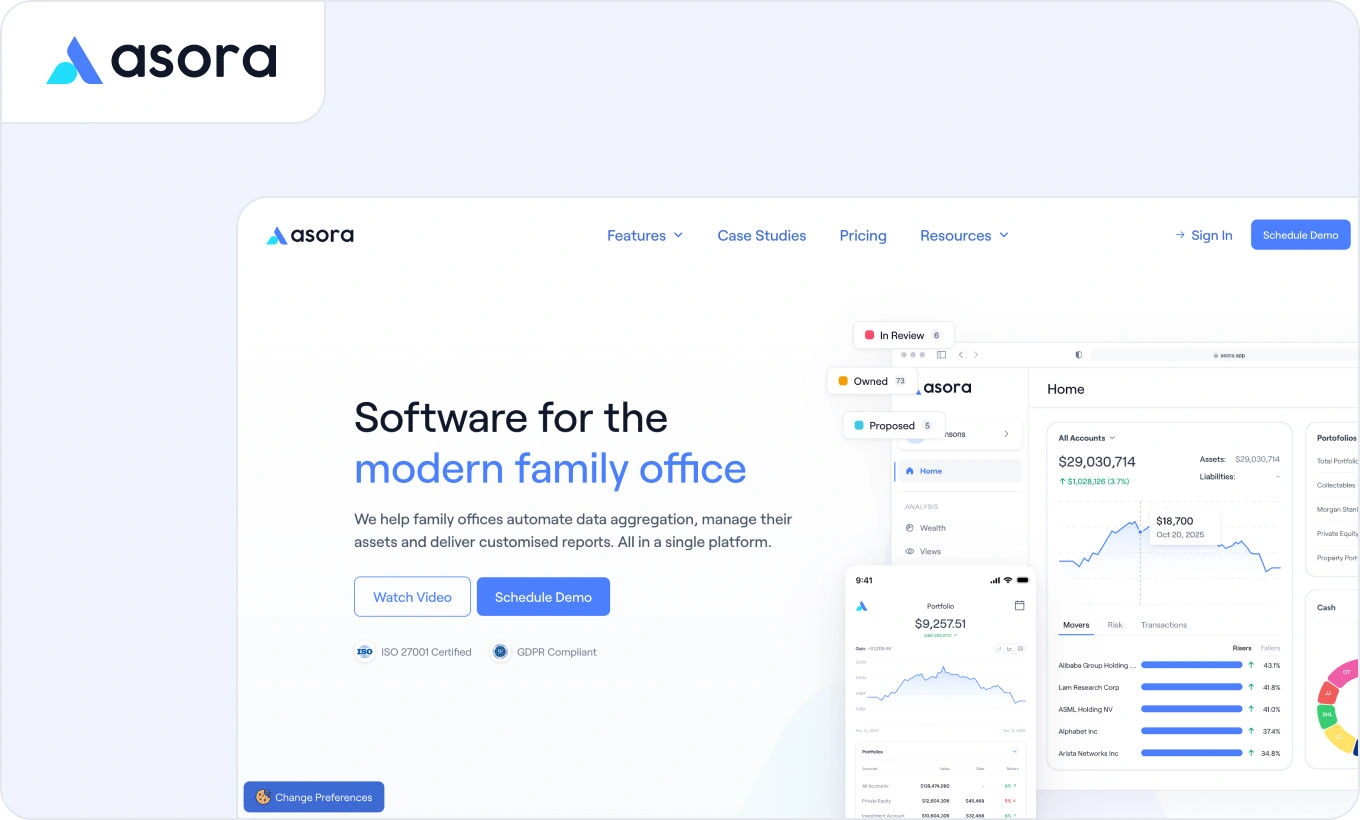
Best for: Integrated aggregation, reporting, and document management for lean single family offices
Asora supports family offices with a combination of data aggregation, performance monitoring, accounting, private assets tracking, documents, workflows, and a wealth map ownership visualisation (see our overview of what wealth mapping means in practice) within a single platform.
Its positioning focuses on UHNW individuals and lean single family offices managing approximately 5–50 entities. Rather than separating portal access from the reporting and calculation layers, Asora integrates them. The portal functions as the access and collaboration layer, while aggregation and reporting operate underneath.
Capabilities include:
- Consolidated reporting across multiple custodians
- Performance calculations, including time-weighted return (TWR) and internal rate of return (IRR)
- Cost basis and lot tracking
- Private asset registers for private equity, real estate, and other alternatives
- Document storage with entity-level organization
- Workflow support for recurring operational tasks
- Wealth Map for ownership/entity visualisation
- Mobile access with multi-factor authentication (MFA)
Asora supports families transitioning from Excel-based reporting toward a structured cloud environment and is designed specifically for UHNW individuals and lean SFOs .
Pricing: Tier-based. Starts at $900 per month for structures under $30M. All features are available across tiers.
2. Masttro
Best for: Entity mapping and multi-structure visualisation across complex ownership environments
Masttro is a family office software platform that combines data aggregation, reporting, and document management within a unified interface. It is used by family offices and wealth owners seeking consolidated visibility across financial institutions and entity structures.
The platform is particularly known for its emphasis on ownership visualisation, displaying relationships across trusts, holding companies, and underlying assets. For families with layered entity structures, this visual representation can provide clarity at both the principal and advisor level.
Capabilities include:
- Data aggregation across financial institutions
- Consolidated reporting outputs
- Document storage and sharing
- Multi-entity performance visibility
Its architecture is often suited to families seeking visibility into complex ownership networks, particularly where structural transparency is a priority alongside reporting.
Pricing: Custom pricing, contact vendor
3. Summitas
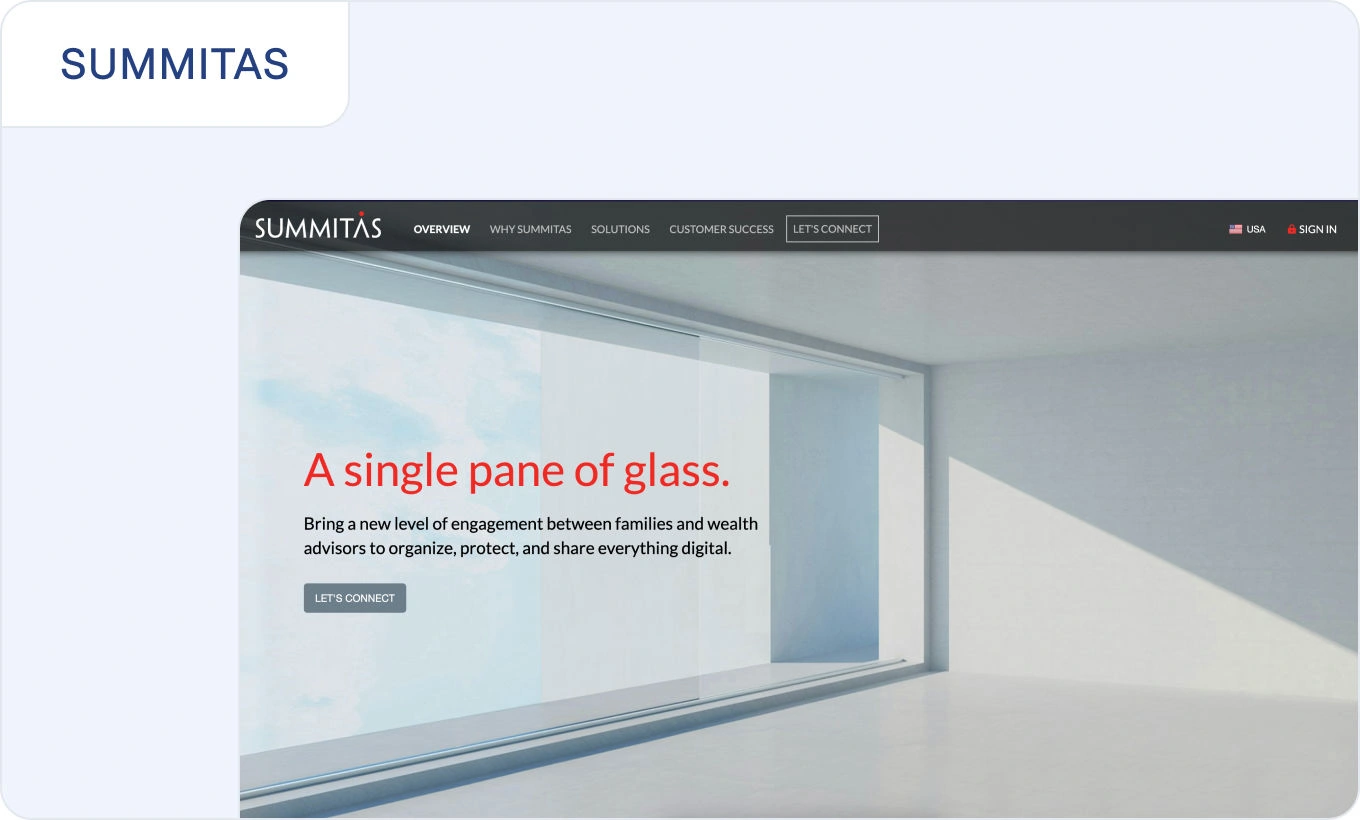
Best for: Secure communication and structured family–advisor collaboration
Summitas focuses primarily on the portal and collaboration layer. Its core strength lies in secure communication, document exchange, and controlled information sharing between families and their advisors.
Capabilities include:
- Secure document sharing
- Collaboration tools
- Role-based access controls
- Communication features designed for family governance
For families prioritising communication infrastructure and advisor coordination, Summitas operates primarily at the access and collaboration layer rather than as a full accounting or performance engine.
Pricing: Contact vendor
4. Leafplanner
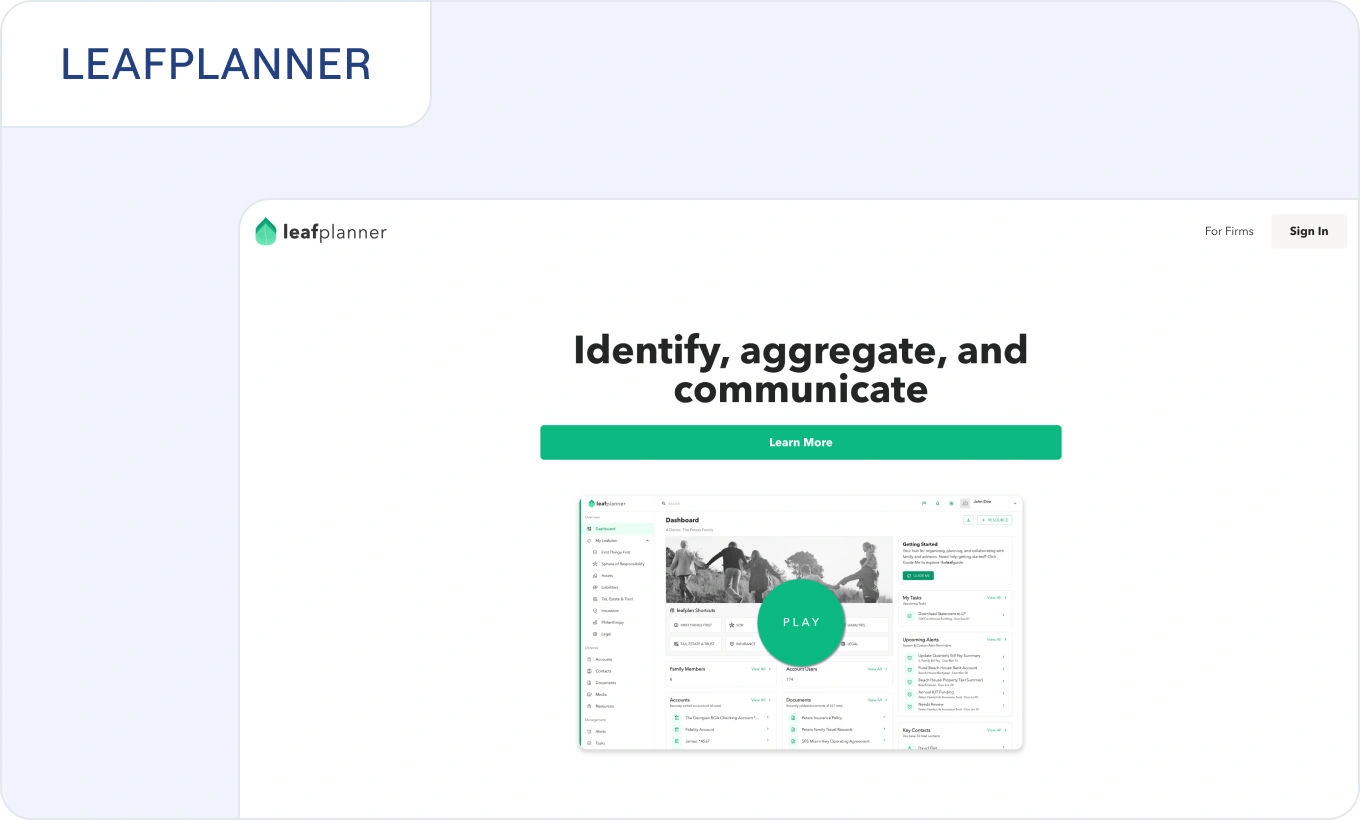
Best for: Centralising legacy, estate, and non-investment information
Leafplanner is structured around long-term information continuity. It provides a centralized environment for documenting estate plans, key contacts, insurance policies, and instructions for heirs and executors.
Typical use cases include:
- Succession planning documentation
- Organizing family records
- Storing key administrative information
- Creating a structured “manual” for future generations
Leafplanner is often complementary to investment reporting systems rather than a replacement for them.
Pricing: Tiered pricing starting at $4,000 for an annual subscription.
5. Copia Wealth Studios

Best for: Portfolios with significant allocations to private equity and real estate
Copia Wealth Studios emphasises performance analytics for alternative investments. For families with substantial exposure to private markets, detailed tracking of capital calls, distributions, and fund-level performance may be central.
Capabilities include:
- Alternative investment reporting
- Fund-level performance analysis
- Allocation visibility across private assets
- Data aggregation from multiple sources
Its orientation is toward analytical depth within alternatives, often complementing broader net worth reporting tools.
Pricing: Contact vendor
6. Strad Pro
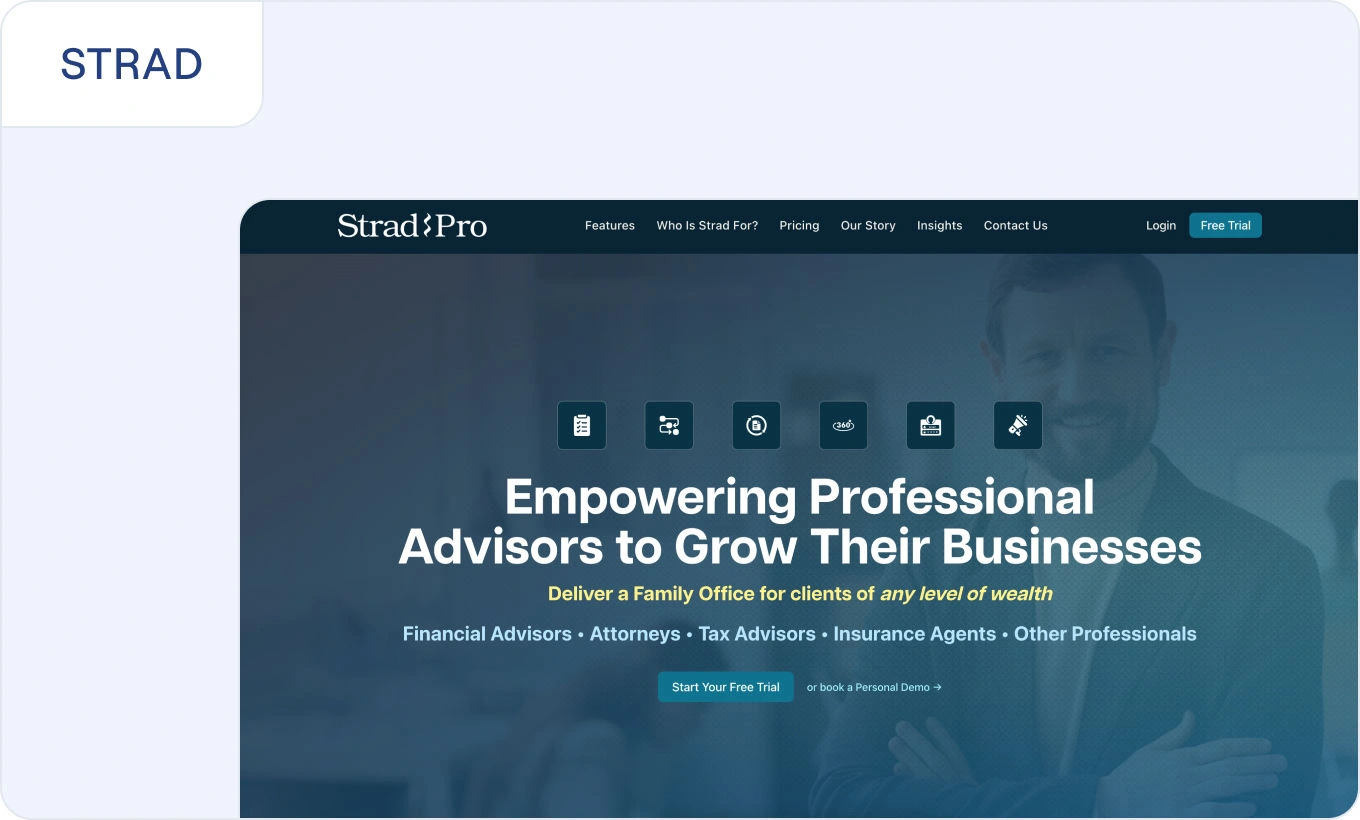
Best for: Registered Investment Advisors (RIAs) coordinating multi-advisor family structures
Strad is used by advisory firms operating virtual family office models. It supports workflow coordination and centralized client information across advisory teams.
Capabilities include:
- Workflow coordination
- Client-level document organization
- Reporting outputs
- Team collaboration features
Its architecture often aligns with advisor-led models rather than internally staffed single family offices.
Pricing: Tier pricing starting at $250 per month
7. Private Wealth Systems
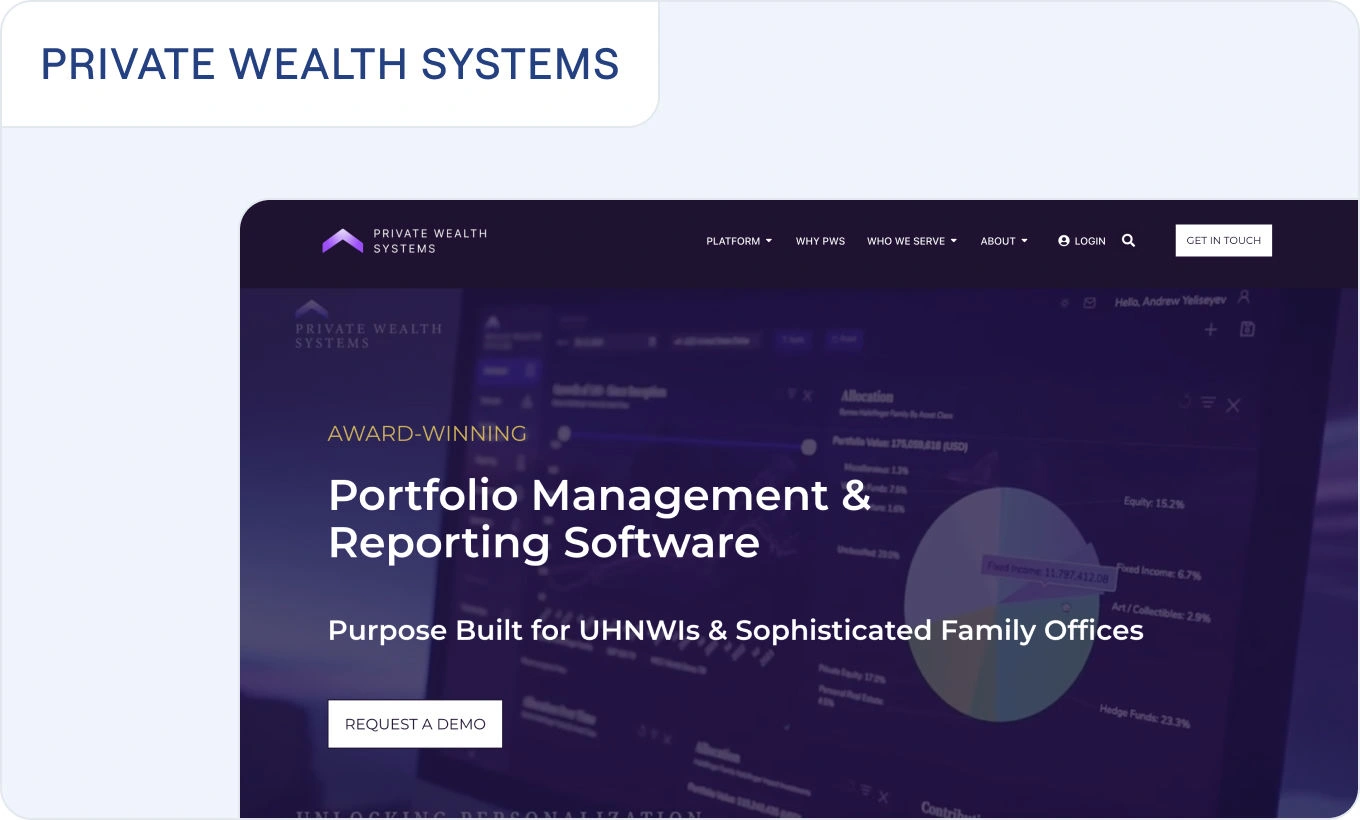
Best for: Multi-custodial investment oversight and consolidated reporting
Private Wealth Systems focuses on consolidated net worth reporting across custodians and investment accounts.
Capabilities include:
- Multi-custodial aggregation
- Investor portal to curate client experience
- Performance calculations
- Reporting exports
It is frequently considered by families prioritising detailed financial reporting across institutions.
Pricing: Contact vendor
Implementation
Selecting a family office portal is a strategic decision, but implementing it is an operational one. Many portals fail not because the technology is insufficient, but because governance, structure, and reporting priorities were not defined upfront.
For UHNW individuals and lean single family offices, implementation should follow the operating model of the office, not the other way around.
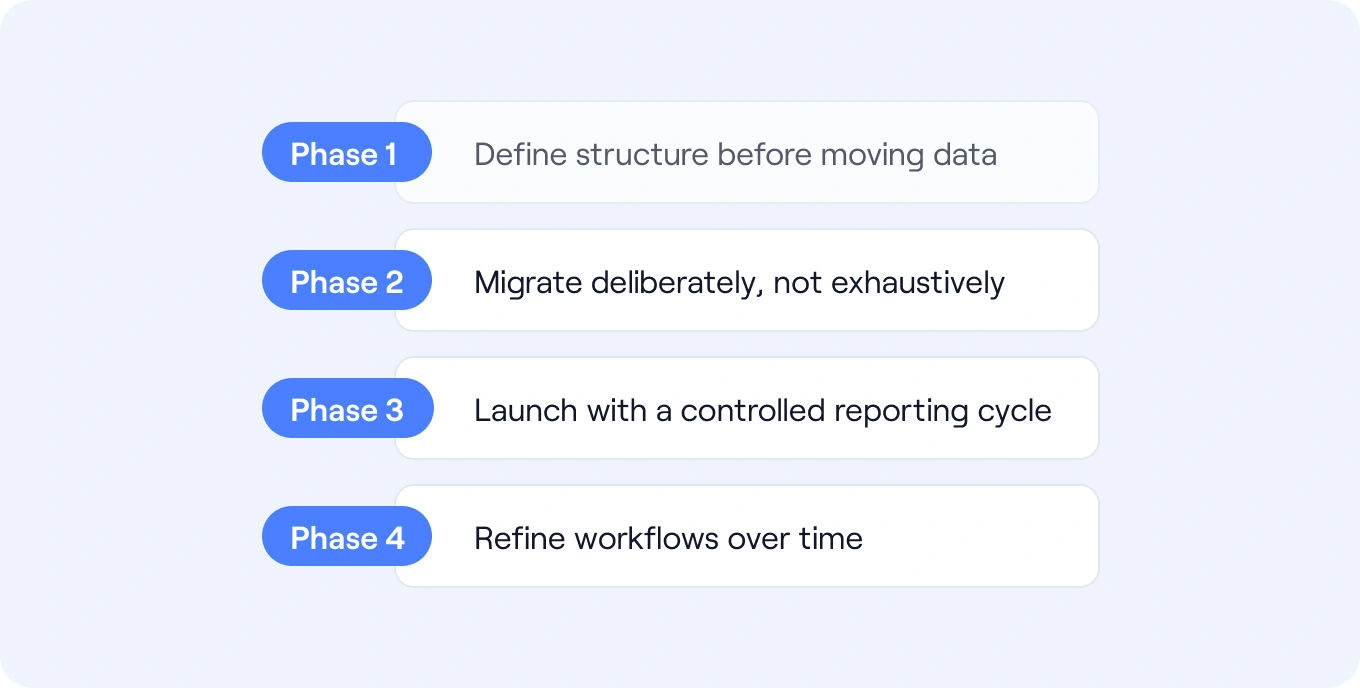
A phased approach allows the portal to become part of the reporting and governance infrastructure without disrupting quarter-end cycles or advisor coordination.
Phase 1: Define the structure before moving data
Before migrating a single document, clarify how the family office actually operates. This means identifying who needs access, what level of visibility is appropriate, and how entities relate to each other. A portal should reflect legal and governance reality, not override it.
Key preparatory steps typically include:
- Defining user roles (principal, COO, CFO, trustee, advisor, next-generation member)
- Mapping the full entity structure (trusts, holding companies, SPVs, operating entities)
- Categorising document types (legal, tax, reporting, investment-level documentation)
- Identifying which reports must be available at quarter-end
This structural clarity prevents later rework. It also ensures role-based access aligns with governance policy from day one.
For families operating across the US and Europe, mapping regulatory and reporting obligations early reduces friction during audit or tax coordination.
Phase 2: Migrate deliberately, not exhaustively
A common mistake is attempting to upload every historical document at once; this slows momentum and delays value. Instead, prioritise operational relevance.
Start with:
- Current-year reporting
- Active investment documentation
- Core legal documents (trust deeds, governing agreements, side letters)
- Compliance-sensitive records with expiry timelines
During migration, define a consistent folder taxonomy and tagging convention. Structure should be intuitive at the entity level, not dependent on one team member’s memory.
Date-based flags should be configured early, particularly for:
- Capital call deadlines
- Redemption notice periods
- Tax form delivery tracking
- Insurance and compliance renewals
Priority should be given to gaining visibility over active obligations. Historical records can then be migrated in structured phases without slowing momentum.
Phase 3: Launch with a controlled reporting cycle
A portal becomes embedded when it is tied to a real operational event. For most single family offices, this is quarter-end reporting. Rather than announcing a broad “system go-live,” publish a defined starter set:
- Consolidated net worth view
- Entity-level reporting
- Investment-level documentation where applicable
Onboard family members and advisors in stages. Principals may require overview reporting first, while advisors may require entity-specific access and next-generation members may receive read-only visibility.
Before formal distribution, conduct an internal dry run:
- Can required reports be accessed quickly?
- Are permissions aligned with governance expectations?
- Are document versions clearly identifiable?
These questions help to identify any potential friction before it becomes visible to external stakeholders.
Phase 4: Refine workflows over time
A family office portal should evolve alongside the office itself. After the first reporting cycle, gather structured feedback:
- Were any documents difficult to locate?
- Did advisors request materials outside the portal?
- Were deadlines clearly visible?
- Did governance boundaries hold as intended?
Refinement may include:
- Adjusting role-based permissions
- Reorganizing document categories
- Expanding liquidity tracking
- Improving report export consistency
For lean teams managing 5–50 entities, incremental refinement is more sustainable than large structural resets.
Portal implementation often aligns with natural operational inflection points such as year-end reporting preparation, audit cycles, tax season planning, or the arrival of a new COO or operational lead tasked with modernising infrastructure. Introducing a family office portal immediately before a major reporting deadline can create unnecessary pressure.
A phased rollout anchored to an upcoming reporting milestone (such as the next quarter-end cycle) typically allows governance, permissions, and document structure to stabilise before full reliance is placed on the system.
When introduced deliberately, a family office portal does not alter how a family governs wealth; it simply brings structure to it
Clearly defined roles, aligned entity mapping, disciplined document control, and structured reporting access transform the portal into the operational front door of the broader aggregation and reporting stack.
Choosing the Right Family Office Portal For Your Structure
A family office portal functions as the secure front door to a broader reporting and aggregation stack. Platforms such as Asora integrate this portal layer with data aggregation, performance monitoring, accounting, and document management underneath, while others may combine separate systems. In either case, the portal does not replace custodians, and it does not operate in isolation from performance and accounting infrastructure.
For UHNW individuals and lean single family offices, centralising communication and access supports:
- Clearer governance
- Structured reporting cycles
- Reduced manual document handling
- Controlled advisor collaboration
Selection of any new family office portal should focus on how well the portal layer integrates with aggregation and reporting underneath, and whether governance and security controls align with your entity structure.
If you are evaluating how to centralize communication, reporting, and document control within your family office, seeing the architecture in practice is often more useful than reviewing feature lists.
Request a demo to explore how Asora’s structured family office portal can support your reporting, governance, and operational needs.
FAQ
Can a family office portal handle complex ownership structures and personal assets?
Yes. Modern portals are designed to reflect layered ownership structures across trusts, holding companies, and special purpose vehicles. They centralize visibility across both investment holdings and personal assets, creating a comprehensive view of the family balance sheet. For example, Asora supports multi-entity structures common in single family offices and links asset registers with supporting documents in one place. This improves the ability of family office staff to organize records clearly and analyze exposure across entities, particularly in multi-jurisdiction structures.
How do direct feeds improve reporting accuracy for multi-asset portfolios?
Direct feeds, including direct data feeds from custodians, reduce manual entry and fragmented spreadsheet tracking. When integrated into a single portal, they provide timely visibility across multi-asset portfolios and support consistent reporting cycles. This enables family office professionals to generate more reliable insights, track growth across asset classes, and evaluate strategies with greater precision.
How can a family office portal be future-proof for generational transitions?
A portal becomes future-proof when it is structured around governance, role-based access, and documented ownership structures. By centralising documents and reporting in one secure environment, it allows family office staff to gradually extend visibility to the next person in line for leadership. Controlled access to reports and data-driven insights supports education, continuity, and long-term growth without exposing sensitive information prematurely.
Why do family office staff and prospective clients value a single portal experience?
Fragmented systems create friction and reduce clarity. A single portal provides a consolidated view across custodians, banks, entities, and investments, making it easier to organize documents, analyze performance, and communicate clearly. For family office staff, this improves operational efficiency. For prospective clients evaluating private wealth management firms, structured reporting and visible industry standards can strengthen confidence in the firm’s governance and strategic approach.
.jpg)
.png)
 ISO 27001 Certified
 GDPR Compliant