

Author

.jpg)

Table of contents
"What used to take hours or days is now done in minutes"

A durable family wealth plan connects family values to day-to-day execution. It clarifies roles for family members, aligns an evidence-based investment strategy across public markets and alternative investments, formalizes estate planning and other critical legal documents, and develops financial education to enable younger family members to learn how to manage and grow wealth for their family. Governance stays light; reporting stays consistent. The right platform, such as Asora, consolidates banking, portfolios, private assets, entities, and documents to give families a unified financial view. This supports the family’s financial future through long-term family wealth planning rather than one-off decisions.
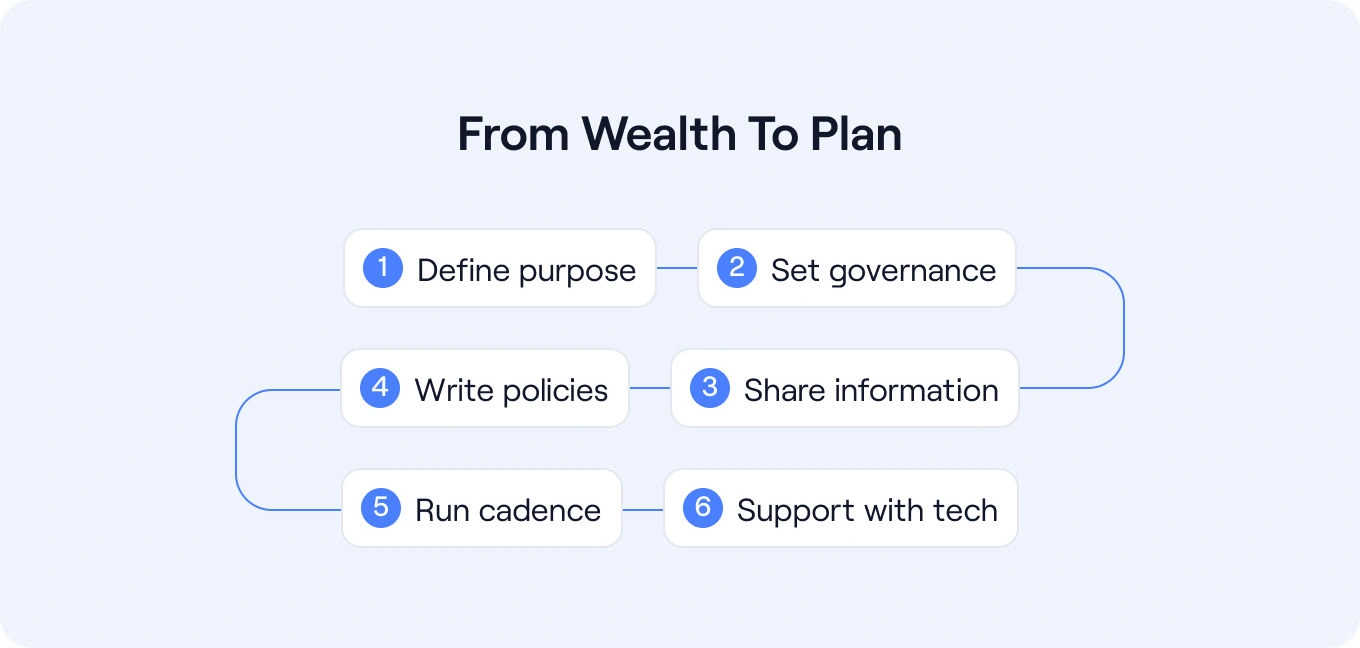
Families that preserve and grow family wealth typically share three traits: purpose, process, and shared information. Purpose explains what the money is for and how it reflects family values. The process sets out who decides what, when, and on what evidence. Shared information ensures everyone sees the same picture of accounts, entities, asset classes, cash flows, and obligations.Informal arrangements often fail under pressure. Numbers get scattered across inboxes, outdated information starts to drive financial decisions, and routine financial transactions consume the time that should be spent on judgment. A written plan establishes the baseline: a small family council that meets on schedule, an agreed-upon policy for spending, saving, and charitable giving, and clear rules for succession planning and intergenerational wealth transfer.
Technology should serve that discipline. Asora aggregates accounts and entities, tracks private assets, and stores and links documents to the records they support, so family meetings run on current, consistent data.This article delivers a practical, principles-based framework for family wealth planning. It covers how family offices must balance governance, structure, planning, education, allocation, tax, liquidity, and operational discipline while addressing common questions.
Modern wealth rarely sits in a single brokerage account. Most wealthy families hold a diverse portfolio of assets, including bank deposits, listed securities, family businesses, partnerships, trusts, alternative investments, and personal assets with emotional value. Each source produces data and documents on its own timetable. Without a system, teams re-key information, evidence is hard to find, and wealth transfer becomes reactive rather than planned. A consistent approach reduces those frictions and keeps the entire family aligned with the same facts.Asora supports this approach in three practical ways. First, by aggregating positions, transactions, holdings, and cash across banks and custodians to produce a timely consolidated view of financial assets. Second, by treating private assets as dated events, commitments, capital calls, distributions, and valuations, exposure and cash planning become straightforward. Third, by tying documents to the numbers they substantiate, which shortens reviews and anchors decision-making processes in evidence.

The following 10 essentials walk through the core building blocks: values and governance, legal and structural foundations, family-business alignment, an investable policy across public and private assets, education for younger family members, succession planning, cash and liquidity management, and day-to-day operations. Each essential builds alignment across investments, goals, and family members by linking financial decisions to shared purpose.
A resilient family wealth succession plan begins with a clear purpose. The family’s values and personal values should be expressed in clear prose, not jargon. Some families prioritize education for future generations, while others emphasize entrepreneurship, stewardship of a family legacy, or charitable causes. The plan should also define where financial support begins and ends for different family members, as well as what constitutes financial independence at various life stages.
Values become operational when expressed as outcomes, such as education funded through completion, a liquidity buffer for living expenses, exposure limits for concentrated holdings, and a giving policy (foundation or donor-advised fund) with established approval thresholds. These outcomes guide allocation, liquidity, and wealth transfer decisions, thereby reducing ambiguity and uncertainty. In practice, families keep this one-page preface with the main family wealth plan and refer to it in reviews. Asora can pin this document to the relevant entities so the context is always one click away.
Family governance is effective when responsibilities are clearly defined. A compact family council, representing both older and younger generations, helps maintain momentum between meetings. Decision rights need to be documented, specifying which items require full-family consent (such as major liquidity events or new legal vehicles) and which the council can decide within agreed-upon ranges.
A fixed rhythm beats ad-hoc urgency. Meetings should focus on performance versus plan, cash needs and commitments, and updates to trusts or company documents. Short minutes, kept with the assets and entities they affect, prevent misunderstandings later. Asora helps by storing meeting agendas and notes in Documents, linking them to the relevant portfolios and entities, and utilizing Workflows to track follow-ups, ensuring that everyone reviews the exact figures and source evidence.
Approvals, memos, trustee directions, and board resolutions are most useful when stored as documents and explicitly linked to the relevant holdings (entity, portfolio, account, or asset). In Asora, you save each item in Documents and link it to the underlying structure. Those links live with the entity, so they persist through staff changes.
Wills, trusts, powers of attorney, and health directives require periodic review. Beneficiary designations should match the intended wealth transfer, not an outdated draft. Ownership registers for companies, partnerships, and properties need to reflect reality rather than assumptions. Keeping these critical legal documents tagged and linked inside Asora reduces search time and avoids version drift.
Where estate taxes or similar transfer costs apply, liquidity matters as much as intent. A funding plan—such as retained cash, distributions, or insurance policies—prevents forced sales. The plan complements the main family wealth plan and should be reviewed at each governance meeting, particularly after significant life events or the sale of assets.
Charitable giving deserves the same clarity as investing. Families often adopt a policy for recommendations, approvals, and reporting. Donor-advised funds can simplify timing; foundations offer additional structure and oversight. Storing policy documents and grant records with the giving entity in Asora enables reports to display both numerical and narrative information together.
A family business complicates both ownership and careers. Criteria for successors, development timelines, and alternatives, such as board roles, reduce confusion and resentment. Non-operating family members may receive distributions or other financial support in accordance with rules that protect working capital and lender covenants.
Voting rules, buy-sell provisions, and redemption terms work best when agreed well before they are needed. Shareholder agreements must align with the language of trust and the broader estate plan. Structural maps (holdcos, operating companies, SPVs) help everyone understand control and cash flows. Asora mirrors these relationships and links the underlying agreements to the entities they govern, which keeps reviews practical.
An effective investment strategy sets ranges across asset classes (equities, fixed income, cash, property, and alternative investments) with clear rebalancing rules, currency treatment, and an illiquidity budget tied to spending and commitments. Short, explicit policies are more likely to be read and followed. Policies can be stored alongside performance views in Asora, ensuring that discussions remain anchored in agreed-upon definitions rather than ad hoc opinions.
Supporting documents (LPAs, side letters, valuation statements) should accompany the entries they support. Asora handles private asset tracking and shows exposures per owner or entity, simplifying multigenerational wealth planning.
Past performance informs assumptions but should not dictate allocation. Reviews should focus on contributors and detractors, exposures against policy, and the risk the entire family is willing to accept. With Asora’s performance and accounting views, time is spent on interpretation rather than reconstruction.
Effective family wealth planning depends on routine. Results are reviewed on schedule rather than in reaction to headlines; spending stays within policy; records remain current; and every financial transaction can be traced to its source. By aggregating data from banks and custodians, and by keeping the supporting evidence (statements, resolutions, trustee directions) alongside the numbers they substantiate, Asora reduces manual effort and enhances auditability.
Growing family wealth is a cumulative process rather than a dramatic one. Consistent saving, diversification across asset classes, deliberate exposure to illiquidity, measured leverage, and periodic rebalancing do most of the work. Decisions remain small and reversible where possible, and are practical steps for growing family wealth. Families often record key decisions in Asora as notes or documents, ensuring that future reviews include both context and outcomes.
Financial education begins with money lessons (budgeting, compounding, reading statements, understanding fees and taxes) and moves to governance: trustee duties, voting rules, and documentation standards. Younger family members benefit from supervised responsibilities, such as presenting an exposure summary, coordinating a review of charitable giving, or drafting a memo for a capital call. Recording these events in Asora builds continuity and demonstrates progress over time.
Participation should feel routine rather than exceptional. Inviting the next generation to segments of family meetings where learning outweighs sensitivity builds confidence and context. Over time, this results in practical financial responsibility and improved succession outcomes.
Effective family wealth transition planning removes ambiguity. Rules for gifts, distributions, and loans should be clear, including documentation standards and approval thresholds. The distinction between equal and fair needs to be explicitly addressed when unique assets or a family business are involved.
Family wealth succession planning fails when documents say one thing and practice contradicts it. Trust language, beneficiary designations, and account titling must align with the real goals. Keeping documents current and accessible to stakeholders reduces friction when responsibilities change. Asora’s document links keep evidence linked to the assets they govern.

A plan without a cash engine is fragile. Each household’s baseline living expenses should be modeled, including irregular obligations. Income streams and distributions then match the timeline. The definition of “enough money” must be explicit for each branch of the family so generosity does not become drift.
Stress tests for drawdowns, rate shifts, and clusters of private-asset calls provide a more useful picture than point estimates. The order of sale and the assets protected from sale are worth deciding in calm periods. Recording those rules in Asora keeps them at the front of mind when markets are noisy.
Clarity improves when teams rely on a single source of truth. A right-sized system reduces re-keying and version drift by consolidating bank, broker, and private asset records, linking evidence, and maintaining visible entity relationships. Asora focuses on this operational backbone (consolidated reporting, performance tracking, accounting details, document management, and lightweight workflows) so that small teams can handle complexity without an institutional stack.
Technology equips professionals; it doesn’t replace them. Shared facts enable financial advisors, accountants, and lawyers to focus on financial strategies, structure, and risk management rather than chasing files. That partnership enables high-net-worth individuals and families to simplify their routines.
Multigenerational wealth endures when purpose, process, and information align in harmony. A concise statement of family values, light-but-real governance, current documents, a policy-led investment strategy, and deliberate education for younger family members turn “wealth” into a repeatable operating system. Run that system on a set cadence, measure what matters, and adjust as roles and markets change.Asora helps you keep the mechanics tight without the overhead: consolidated banking and custodial data aggregation, structured tracking for private assets, performance and accounting views that match your policy, and documents linked to the numbers they substantiate. The result is fewer surprises in succession, faster reviews, and decisions made from one shared picture rather than scattered files.
Request a demo of Asora to see how the right wealth platform supports consolidation, reporting, and governance for families today and for future generations.
Lorem ipsum dolor sit amet, consectetur adipiscing elit. Suspendisse varius enim in eros elementum tristique. Duis cursus, mi quis viverra ornare, eros dolor interdum nulla, ut commodo diam libero vitae erat. Aenean faucibus nibh et justo cursus id rutrum lorem imperdiet. Nunc ut sem vitae risus tristique posuere.
Purpose-built technology replaces ad-hoc spreadsheets with a single source of truth, reducing re-keying, version drift, and review friction. Asora aggregates data from banks and custodians, tracks private asset events (commitments, capital calls, distributions, and valuations), supports tranche/lot accounting, and delivers consistent reporting views on the web and mobile. With documents stored alongside holdings and entities, families and advisors can collaborate on the same facts, spending more time on strategy rather than reconstruction.
The essentials are: shared values and governance, complete visibility of holdings, a policy-led investment approach, documented succession, and disciplined reporting. Asora supports these steps in an ISO 27001-certified, GDPR-compliant environment by consolidating positions, transactions, and cash; linking critical legal documents to assets and entities; and providing on-demand reporting and timely performance metrics (e.g., TWR/IRR) that align with the family’s policy.
Strong controls combine secure infrastructure with transparent processes for access and evidence. Asora is ISO 27001 certified and designed with GDPR in mind; documents are securely stored and linked to the relevant entities or assets, while data is encrypted both in transit and at rest. This setup helps family offices keep sensitive records protected and retrievable for reviews without maintaining parallel file stores.
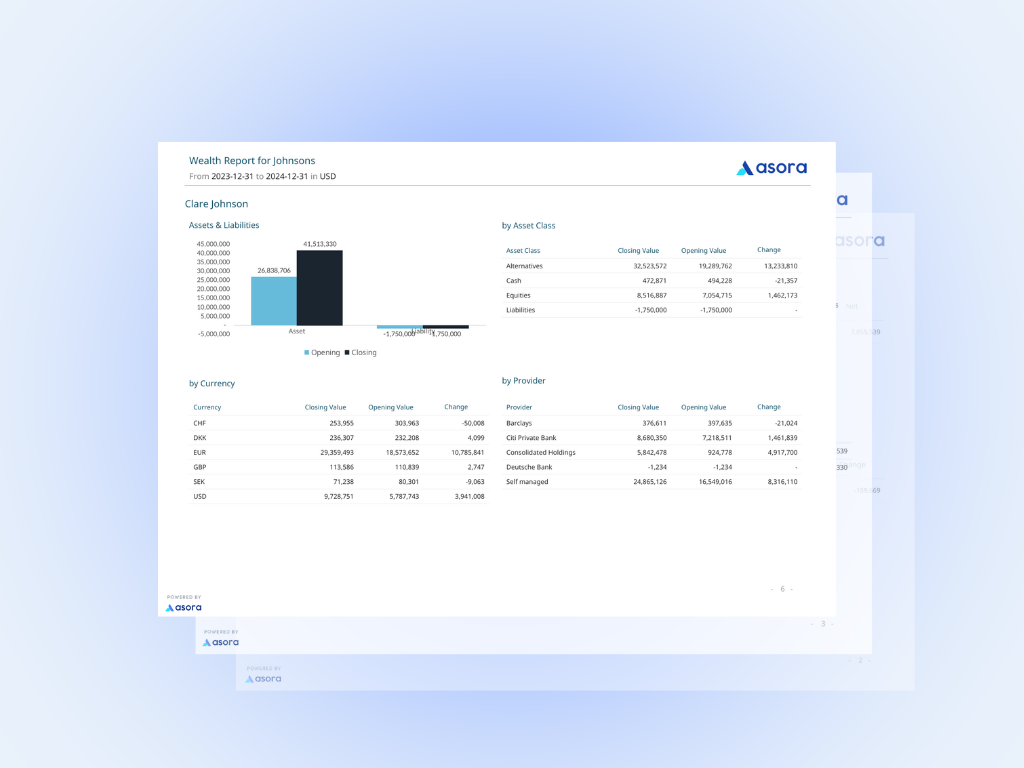
Consolidated reporting transforms fragmented data into a coherent view of performance, exposures, cash, and obligations, critical for allocation, risk, and progress against goals. Asora removes manual compilation by bringing bankable and private assets together, applying consistent calculation methods, and producing on-demand reports that reflect the family’s structure and definitions. The result is faster reviews, fewer discrepancies, and decisions grounded in the same evidence across the entire family and advisor bench.




.png)
.jpg)
.png)
.png)
.jpg)
.png)

.png)

.png)
.png)
.jpg)

.jpg)
.jpg)
.png)




.jpg)
.jpg)


.png)
.jpg)
.jpg)
.jpg)
.jpg)
.jpg)
.jpg)

.png)
.webp)


.png)
.png)
.png)
.png)
.png)
.png)
.jpg)
.jpg)
.png)
.png)
.png)
.png)
.jpg)
.png)
.png)
.png)
.png)
.png)
.png)
.png)
.png)
.png)
.jpg)
.png)
.png)
.png)


.png)


.webp)