
.jpg)
TL;DR
Single-family offices need software that aggregates data from custodians, banks, and non-custodied sources, tracks alternatives, and produces timely reports. This guide profiles 10 platforms used by lean SFO teams, with notes on features, pricing models, and fit by complexity. Use it to shortlist 3–4 vendors for demos with your data.
The Software Side of SFO Private Wealth Management
Private wealth management for single-family offices covers a broad range of activities. This article focuses on the operational and reporting side:
- Aggregating data from custodians and banks
- Tracking private investments
- Maintaining investment accounting records
- Generating reports for principals and advisors
These tools help wealthy families improve data quality, reporting timeliness, and operational control, in support of long-term wealth stewardship and the maintenance of a long-term vision for their family's financial future.
We're not covering investment advisory services, concierge services, trust services, or wealth advisory relationships here. Those are other family office services often handled by external private wealth advisors, family office experts, or multi-family office providers. Strategic generational wealth management requires both sophisticated solutions and the right operational infrastructure.
We’re looking at software-only platforms adopted by lean SFO teams, typically supporting complex entity structures and multi-asset portfolios (often $100M+, but not strictly limited by AUM), handling both liquid portfolios and alternative investments.
This list reflects editorial fit assessment for lean SFO teams (not market share). Most family offices should shortlist 3–4 platforms and run demos before making a decision.
What Counts as Private Wealth Management for SFOs
A single family office is a private organisation that manages a family’s wealth, entity administration, reporting, governance, and often selected administrative functions (scope varies by family). Unlike a multi-family office serving multiple clients, an SFO offers greater control and a personalized approach tailored to the family's mission and shared values.
Single-family offices face complex challenges that require advanced solutions. You're managing wealth for one family, but those family members may have dozens of entities, multiple custodians, and a mix of liquid and illiquid holdings.
Here's what private wealth solutions for single-family offices need to handle:
- Multi-bank aggregation: Pulling data from custodians, brokers, and banks with timely updates. Manual upload paths for institutions without feeds.
- Private assets: Private investments (PE/VC, hedge funds, direct deals, private credit, real estate). Entity/structure tracking (trusts, SPVs, partnerships). Non-financial asset registry (art/collectibles) where relevant
- Portfolio and investment accounting: Cost basis tracking, tranche/lot accounting, realized and unrealized gains. Time-weighted return (TWR) (typically for liquid portfolios) and IRR/XIRR (commonly for cashflow-driven private investments), subject to valuation frequency and reconciliation quality.
- Document management: Secure storage with tagging, linking documents to entities, assets, or transactions.
- Reporting: Period reports for principals and advisors. Exportable reports and data extracts to support tax preparation and planning.
- Workflow support: Tasks, reminders, and deal/pipeline tracking.
- Ownership visualization: Mapping entity structures and look-through ownership (where data is available) to support planning and reporting to support the family legacy and estate planning goals.
The risks of staying in spreadsheets:
Most family offices still rely on Excel, and that’s a liability for long-term investment goals. Manual workflows lead to broken formulas, version chaos, missing files, and slow reporting. Tax planning and due diligence can become harder when data sits in silos. Estate planning turns fuzzy when no one sees the full picture of what’s held where.
Building a lasting legacy with reliable contingency plans takes time spent on accuracy instead of manual spreadsheet maintenance. Without proper systems, succession planning for the next generation stays theoretical, and multi-generational wealth becomes harder to manage.
10 Single-Family Offices Private Wealth Management Software Platforms to Consider
1. Asora
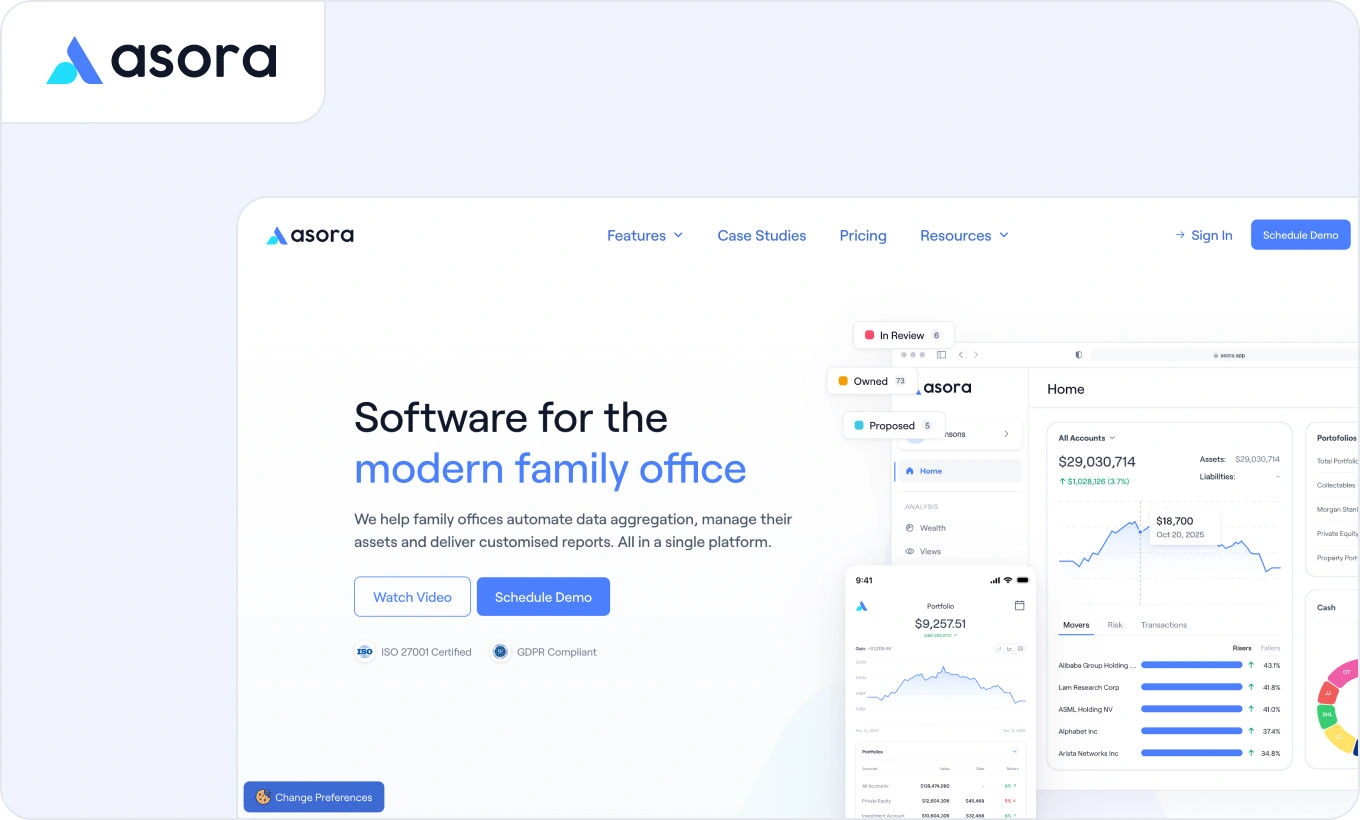
Asora is a wealth platform purpose-built for family offices and ultra-high-net-worth individuals (UHNWIs). It brings banking, investments, and private assets into one place with a clean interface designed for lean teams.
Who uses it: Single family offices and multi-family offices of all sizes, with $30M+ AUM looking to move beyond spreadsheets with automation and structured reporting
Key features:
- Data Aggregation from custodians and banks with timely updates
- Private Assets tracking for PE, real estate, collectibles, and direct deals
- Performance Monitoring with TWR and IRR calculations
- Accounting with tranche-level cost basis and gains tracking
- Wealth Map for visualizing ownership across entities
- Documents vault with tagging and linking to assets
- Workflows for tasks and pipeline tracking
- Mobile app with MFA for principal access
Pricing : Tier-based, starting at $900/month, with full platform access and optional add-ons depending on needs.
2. Asset Vantage
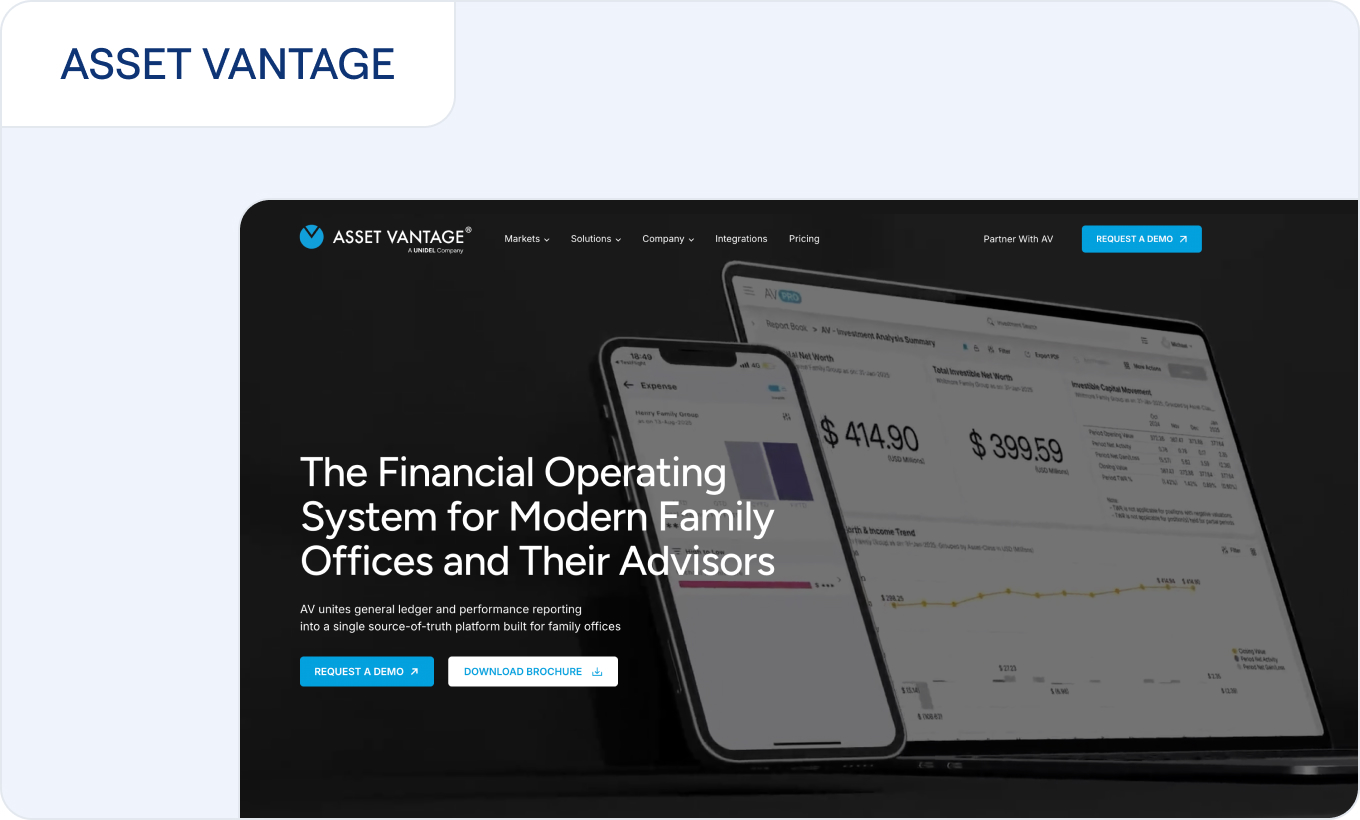
Asset Vantage is a GL-led family office platform combining general ledger accounting with investment data aggregation and partnership accounting.
Who uses it: Single and multi-family offices with complex partnership structures requiring integrated accounting. Founded in 2011, the platform serves 300+ families globally.
Key features:
- General ledger integrated with investment accounting
- Partnership accounting with look-through capabilities
- Performance reporting (IRR for illiquids, TWR for liquid)
- Data feeds from custodians and banks
- Mobile app for portfolio access
- Tax reporting support (US-focused)
Pricing: Asset Vantage lists SFO pricing at ~$30k+/year range depending on entity count.
3. Black Diamond (SS&C)
.webp)
Black Diamond is a portfolio reporting and analytics platform from SS&C, primarily serving wealth managers and RIAs but also used by family offices.
Who uses it: Wealth managers, RIAs, and family offices focused on liquid portfolio reporting and performance analytics.
Key features:
- Portfolio performance reporting
- Custodian data aggregation
- Customizable dashboards
- PDF report generation
- Investment analytics
- Client portal access
Pricing: Contact vendor.
4. Copia Wealth Studios
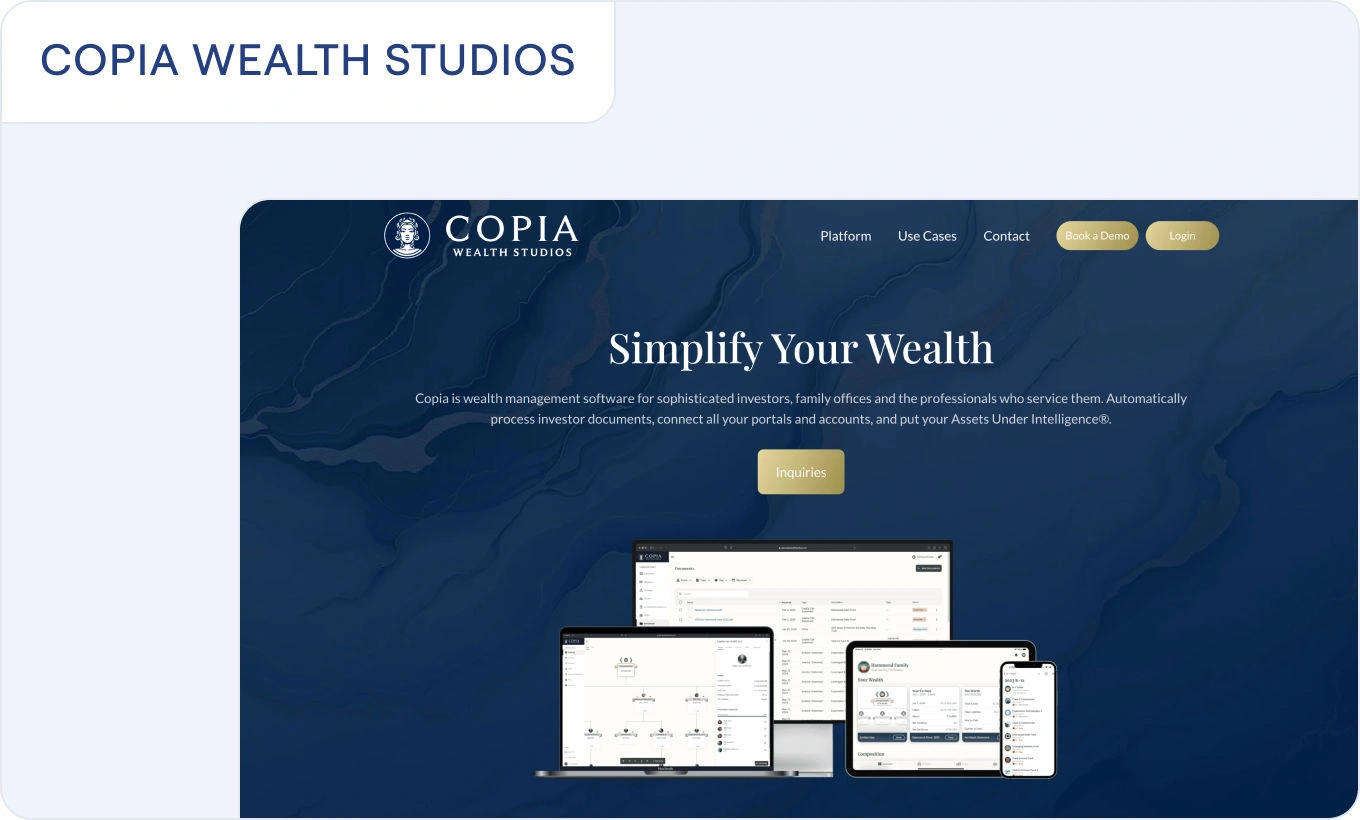
Copia offers a wealth consolidation platform with document processing capabilities and owner-focused dashboards.
Who uses it: Single-family offices seeking consolidated views with strong document ingestion and a principal-facing interface.
Key features:
- Wealth consolidation across custodians
- AI-powered Document processing and extraction
- Performance reporting
- Entity mapping
- Workflow sequences for repetitive tasks
- Cash flow forecasting
Pricing: Contact vendor.
5. Landytech
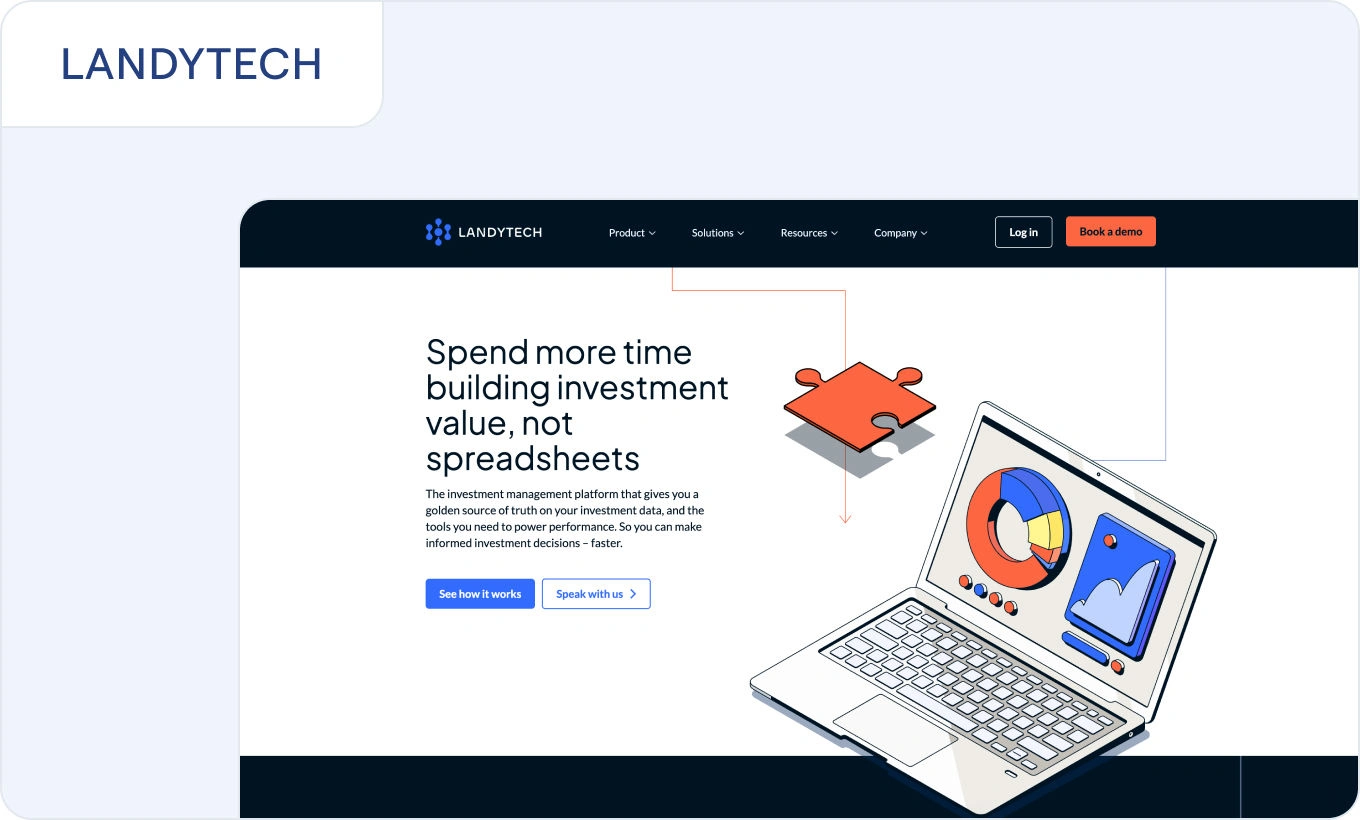
Landytech provides analytics and reporting through its Sesame platform, designed for multi-asset portfolios including alternatives.
Who uses it: Asset owners, managers, and advisors focused on analytics, risk management, and reporting across complex portfolios.
Key features:
- Multi-asset portfolio analytics
- Performance reporting
- Risk analytics
- Private asset reporting
- Look-through ownership analysis
- Data aggregation from custodians
- Custom reporting
Pricing: Contact vendor.
6. QPLIX

QPLIX is a wealth management software platform with family-office origins, offering portfolio management and reporting capabilities.
Who uses it: European family offices, wealth managers, and asset managers. Strong presence in the DACH region.
Key features:
- Portfolio management and accounting
- Automated trading and rebalancing
- Performance reporting
- Document management
- Accounting and tax integration
- Client portal and app
Pricing: Contact vendor.
7. Private Wealth Systems
Private Wealth Systems offers a consolidated wealth platform for tracking total net worth across asset classes and entities.
Who uses it: UHNWIs and family offices seeking consolidated views of their wealth data.
Key features:
- Consolidated reporting across asset classes
- Performance reporting
- Custodian data aggregation
- Document management
- Entity mapping
- Open architecture for integrations
Pricing: Contact vendor.
8. FundCount
FundCount unifies fund accounting, partnership accounting, and portfolio management into a single platform built for hedge funds. Its edge lies in the tight integration between the general ledger, partner accounting, and portfolio analytics, keeping capital accounts, allocations, and performance in sync. It supports tax preparation workflows such as tax lot tracking and gain or loss reporting, but it is not a tax filing system and does not replace qualified tax counsel or filing software.
Who uses it: Family offices with complex partnership structures, fund administrators, and offices managing alternative investments.
Key features:
- Unified general ledger with investment accounting
- Partnership accounting with nested entities
- Portfolio accounting with performance metrics
- Bill pay functionality
- Data feeds from custodians
- US tax reporting support
Pricing: Tier-based. Single-family office plans start around $30,000/year.
9. Masttro
Masttro is a consolidation and reporting platform designed for complex, multi-asset wealth across multiple jurisdictions.
Who uses it: Single and multi-family offices, wealth professionals, and institutions managing global portfolios.
Key features:
- Consolidated reporting across asset classes
- Performance reporting
- Data aggregation from custodians
- Compliance module
- Entity mapping
- AI-assisted document processing and analytics
Pricing: Fixed pricing, contact vendor.
10. Altoo

Altoo offers an owner-centric consolidation platform that provides principals with clear views of total wealth.
Who uses it: UHNWIs and single-family offices in Europe seeking principal-facing dashboards.
Key features:
- Wealth consolidation
- Performance reporting
- Dashboards designed for principals
- Multi-currency support
- Document storage
Pricing: Contact vendor.
How We Picked: Buyer Criteria
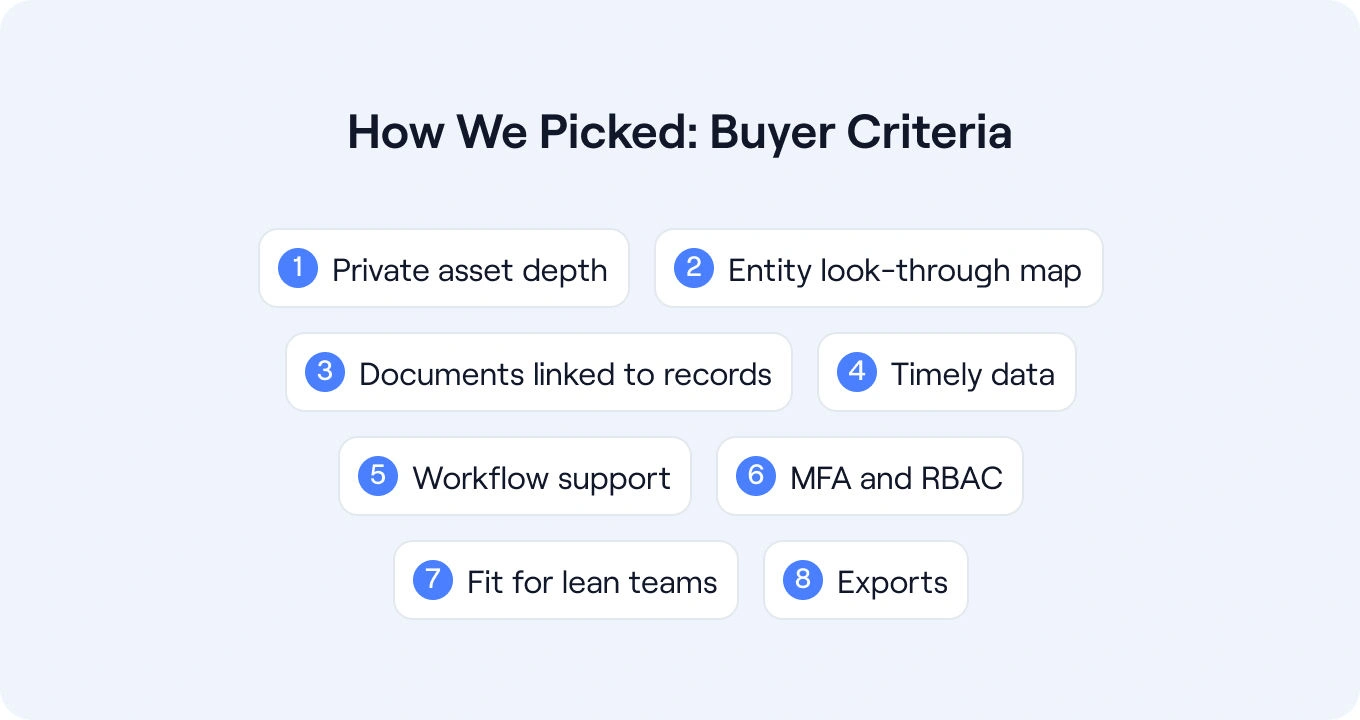
We evaluated fit against criteria that matter for lean SFO teams managing wealth for new generations:
- Private asset depth: Commitments, capital accounts, calls and distributions, book and fair value, cash flow schedules, document linking
- Entity look-through map: Ownership graph with percentages, roll-ups to people or entities across generations
- Documents linked to records: Attach files to assets, entities, or transactions with tagging
- Timely data: Defined cutoffs, reliable feeds, fast manual update paths
- Workflow support: Tasks, reminders, reconciliation tracking (approvals typically occur in external processes)
- MFA and RBAC: MFA support, least-privilege access, view/edit/download controls
- Fit for lean teams: Fast implementation, intuitive interface, low admin burden
- Exports: Clean CSV, XLSX, PDF exports for external advisors
Note: Reporting speed depends on reconciliation quality, data cutoffs, and pipeline reliability.
Conclusion
Modern single-family offices need a single source of truth that links documents, tasks, and data to the right entities and assets. Spreadsheets serve their purpose, but they create risk as wealth grows more complex. Tax planning, estate strategies, investment management, and charitable giving all suffer when data is scattered.
Use the criteria above to shortlist 3–4 platforms. Confirm export formats work for your external advisors. Run demos with your actual use cases rather than the vendor's sample data.
Asora offers a free demo for SFOs ready to manage their family's financial resources more effectively. Request a demo to see how it handles your specific portfolio mix.
FAQ
How is a single-family office different from a multi-family office?
A single-family office serves one family with a fully customized approach to managing assets and operations. A multi-family office serves multiple families and shares resources across clients. Single-family offices offer more control and privacy but cost more to run.
What types of investments do family offices typically manage?
Family offices usually manage a mix of public equities, fixed income, private equity, venture capital, real estate, hedge funds, and alternatives. Many also track private deals and collectibles. This complexity makes consolidated tracking and reporting essential.
.png)
.jpg)
 ISO 27001 Certified
 GDPR Compliant