
.jpg)
TL;DR
Wealth tech for family offices focuses on data aggregation from banks and custodians, multi-entity modeling, private asset tracking, dual performance measurement (TWR/IRR), document linking, workflow support, and mobile access. Asora brings these into a single, secure view and produces timely reporting packs with source-linked evidence and consistent methodologies, suitable for internal review and supporting audit requests at both entity and consolidated levels.
Evaluating Wealth Tech
Evaluating wealth tech for a family office reveals a gap. Many mainstream wealth platforms are optimized for RIAs with large numbers of accounts or enterprises with formal IT and operations functions.
Family offices, especially single-family offices, require something different: the sophistication to handle complex portfolios spanning private equity, venture capital, real estate, and direct investments, delivered in a package that does not require enterprise IT staffing, and with implementation timelines that can be materially shorter than traditional enterprise deployments (depending on complexity and data history).
The landscape is changing. Capabilities that once demanded institutional-scale resources are now accessible to lean family office teams. However, platforms vary widely, and not every innovation in wealth management solutions advances family office operations.
The sections below outline 10 wealth tech trends that family offices should prioritize in 2026. Each represents a practical innovation and wealth tech solution that reduces costs, improves efficiency, and strengthens defensible reporting without overwhelming small teams.
What Wealth Tech Means for Family Offices
The wealth tech meaning varies depending on who you ask:
- Wealth management firms serving retail clients: It might mean automated investing platforms and robo-advisors.
- Institutional investors: It’s often portfolio management systems and risk analytics platforms.
- Broker dealers: It centers on account opening automation and compliance tasks.
However, for family offices, wealth tech encompasses the technology that consolidates multi-entity wealth into a timely view, supports investment and operational workflows, and enables defensible reporting with appropriate controls and evidence.
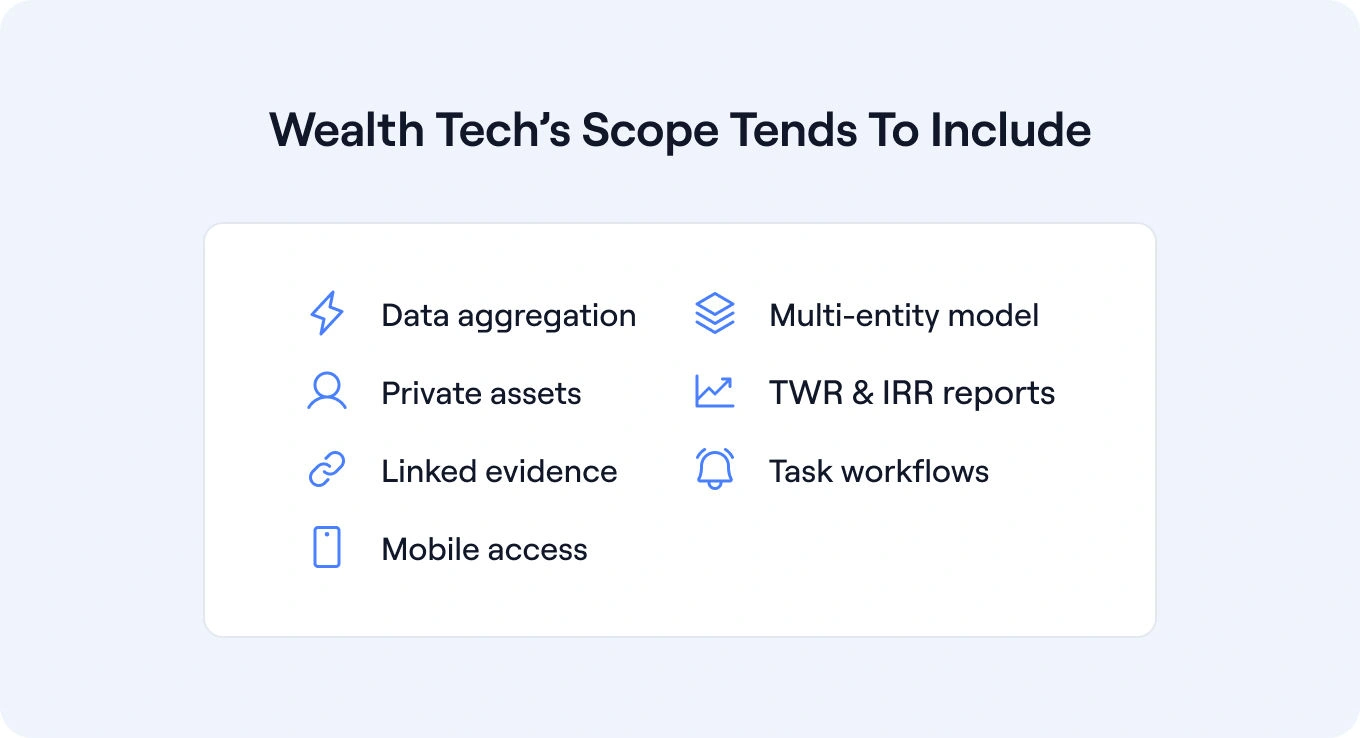
Wealth tech’s scope tends to include:
- Data aggregation: Automated feeds from banks, custodians, and investment platforms, eliminating manual downloads and data entry while protecting sensitive financial data.
- Multi-entity modeling: Handling trusts, SPVs, holding companies, and complex ownership structures that reflect how families actually organize wealth across multiple asset classes.
- Private assets tracking: Systematic management of private equity, venture capital, private credit, real estate, and direct investments, including unfunded commitments, capital calls, and valuation roll-forwards.
- Performance measurement: Both time-weighted return (TWR) for liquid portfolios and internal rate of return (IRR) for private investments, calculated properly with flow reconciliation across the entire investment process.
- Evidence linking via document management: Linking supporting evidence (LPAs, appraisals, capital account statements, fee letters) directly to assets, creating a single interface for portfolio data and supporting documents.
- Workflow support: Task management and preparation/review handoffs that reduce key-person risk while improving operational efficiency.
- Mobile access: Secure on-the-go review for principals who travel, with multi-factor authentication.
Wealth tech for family offices is not tax return software, investment research terminals, or a generic off-the-shelf GL. Many offices still rely on CPAs to file returns, but they do use technology for tax workflow, entity tax packages, K-1 tracking, and tax data collection. On accounting, family office needs often include multi-entity structures, intercompany flows, investment-specific workflows, and integration with portfolio data. NetSuite can address this with significant configuration and specialist support, while QuickBooks often becomes a constraint as scale and complexity grow.
The goal is to establish an operational infrastructure that transforms fragmented data into consolidated reporting, enabling entity-level and family-level views that support informed decision-making and respond efficiently to audit and trustee requests.
The 10 Wealth Tech Trends Family Offices Should Adopt Next (2026)
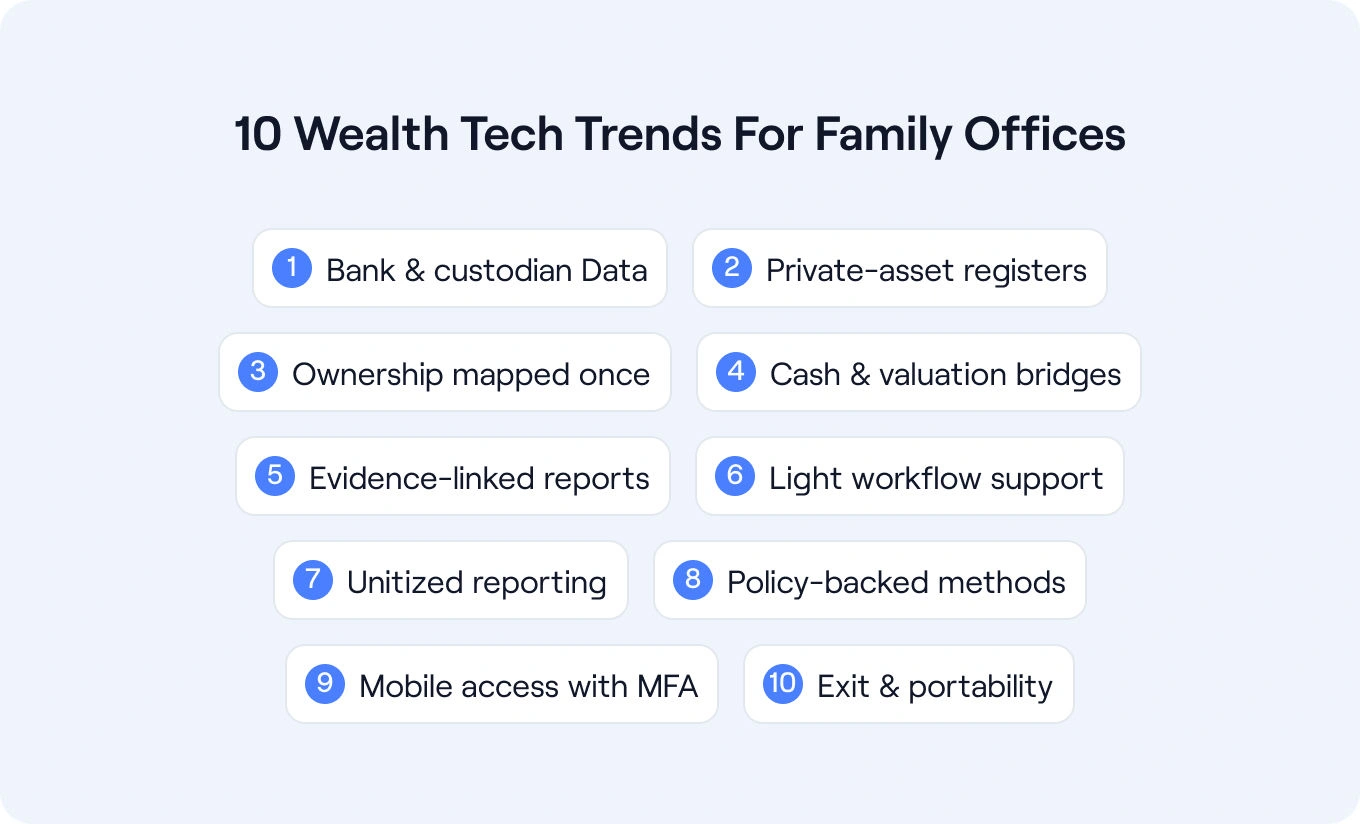
Each innovation below addresses a specific pain point in family office operations. Together, these top tech trends in wealth management form a comprehensive wealth management tech stack for modern family offices, helping investment and operations teams work more efficiently.
1. Bank & Custodian Data
Standardized regular data aggregation from banks and custodians becomes the default, eliminating ad-hoc manual pulls and reducing transcription errors, thereby ensuring a data-driven process.
Instead of logging into multiple portals to download statements, wealth tech platforms connect directly to financial institutions and automatically pull position data, transactions, and market values.
This isn't new technology, but its adoption among family offices lags behind that of wealth management firms serving retail clients. By 2026, this will be a table-stakes requirement for any serious wealthtech solution.
Why it matters: Manual data collection consumes hours each week and creates errors. Every time someone types a position or transaction into a spreadsheet, there's a risk of mistakes. Automated data aggregation with robust mapping, normalization, and exception handling reduces manual work and error rates. Rules-based checks and AI/ML anomaly detection can further improve data quality.
Key elements:
- Multi-bank and multi-custodian coverage supporting major financial institutions globally
- Exception alerts flagging connection failures or unusual position changes
- Source provenance showing which custodian provided which data and when, using a data-driven approach to track quality
- Reconciliation function highlighting discrepancies between feed data and statements
For family offices managing financial assets across multiple jurisdictions and currencies, data aggregation lays the foundation for everything else to be built upon.
2. Private-Asset Registers, Not Side Files
Private equity, venture capital, private credit, and real estate holdings are transitioned from spreadsheets and side files into centralized registers, featuring capital-account roll-forwards and linked appraisals.
Most family office wealth tech has historically focused on liquid assets (stocks, bonds, mutual funds, and unified managed accounts) because that's what custodian feeds typically provide. Alternative investments got tracked in separate spreadsheets, creating disconnected views and reporting headaches.
Modern wealth tech platforms treat private assets as first-class citizens alongside public assets, utilizing digital tools that effectively manage illiquid investments.
Why it matters: For family offices with significant allocations to alternative investments, private assets often represent a meaningful share of their portfolios. Tracking these in disconnected systems means your "consolidated" view isn't actually consolidated, and performance reporting excludes prominent positions that are crucial for principals and family members.
Key elements:
- Unfunded commitment tracking showing what capital remains callable
- Capital call and distribution cadence with historical patterns informing future projections
- Track valuations in a structured way between manager NAV updates, which are often quarterly.
- Fee and carried interest notes documenting preferred returns, management fees, and performance allocations
- Document linking connecting each position to its LP agreement, subscription docs, side letters, and capital account statements
Private assets functionality, designed specifically for family offices, handles complexity without forcing private investments into public market paradigms.
3. Ownership Mapping Once, Reused Everywhere
Look-through ownership charts maintained centrally with controlled updates drive entity-level views, consolidated family wealth views, and owner-specific perspectives, eliminating duplicate mapping across different reports.
Family wealth typically sits in complex structures: individual accounts, joint accounts, trusts for different beneficiaries, holding companies, SPVs for specific investments, and entities structured for tax or liability reasons.
Understanding who ultimately owns what through which structures is foundational. However, most systems require rebuilding this ownership map for every different reporting view, which can be frustrating for tech wealth management service professionals trying to serve stakeholders efficiently.
Why it matters: When ownership mapping is maintained in multiple locations (one version for entity reporting, another for beneficiary statements, and a third for consolidated family wealth), they inevitably diverge. Changes don't propagate consistently, and reports show conflicting information.
Key elements:
- Native handling of trusts, SPVs, and holding companies with different ownership percentages
- Look-through calculations showing ultimate beneficial ownership through multiple entity layers
- Entity-level reporting reflects a legal structure for tax and audit purposes
- Consolidated views rolling up through ownership chains to family totals
- Owner-specific perspectives showing what each beneficiary ultimately owns
The wealth map becomes the single source of truth for structure, informing all other reporting views and improving the experience for family members reviewing their interests.
4. Cash Flow & Valuation Bridges as a Standard Artifact
Movement bridges separating cash flows, valuation changes, FX impacts, and other adjustments become standard artifacts in quarterly reports (or monthly, where meaningful), not special requests.
When someone asks, "Why did our portfolio change by $5M this quarter?" you should be able to answer immediately: $2M from contributions, $4M from appreciation, -$1M from FX moves, and $0 from other adjustments.
Most wealth management technology provides period-over-period change but does not systematically decompose it into its sources. That’s often a gap that frustrates both investment professionals and stakeholders seeking transparency.
Why it matters: Understanding why wealth changed informs better decision-making. Did performance drive the increase, or were contributions the primary factor? Is FX exposure creating volatility? Movement bridges make this transparent and create accountability.
Key elements:
- Consistent bridge templates applied to every reporting period
- Separation of: cash flows (contributions/withdrawals), investment returns (realized/unrealized gains), FX translation impacts, valuation methodology changes, and other adjustments
- Variance notes explaining significant movements in each category
- Reconciliation to the custodian performance outputs where relevant, while preserving internally defined performance policies and assumptions
For family offices managing wealth across multiple currencies and private investments with infrequent valuations, these bridges are crucial for providing defensible reporting, enhancing engagement, and considering their risk tolerance.
5. Evidence-Linked Reporting Packs for Financial Professionals
Every position in reporting is directly supported by evidence (statements, capital account reports, appraisals, fee letters, and foreign exchange sources), eliminating the need for document hunting when questions arise.
Traditional reporting generates PDFs that display positions and values. When someone asks, "Where did this valuation come from?" or "What's the management fee on this fund?" you're hunting through emails and folders to find supporting documentation.
Wealth tech platforms in 2026 link evidence to positions, so documentation is one click away.
Why it matters: Auditors require documentation. Principals ask questions. Investment committee members want to verify assumptions. Every minute spent hunting for documents is wasted time, and missing documentation creates risk.
Key elements:
- Document-to-position linking with coverage metrics, tracking what percentage of portfolio value has current supporting docs
- Reviewer checklists ensure complete documentation before finalizing reporting periods
- Version control for documents that update periodically (quarterly capital account statements, annual appraisals)
- Secure upload links so fund managers and external parties can submit documents directly to the right assets
- Audit trail showing when documents were added, by whom, and based on what source
Document management that treats evidence as integral to portfolio data rather than a separate file system changes how quickly you can respond to questions.
6. Light Workflow Support for Preparation and Review
Task management and alerts make handoffs visible (who needs to do what by when). This reduces key-person risk without heavy process overhead.
Family office operations involve recurring workflows: monthly valuations, quarterly performance reviews, capital call responses, rebalancing assessments, and manager evaluations. When these workflows reside in people's minds or email chains, things slip through the cracks.
Light workflow support means tasks with owners and deadlines, rather than complete BPM systems that require consultants. These digital tools improve efficiency without adding complexity.
Why it matters: Lean family office teams can't afford key-person risk. When one person knows how to value private assets or where documents live, their vacation creates a crisis. Documented workflows with visible task assignments create continuity and operational efficiency.
Key elements:
- Task assignments with owners, due dates, and links to related assets or documents
- Optional deal pipeline tracking for direct investments and co-investments moving through diligence
- Alerts for approaching deadlines: capital call response dates, valuation reviews, compliance tasks
- Timestamps for cycle-time measurement showing how long each workflow takes
- Comment threads connecting task discussions to the underlying positions
Workflows alongside portfolio data reduce swivel-chair work (switching between systems to find information and track tasks).
7. Unitization Where Wrappers Matter
Optional unitized views by beneficiary or owner enable apple-to-apple comparisons across different entity wrappers.
Some families hold investments in pooled structures where multiple beneficiaries own interests. Traditional position-based reporting shows what the entity owns, but doesn't easily answer the question, "How did each beneficiary's interest perform?"
Unitization calculates unit values that represent each owner's proportional interest, enabling comparable performance views across pooled structures, provided unitization policies (equalization, fees, FX, timing) are clearly documented.
Why it matters: For families with multiple beneficiaries holding interests in shared structures, unitization creates transparency. Each beneficiary can see their performance independent of others' contributions or withdrawals. This matters especially when different generations are involved or when estate planning involves complex ownership arrangements.
Key elements:
- Consistent unit-value baselines at inception with clear FX treatment
- Allocation of flows, returns, and expenses proportionally to unit holdings
- Historical unit-value series enabling performance comparison over time
- Reconciliation of unit-based and position-based views, ensuring consistency
- Support for multiple unit classes if different owners have different terms
Not every family office requires unitization, but for those with complex beneficial ownership, it's a valuable wealth tech tool for enhancing the user experience across generations.
8. Policy-Backed Valuation and Performance Methodologies
Performance calculation follows documented policies: time-weighted return (TWR) for liquid portfolios, IRR for private assets, with sensitivity notes for key valuation drivers.
Many wealth tech solutions apply institutional methodologies without critical examination. Family offices need both TWR (for evaluating manager skill on liquid holdings) and IRR (for private investments where cash flow timing matters).
Why it matters: Defensible performance reporting requires a documented methodology applied consistently. When your wealth management professionals and asset managers calculate returns differently quarter to quarter or can't explain their approach, audit questions multiply, and client relationships suffer.
Key elements:
- Policy documentation stating which methodology applies to which asset classes
- TWR for liquid, publicly traded holdings with daily price updates
- Money-weighted measures (e.g., IRR/XIRR) for private equity/venture/direct investments, and appropriate yield/money-weighted reporting for private credit, depending on instrument type
- Flow reconciliation ensures all contributions, distributions, and fees are captured before finalizing performance
- Optional sensitivity analysis for private valuations showing how changes in key assumptions affect reported values using advanced analytics
- Controls for restatements and late adjustments, with change logs and documented reasons (including corrected manager statements)
Performance monitoring that handles methodologies without requiring separate systems gives family offices accurate reporting that serves the entire investment process.
9. Mobile Access with MFA for Traveling Principals
Secure mobile apps with multi-factor authentication enable principals to review their wealth position, check performance, and view documents on the go.
Principals don't wait for formal reporting cycles to occur. They want to check portfolio status between meetings, review position details while traveling, or pull up a document during advisor conversations.
Why it matters: Modern wealth tech recognizes that high-net-worth individuals expect mobile access to their financial information. However, family office requirements differ significantly from those of retail wealth management apps and financial planning tools. No trading, just secure viewing of portfolio data and documents.
Key elements:
- MFA is enforced for all users, protecting access to sensitive financial data
- Core features accessible: portfolio positions, performance summaries, asset allocation, document retrieval
- Responsive design working across phones and tablets
- Offline mode for viewing recently accessed information during travel
- Clear scope: mobile for review, not for executing approvals or transactions
Mobile access extends family office operations and can help expand access without compromising security or creating approval workflows that bypass proper governance.
10. Exit and Portability Planning
Wealth tech platforms provide open, well-documented export formats for assets, documents, and integration mappings. This minimizes vendor lock-in and enables smooth transitions.
Nobody wants to consider switching platforms when evaluating solutions. But operational continuity matters. You should be able to export your complete portfolio data, document library, and entity structures without being held hostage.
Why it matters: Vendor lock-in creates risk. If your wealth tech platform doesn't provide clean exports, you're stuck even if the solution stops meeting your needs, pricing becomes unreasonable, or the vendor gets acquired, and the solution is sunset.
Key elements:
- Documented data model explaining how assets, entities, ownership, transactions, and documents are structured
- Standard export formats (CSV, JSON, XML) for all core data
- Document export preserving folder structures and metadata
- Integration mapping documentation showing how external systems connect
- Tested exports verified during onboarding, so you know they work if needed
This isn't the most exciting feature, but it's insurance that protects your operational continuity and reduces vendor concentration risk in the event that you need to switch providers.
How Asora Helps You Capitalize on These Trends
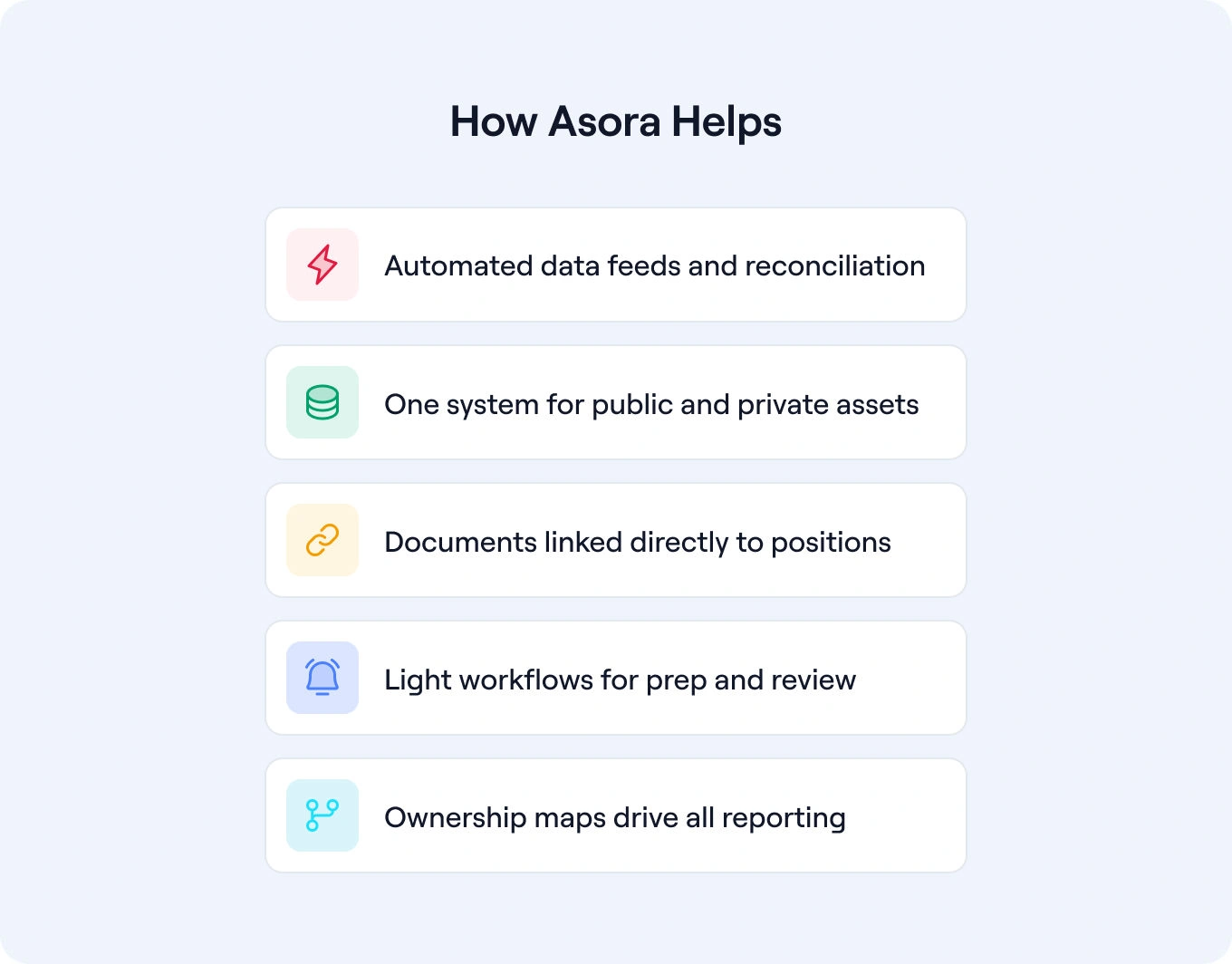
Asora embodies these wealth tech trends in a platform built specifically for family offices:
- Data Aggregation: Score the platform on scheduled bank/custody feeds, a central register for private assets with documents attached, and a defined reconciliation workflow. Look for exception queues, variance thresholds, ID mapping, and two-person review. Confirm broad institutional connections and workable alternatives for accounts without a direct feed.
- Single Source of Truth: Public and private assets live together in one system. Liquid assets from custodian feeds and illiquid investments in private assets registers create complete portfolio views across multiple asset classes.
- Documents: Evidence links directly to assets. LPAs, appraisals, capital account statements, and fee letters are attached to the positions they document, making supporting details accessible with a single click through document management.
- Workflows: Tasks reduce key-person risk. Workflow support makes preparation and review handoffs visible without heavy process overhead.
- Wealth Map: Ownership charts drive entity, consolidated, and owner-specific reporting views. Complex structures, including trusts, SPVs, and holding companies, map naturally.
The platform scales without requiring dedicated IT staff, making sophisticated wealth management technology accessible to lean family office teams.
Why These Wealth Tech Trends Matter
The wealth management industry has seen significant innovation in recent years, driven by wealth tech companies, wealth tech startups, and strategic partnerships between established financial institutions and technology solutions providers.
Much of this innovation targets wealth managers at financial advisory firms, asset managers at institutions, or retail clients through automated investing platforms and financial planning software. The financial services industry has embraced direct indexing, model portfolios, and high-yield cash accounts as standard product offerings.
Family offices benefit from some of these advances, but they require different priorities and approaches. While wealth management solutions for retail clients focus on account automation, retirement planning tools, and Social Security optimization, family offices require a greater depth of complexity.
For single family offices managing complex portfolios across multiple asset classes, this means:
- Fewer errors: Automated aggregation eliminates transcription mistakes. Systematic workflows help prevent things from falling through the cracks, significantly improving operational efficiency.
- Faster reporting: With automatic data updates and documents linked to positions, monthly and quarterly packs are produced in hours rather than days. Teams spend more time on analysis and discussions instead of assembling files.
- Cleaner audits: Evidence-linked positions and documented valuation policies provide auditors with the necessary information, eliminating the need for extensive document requests and reducing audit friction and ad-hoc information requests.
- Better decision making: Movement bridges show why wealth changed. Performance measurement using appropriate methodologies across the entire investment process informs manager evaluation and investment strategies.
- Operational continuity: Documented workflows and systematic processes reduce key-person risk when team members change roles, ensuring profitable growth doesn't depend on heroic individual effort.
- Scalability: As family wealth grows or next-generation members become active, the platform accommodates more entities, accounts, and users while giving the team the tools to support changing relationships.
These benefits compound over time. The family offices that adopt modern wealth tech solutions now build advantages that persist for years to come.
How to Evaluate Technology Solutions for Your Family Office
When checking wealthtech platforms and software solutions, focus on fit for your structure and operations:
- Data coverage: Does the platform connect to your banks and custodians? Can it handle your private investments rather than forcing them into public market templates? Does it provide global market data integration for performance tracking and analysis?
- Entity complexity: Does it accurately model your trusts, holding companies, and ownership structures? Can it produce both entity-level and consolidated reporting that supports investment oversight, governance, and planning inputs?
- Performance methodology: Does it calculate both TWR and IRR appropriately with documented methodologies, cash-flow completeness checks, fee treatment, and valuation timing controls? Can it handle private asset valuations with infrequent updates?
- Document integration: Can you link supporting evidence to positions? Is there a reviewer workflow in place to ensure complete documentation and improved client engagement?
- Workflow support: Does it help with recurring tasks, or is portfolio data completely separate from operational workflows? Does it help reduce costs through automation?
- Implementation timeline: How long until you're live? What resources does it require from your team? Can it deliver greater efficiency quickly?
- Pricing model: Is pricing transparent and predictable as your portfolio grows?
- Vendor stability: Is this a venture-backed wealth tech company that might pivot, or an established solution with a multi-year track record serving family offices? Investors and strategic partners can be one signal, but weigh them alongside client retention, roadmap execution, support model, financial runway, and data portability.
The wealth management tech stack for family offices should reduce complexity, not add it. The right wealth tech platform feels like infrastructure supporting your work, rather than another system requiring constant attention.
Make the Shift to Modern Wealth Management Technology
If your family office currently manages wealth through spreadsheets, manual processes, and disconnected systems, transitioning to proper wealth tech software might feel daunting.
Many financial services professionals trained in traditional methods, including wealth managers, financial advisors, and asset managers, initially resist change. But the efficiency gains and error reduction make the shift worthwhile.
Start with your most significant pain point:
- If data collection consumes the most time: Focus on data aggregation first. Automated feeds immediately reduce manual work and help lower operational costs.
- If private investments are hard to track: Implement a private assets register with capital call tracking and document linking wealth tech applications purpose-built for alternative investments.
- If reporting takes too long: Build consolidated views with movement bridges that separate flows from valuation changes.
- If documents are scattered: Centralize evidence with document management linking files to assets, using digital tools that create an interface for portfolio data and supporting documentation.
- If workflows are unclear: Implement light workflow support, making tasks and handoffs visible, helping advisors coordinate more effectively.
You don't need to adopt everything simultaneously. Each wealth tech innovation you implement compounds benefits over time, creating profitable growth through operational leverage.
The 10 trends outlined above give you a framework for evaluating wealthtech platforms and prioritizing which innovations matter most for your family office operations. These solutions cater to financial professionals, financial advisors, and wealth managers who work with high-net-worth individuals, offering sophisticated capabilities without the associated institutional overhead.
See how Asora operationalizes these trends. Request a demo to learn if Asora meets your family office's wealth technology requirements.
FAQ
How is family office fintech different from wealth management technology for RIAs?
Family office fintech handles complex ownership structures, significant alternatives that require private-asset registers, entity-level reporting for tax and audit purposes, and governance tailored to a single family. RIA technology focuses on many client relationships, regulatory workflows, trading, and billing.
What are the top tech trends in wealth management that family offices should prioritize?
Key trends for 2026 include automated aggregation from custodians, private-asset registers for PE/VC/credit/real estate, ownership mapping that drives multiple reporting views, cash-flow and valuation bridges as standard artifacts, evidence-linked reporting, light workflow to reduce key-person risk, and mobile access with MFA.
How do wealth tech platforms handle equity and alternative investments?
Modern platforms treat private assets as first-class alongside public assets. They track commitments, capital calls, distributions, and capital activity, then consolidate public and private positions into unified performance reporting. This replaces disconnected spreadsheets for alternatives. Asora does this by tracking private-asset activity and standardizing performance views across asset classes.
What should family offices look for when evaluating wealth tech solutions?
Evaluate data coverage, ability to model complex entities, correct performance methodology for both TWR and IRR, document integration with evidence linked to positions, workflow support, implementation requirements, pricing clarity, and vendor stability. The right solution should reduce complexity. Asora focuses on these areas for lean teams that need transparent reporting, secure document linkage, and dependable workflows without enterprise bloat.

.png)

 ISO 27001 Certified
 GDPR Compliant