

.png)


Author
Table of contents
"What used to take hours or days is now done in minutes"

Choosing between Black Diamond family office software and Asora depends largely on how your family office operations are structured. The Black Diamond wealth platform, part of Black Diamond Wealth Solutions, is widely used by financial advisors and wealth management firms that prioritize performance reporting, portfolio management, trading, and client engagement, often alongside CRM and other integrated systems, supported by an immersive client portal and smart integrations across a vast ecosystem of technologies. Asora focuses on data aggregation, ownership visibility, and operational coordination for lean family offices, providing a single source of truth for consolidating financial data and reporting views across accounts and entities and supporting internal operations without building an enterprise portfolio management stack.
Many family offices evaluating Black Diamond family office software are considering a deeper question than simply which reporting tool will fit them better, especially when comparing platforms in broader guides to the best family office software available today. What they're often evaluating is where they need depth: advisor-style portfolio reporting and trading workflows, family-office operational coordination, or a mix of both.
At a high level, platforms like Black Diamond and Asora appear similar. Both provide portfolio visibility, data aggregation, dashboards, and reporting outputs. But the operational assumptions behind each solution are very different.
Enterprise-style platforms are often designed for advisory firms with multiple power users, extensive integrations, and structured reporting cycles, while lean family office teams may prioritize clarity, simplicity, and coordination across a smaller internal team. However, these are not rigid categories: some single family offices are highly investment-intensive, and some advisory firms prioritize simplicity in reporting and operations.
This distinction matters more than ever. According to Deloitte Private’s 2024 Digital Transformation of Family Office Operations report, 43% of family offices are currently developing or rolling out a technology strategy, reflecting the growing importance of operational systems that provide consolidated visibility across complex wealth structures.
That shift has changed how buyers evaluate platforms. Instead of comparing feature grids, many offices are asking a more practical question: which system actually fits the way our family office operations actually work?
This comparison assumes a smaller internal family office team rather than a large institutional-style investment office. Larger SFOs, MFOs, OCIO-led models, or offices with internal trading or accounting functions may prioritize different capabilities.
At first glance, both platforms appear to solve similar problems. In reality, they tend to serve different operating models.
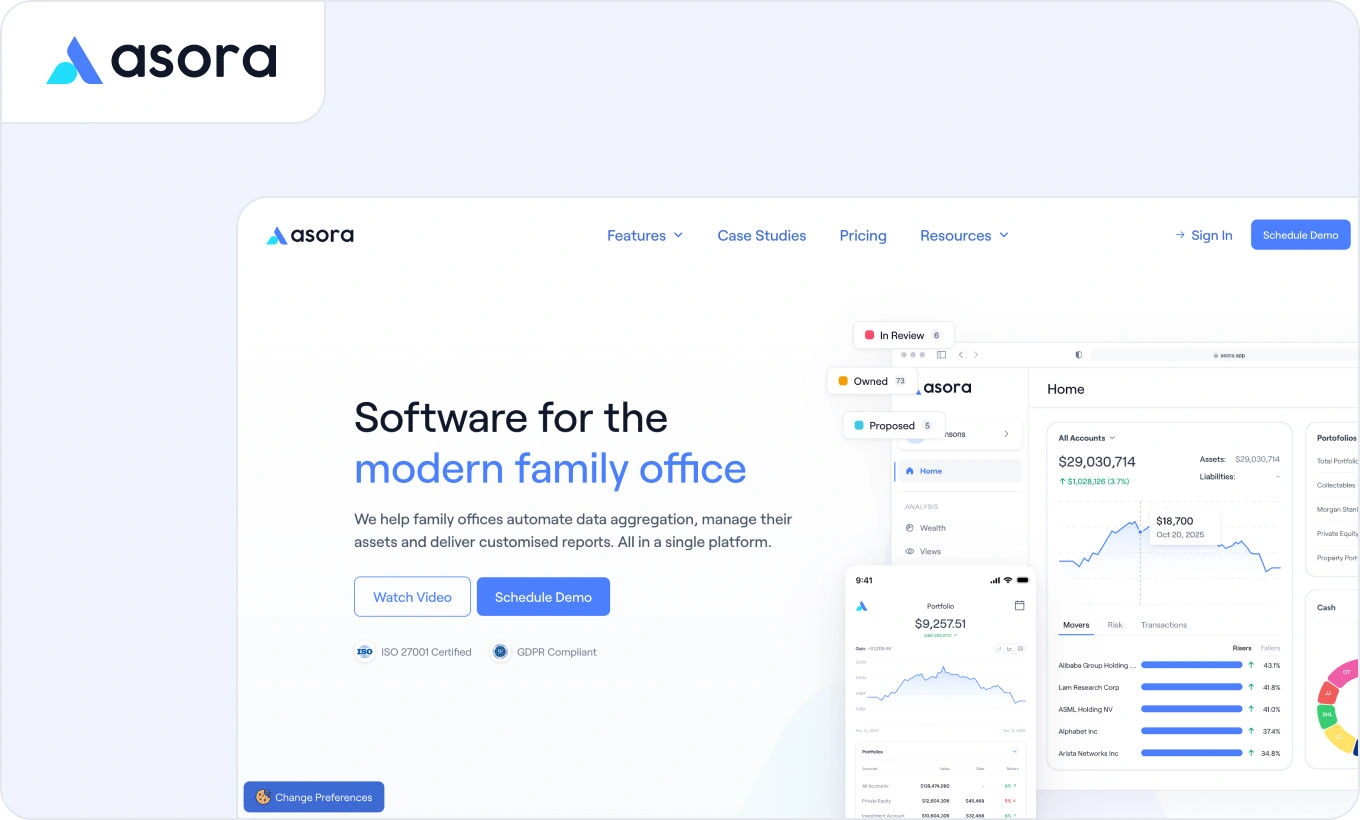
Asora is often positioned for family offices and wealthy families seeking a simpler internal operating environment, particularly where a small team manages multiple entities, assets, and reporting workflows. These offices often need:
Rather than replacing accounting systems or investment management tools, Asora typically sits alongside existing source systems such as custodians, banks, and other financial platforms, helping the team coordinate information and reporting.
It is worth clarifying that Asora is not positioned as a full general-ledger or trading platform. Buyers should confirm which accounting, performance, and reconciliation functions are native versus handled in adjacent systems The platform focuses on data aggregation, ownership visualisation, reporting, and operational coordination rather than becoming the accounting engine itself.
.webp)
Black Diamond family office software is more commonly positioned as a wealth management platform used by RIAs, wealth managers, and advisory firms, although some family offices also use it.
The platform provides a broad suite of capabilities, including portfolio management, reporting, trading, and integrations that may support certain operational and compliance workflows, depending on the firm’s broader stack.
Many firms adopt Black Diamond as a central hub for portfolio management and client reporting, integrating custodial data, CRM systems, and other advisory tools into a single environment.
Because of this architecture, it often fits organizations where investment reporting and advisor workflows are central to operations.
Rather than framing this comparison as a list of universal advantages, it is more useful to look at the types of situations where Black Diamond family office software tends to perform particularly well.
In many cases, these situations involve organizations with structured reporting cycles, advisor-led workflows, and the operational resources needed to maintain a configurable reporting environment. For offices operating within that model, Black Diamond can provide a strong reporting infrastructure.
Asora tends to resonate with a different type of family office operating model.
Rather than focusing primarily on advisor workflows or presentation reporting, the platform is designed around operational visibility for lean internal teams. Many single-family offices operate with small teams responsible for coordinating information across entities, investments, and external advisors.
In those environments, the priority is often clarity and coordination rather than extensive report engineering.
Asora typically performs well in situations such as:
These use cases reflect a broader change in family office expectations. Instead of relying solely on quarterly reporting cycles, many principals now expect continuous visibility into complex wealth structures, particularly as portfolios expand across multiple custodians and private investments.
Platforms designed around operational clarity can help support that shift.
Understanding the differences between Black Diamond family office software and Asora becomes easier when looking at how each platform approaches common operational tasks.
Reporting is one of the core strengths of Black Diamond. The platform emphasizes highly configurable report packs with customizable visualizations, allowing firms to tailor presentations using drag-and-drop report design tools.
These reports can be generated in batches or on demand and distributed through a client portal, supporting structured reporting cycles used by advisory firms.
Asora approaches reporting with an emphasis on clarity, repeatability, and ease of use for smaller teams, rather than highly bespoke report design workflows. The goal is to produce consistent, understandable outputs that support operational discussions rather than requiring specialized report design work.
Black Diamond aggregates financial data from custodians and integrates it into the broader portfolio management environment. The platform supports a large network of custodial feeds and data sources, allowing firms to consolidate portfolio data into a single reporting system. As with many configurable reporting environments, data feed maintenance, mapping, and review processes may require ongoing operational support depending on the complexity of the office.
Asora’s approach focuses on simplifying family office data aggregation and ongoing data maintenance. Your data is aggregated from supported banks ,custodians, and other sources, then mapped, cleansed, and standardized into a unified format. This is visualized on the Wealth Map, giving the team a full picture of wealth structures across accounts and entities. Exception handling and review are managed by the family office team to maintain data clarity.
Alternative assets present one of the biggest reporting challenges for family offices.
Black Diamond includes alternative investment servicing and reporting capabilities, allowing firms to incorporate certain non-traditional assets into portfolio reporting. Black Diamond can incorporate alternative investment data into reporting, though the workflow and level of detail may depend on the source data, integration setup, and operating model.
Asora approaches alternatives from the perspective of family office workflows. Private assets can be tracked with visibility into commitments, capital calls, distributions, and valuations, where data is available through connected sources, administrator data, or managed updates.
Family offices often manage wealth through multi-layered entity structures, including trusts, holding companies, and special-purpose vehicles.
Black Diamond generally organizes relationships through wealth management reporting constructs such as accounts, portfolios, and household or group views, which should not be treated as equivalent to legal-entity ownership modeling.
Asora emphasizes ownership visibility. The wealth map provides a visual representation of ownership relationships across entities and assets, helping teams quickly understand how structures connect. This visualization focuses specifically on ownership relationships, supporting entity understanding, reporting conversations, and selected decisions.
Operational coordination is another area where platform philosophies differ.
Black Diamond includes secure document storage within its client portal, allowing firms to share documents with clients and advisors through the platform. This capability typically supports client communication workflows within advisory relationships.
Asora includes a document repository designed for family office organization, where teams can store, structure, and securely share key documents related to assets, entities, and investments. The focus is on document organization and accessibility across the office, with structured tagging to help teams categorize and retrieve documents efficiently, and the ability for third parties to upload documents directly into the platform where appropriate.
Workflow tools also reflect the difference in operating models. Black Diamond primarily focuses on portfolio management workflows and integrations across advisory tools.
Asora includes task-based workflows designed for operational coordination. Teams can assign and track tasks, and maintain visibility into operational ownership across the deal pipeline and office.
Mobile access has become increasingly important for family principals and staff as mobile wealth management tools allow them to view consolidated information securely on the go.
Black Diamond provides mobile access through its client portal, allowing users to view portfolio information and dashboards from anywhere.
Asora also provides a mobile app experience with multi-factor authentication, allowing principals and staff to securely access consolidated wealth views on the go.
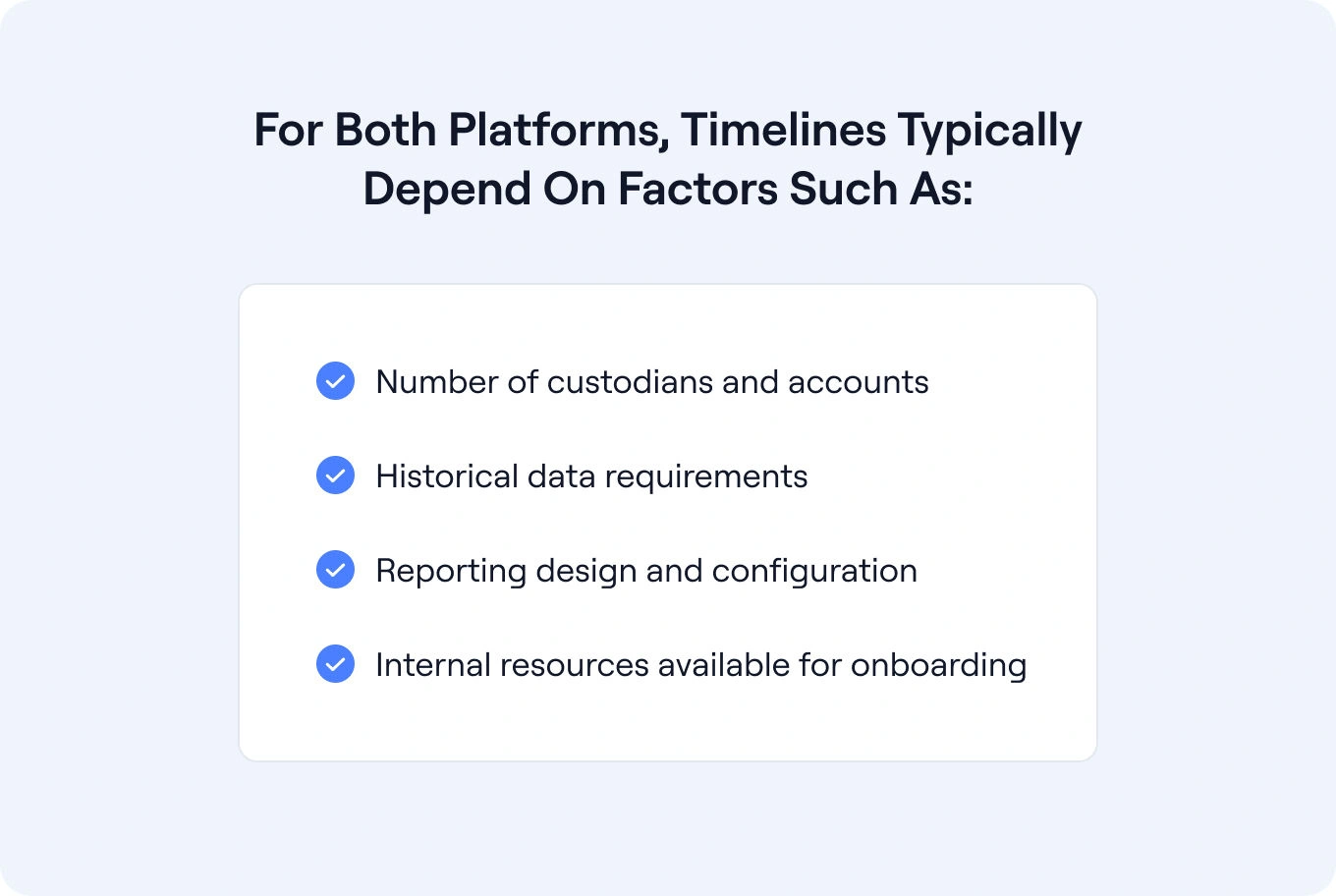
Implementation timelines vary significantly depending on the complexity of the office’s data and reporting requirements.
For both platforms, timelines typically depend on factors such as:
Black Diamond implementation often involves configuring integrations, designing reporting templates, and aligning data sources across the platform ecosystem.
Asora implementations typically focus on connecting data sources, mapping entities, and organizing reporting structures.
This approach can help lean teams reach operational visibility quickly without building a complex reporting infrastructure. As the principal of Tan family office explained after implementing Asora:
“Asora gives us a clear, consolidated view of the family’s wealth across entities and investments. What previously required manual reporting across multiple spreadsheets is now accessible in one place.”
This experience reflects a common outcome for offices adopting modern family office data aggregation platforms, where the focus is on connecting existing data sources and improving operational clarity rather than replacing every underlying system.

Pricing approaches differ between platforms. Asora provides publicly available pricing, while Black Diamond pricing is typically customized based on firm requirements and service scope. In both cases, total cost will depend on factors such as:
When evaluating either platform, buyers often benefit from asking a few practical questions.
Questions to ask both vendors:
These questions often reveal the true operational cost of maintaining the system over time.
Family office platforms handle highly sensitive financial data, making cybersecurity and data governance critical considerations during vendor evaluation.
Security capabilities should be assessed on a vendor-by-vendor basis rather than assumed. Buyers should confirm which controls are implemented natively and how they are maintained in practice, including authentication methods, data protection standards, and access controls.
Asora is ISO 27001 certified and designed to support GDPR compliance, reflecting established standards for information security management and data protection. The platform includes controls such as multi-factor authentication, encryption for data in transit and at rest, and role-based access permissions to support secure access across family office teams.
Black Diamond, as part of SS&C’s wealth technology offering, benefits from SS&C’s broader wealth-technology infrastructure and security framework. However, buyers should confirm specific certifications, hosting configurations, and control implementations as part of their diligence process.
For international family offices, additional considerations may include data residency requirements, default hosting regions, and vendor access policies. Offices operating across jurisdictions such as the EU, UK, and US may need to verify whether regional hosting options are available and how data is stored and accessed.
Choosing between Black Diamond family office software and Asora ultimately comes down to the operating model. Both platforms support complex wealth structures and provide tools for portfolio management, wealth management reporting, and financial data visibility across accounts and custodians. However, they are built around very different assumptions about how family offices operate.
The Black Diamond wealth platform, part of Black Diamond Wealth Solutions, is widely used by financial advisors and wealth management firms. It emphasizes performance reporting, portfolio management, trading capabilities, and client communication through an immersive client portal, supported by smart integrations across a vast ecosystem of custodians and advisor technologies.
For organizations built around advisor-led portfolio oversight, these capabilities can make Black Diamond wealth solutions a strong operational hub for advisor-led investment reporting, portfolio oversight, and client-facing reporting workflows.
Meanwhile, Asora approaches the problem from a different direction. Rather than acting as a full portfolio management and trading system, Asora focuses on providing data aggregation, reporting capabilities, performance monitoring, ownership visibility, and operational coordination for lean family office teams. The platform helps teams consolidate assets across entities and organize documents across the office without requiring an enterprise reporting stack.
For some single-family offices, this design difference is decisive; for others, the critical questions are data coverage, private-asset workflows, entity complexity, and operating support.
Family offices operating within advisor-style workflows, with structured reporting cycles and internal operations teams managing portfolio reporting, may find the Black Diamond wealth platform aligns well with their environment. Its comprehensive portfolio management capabilities, trading tools, and advisor-focused client portal support firms where investment reporting and portfolio oversight are the primary operational focus.
By contrast, lean family offices and UHNW principals often prioritize a different set of requirements. Instead of building a large reporting infrastructure, they may need a single operational workspace that consolidates assets across entities, supports document organization, and provides secure access to wealth information between reporting cycles.
In these environments, clarity and coordination matter more than complex reporting configurations. Asora supports this model by combining data aggregation, ownership visualization, reporting, document organization, and workflow coordination in one environment, helping small teams maintain visibility across complex wealth structures.
Ultimately, the decision is not just about feature count, but about whether the platform’s data model, workflow depth, and operating assumptions match the office’s needs.
If your organization operates more like an advisory firm focused on portfolio reporting, trading, and client-facing reporting, the Black Diamond wealth platform may provide the infrastructure you need.
If your goal is to give a lean family office team clear visibility across assets, entities, and operational responsibilities, a platform designed specifically for family office operations may be a better fit.
If you’re evaluating platforms for a lean family office operating cadence, request a demo to see how Asora supports aggregation, ownership visibility, private assets tracking, documents, workflows, and mobile access in one place.
Lorem ipsum dolor sit amet, consectetur adipiscing elit. Suspendisse varius enim in eros elementum tristique. Duis cursus, mi quis viverra ornare, eros dolor interdum nulla, ut commodo diam libero vitae erat. Aenean faucibus nibh et justo cursus id rutrum lorem imperdiet. Nunc ut sem vitae risus tristique posuere.
The Black Diamond wealth platform focuses heavily on performance reporting and portfolio oversight for financial advisors and wealth management firms. Its tools support trading, rebalancing, and reporting workflows that help advisors manage client portfolios within a unified wealth platform, particularly where investment operations are run internally rather than outsourced. Firms can configure reporting templates and distribute portfolio updates through the platform’s client portal, helping ensure clients receive consistent reporting experiences. These capabilities make Black Diamond wealth solutions particularly well-suited for advisor-led investment operations.
While Black Diamond wealth solutions emphasize advisor workflows and portfolio reporting, Asora is designed specifically for family office operations. Instead of acting as a full trading or accounting platform, Asora focuses on data aggregation, ownership visibility, and operational coordination across entities and assets. The platform helps family offices consolidate wealth information, organize documents, and create and manage tasks. This approach can provide greater simplicity for lean family offices that do not need a full advisor-style portfolio management system.
Asora is designed specifically for family offices that want a centralized workspace for tracking wealth across entities, assets, and operational responsibilities. While the Black Diamond wealth platform focuses on advisor-driven portfolio management, performance reporting, and client relationship management, Asora emphasizes data aggregation, ownership visibility, and internal coordination. This allows lean family office teams to organize documents, track tasks, and maintain clarity across complex wealth structures without relying on a full trading or accounting system. For many offices, the decision comes down to whether they need an advisor-style portfolio platform or an operational wealth platform built for family office workflows.
When evaluating a wealth platform, family offices should consider how the system fits their operating model, asset mix, and internal setup. This includes understanding whether investment operations are run internally or outsourced, how data flows from source systems such as custodians and managers, and what level of reporting is required across entities and stakeholders. Platforms like the Black Diamond wealth platform are often better suited to advisor-led environments with structured reporting cycles, while some family offices prioritize data aggregation, asset visibility, and operational coordination. Ultimately, the right choice depends on the office’s tolerance for operational complexity and how closely the platform aligns with day-to-day workflows.





.png)
.jpg)
.png)
.png)
.jpg)

.png)

.png)
.png)
.jpg)

.jpg)
.jpg)
.png)


.jpg)
.jpg)


.png)
.jpg)
.jpg)
.jpg)
.jpg)
.jpg)
.jpg)
.jpg)

.png)
.webp)

.png)
.png)
.png)
.png)
.png)
.png)
.jpg)
.jpg)
.png)
.png)
.png)
.png)
.jpg)
.png)
.png)
.png)
.png)
.png)
.png)
.png)
.png)
.png)
.jpg)
.png)
.png)
.png)

.png)

.webp)